
Distributor Authorization
Ohio Resale Certificate (STEC B): How to Get and Use One
Ohio uses form STEC B, the Ohio blanket exemption certificate, for ongoing wholesale accounts. If you sell from a location in Ohio, you need an Ohio vendor's license first. Then you fill in a STEC B for each distributor you buy from. The state doesn't send you a certificate. You download the form, fill it in, and hand it to the supplier.
The confusing part is that Ohio also has a second form, STEC U, and the two names look almost the same. Most pages about "the Ohio resale certificate" never say which of the two a distributor wants, so it's easy to send the wrong one. That's the first thing to clear up.
STEC B or STEC U: Which One Does a Distributor Want?
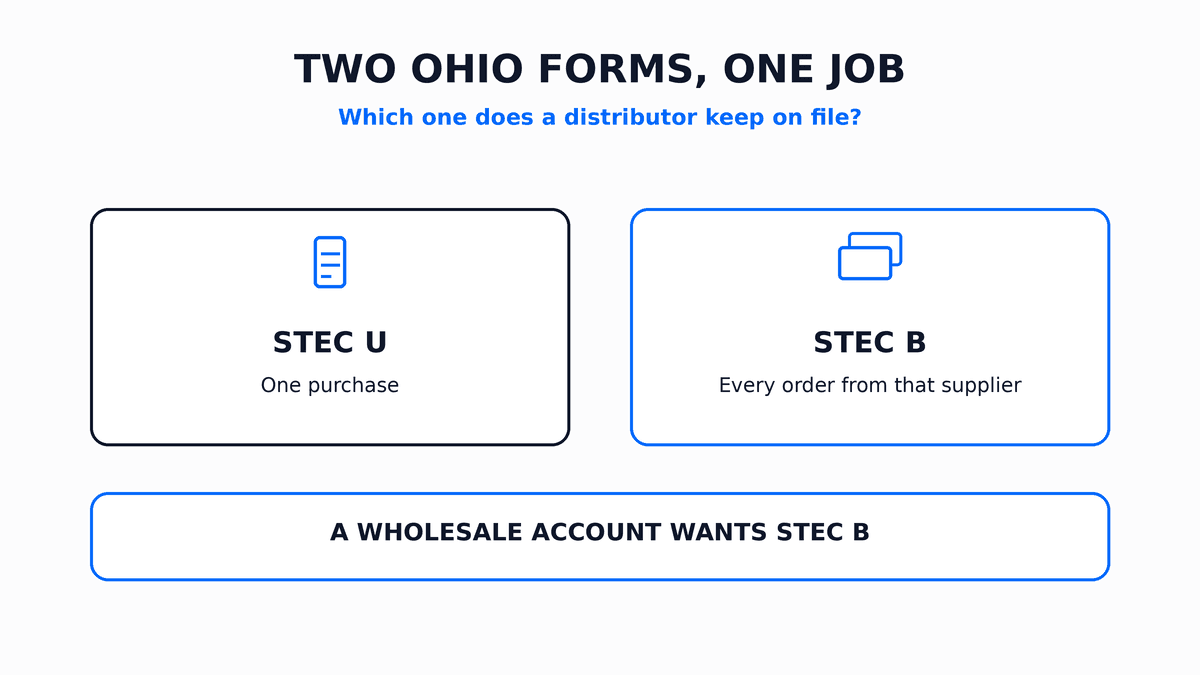
Both are Ohio sales tax exemption certificates, and both are used for the same thing. They tell the seller why they shouldn't charge you sales tax. The difference is how long each one lasts.
Ohio's own exemption certificates page describes each one in a single sentence. STEC U is "used to claim an exemption or exception on a single purchase." STEC B is "used to make a continuing claim of exemption or exception on purchases from the same vendor or seller."
So STEC U covers one order. STEC B covers every order you place with that supplier from the day you sign it. A distributor you'll reorder from wants the blanket one on file, because then neither of you has to fill in a new form for every order.
If you'll only buy from a supplier once, STEC U is enough. But a wholesale account means you'll order again and again, so you need STEC B.
Step 1: Get the Ohio Vendor's License
The form asks for your Ohio license number, so you need that number before you can fill it in. Which license you need depends on where you sell from.
If you sell taxable goods from a fixed location in Ohio, you need a vendor's license for that location. Ohio's registration page lists it at $50, and notes the fee went up "from $25 to $50" on April 9, 2025. You can apply through OH|TAX eServices, and the page says new retailers can get the license right away. You can also apply through your county auditor.
It works differently if your business is outside Ohio. If you have no location in the state, Ohio won't give you a vendor's license. If you pass $100,000 in Ohio sales or 200 separate Ohio sales in a year, you register for an out-of-state seller's use tax account instead. That one has no fee. If you sell less than that and have no office or warehouse in Ohio, you may not have any Ohio number at all.
If you have no Ohio number, you leave the license box on STEC B empty. Ohio's rule allows that.
The license and the certificate are two different things, and resellers mix them up all the time. The license is your registration with the state. The certificate is what you give a supplier. Our post on a resale certificate versus a sales tax permit goes through why the registration always comes first.
Step 2: Fill In STEC B
Download the Sales and Use Tax Blanket Exemption Certificate, revised July 2025. It's one page, and each box is quick to fill in once you know what it's asking for.
Name the vendor
The certification line names the vendor you're buying from. Use their business name, the same one that's on the account you're opening. Don't use a brand name or a sales rep's name.
Give your reason
The form says the purchaser "must state a valid reason for claiming the exception or exemption." For a wholesale reseller, the reason is resale. Write it in plain words. Something like: the goods are purchased for resale in the normal course of your business. If you leave the reason line empty, the distributor will send the form back.
Your name, type of business and address
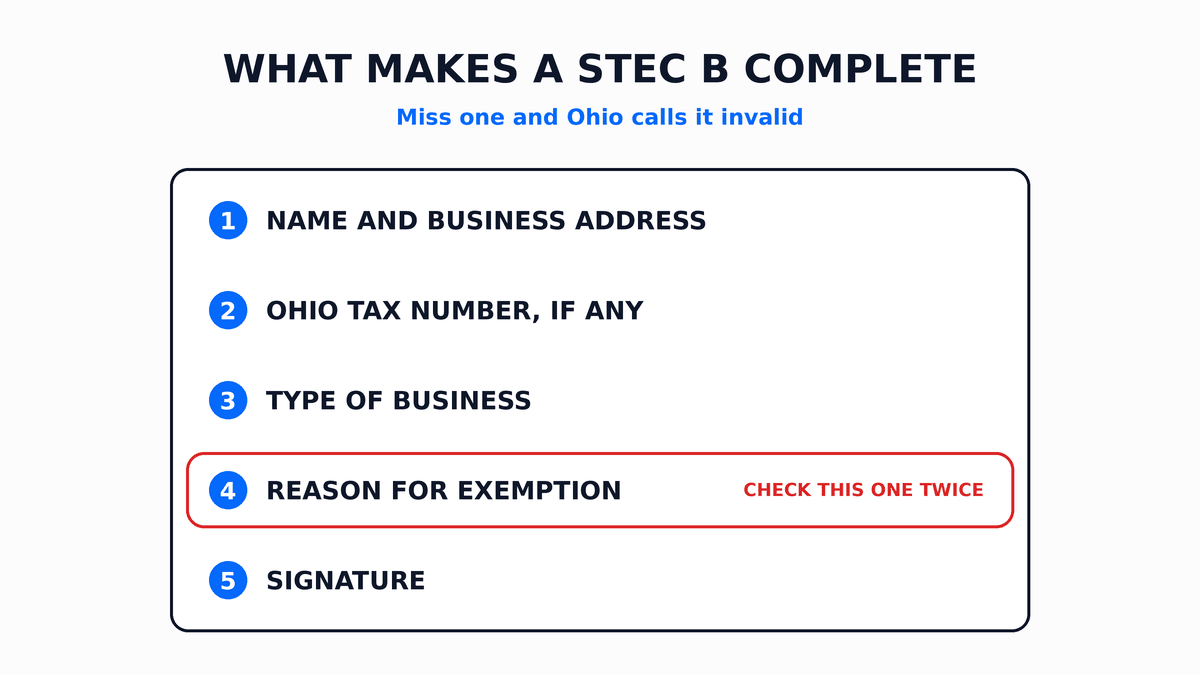
These three are easy. But they're three of the five things Ohio's rule says a certificate must include. If any one is missing, the whole form is invalid.
Vendor's license number, if applicable
Your Ohio vendor's license number goes here. If you have one, use it. The words "if applicable" mean you can leave it empty if Ohio never gave you a number. The rule behind the form says the same thing.
Sign, title, date
A signature, your title, and the date signed. Ohio says a paper certificate without a signature is incomplete, so don't skip it on a printed copy.
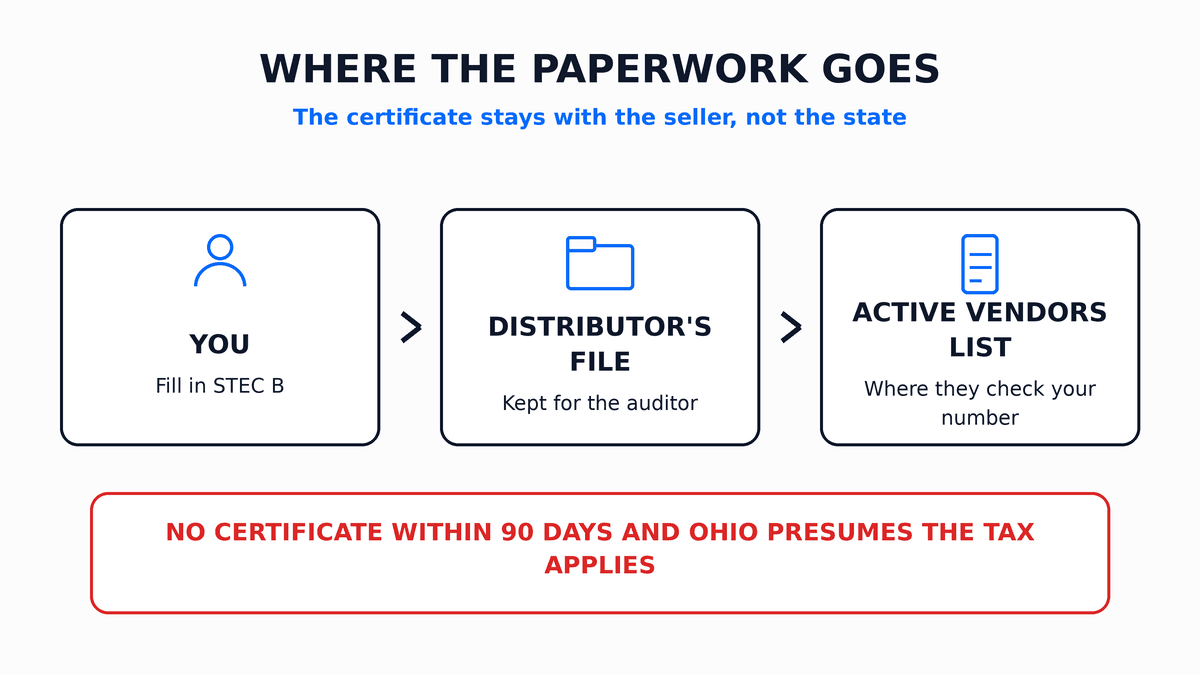
Then the form goes to the distributor, not to the state. They keep it, and they show it to the state if anyone ever asks why they didn't charge you tax.
What Ohio Means by "Fully Completed"
The form itself uses the words "fully completed," but the distributor doesn't get to decide what that means. Ohio's rule lists it.
Rule 5703-9-03, updated in November 2025, lists five things. Your name and business address. Your Ohio tax identification number, "if any." Your type of business. The reason for the exemption. And a signature, if the form is on paper. Then it adds: "If any of these elements are missing the exemption certificate is invalid."
The words "if any" are the ones to notice. They mean the same as "if applicable" on the form. If Ohio has issued you a number, it goes on the form. If Ohio hasn't, because you're outside the state and have no Ohio license, you can leave that box empty. You still have to fill in everything else.
Some distributors will want your home state's registration number written in anyway. Others will ask for one of the two multistate forms instead: the MTC certificate or the Streamlined certificate. Ohio lists both on its own exemption page. Ask their accounts team which one they want before you send anything, so the form doesn't come back.
Why Distributors Are Strict About It
The reason distributors check this so closely is that the certificate protects them, not you. Ohio's law says who pays if something is wrong.
Section 5739.03 of the Ohio Revised Code says both sides have a duty: "the consumer must provide to the vendor, and the vendor must obtain from the consumer, a certificate." A vendor holding a fully completed one "is relieved of liability" for the tax on that sale. If you claimed the exemption when you shouldn't have, you owe the tax instead.
There's also a time limit. If the vendor doesn't have a certificate within 90 days of the sale, the law says "it shall be presumed that the tax applies." In plain words, the state assumes the sale was taxable. The vendor gets one more chance after that. Once the state tells the vendor it owes the tax, the vendor has 120 days to come back to you for a completed certificate. That's why a distributor's accounts team keeps asking for missing forms. If they can't get a completed certificate from you in time, they have to pay the tax themselves.
So a blank reason line or a missing signature leaves the distributor with a sale they can be taxed on later.
Does an Ohio Resale Certificate Expire?
The form has no expiry date, and Ohio's rule doesn't set one. A blanket certificate stays valid until you replace it or the supplier asks for a new one.
But many distributors have their own rule about this. They ask for a new certificate every so often, so nothing in their file looks too old to an auditor. So the question to ask is how long your distributor will keep yours before they want a new one. Their accounts team can tell you.
How to Verify an Ohio Resale Certificate
There's no website where a distributor can type in a certificate and check it, because the certificate isn't filed with the state. What they can check is the license number on it.
Ohio publishes a List of Active Vendors report, with instructions that are "updated almost daily." It shows the license number, the business name and the address, and it can be filtered by county. Out-of-state sellers' accounts are on there too. If the number you wrote on STEC B isn't on that list, or the name next to it doesn't match yours, the distributor will ask you about it.
It's worth checking your own number on that list before you send the form. If you've typed two digits the wrong way round, the distributor can't tell the difference between that and a made-up number.
If you're an out-of-state buyer with no Ohio number, the distributor can't use this list. They'll check the number you gave against your own state's online list instead, so write it exactly the way your state issued it.
If Your Distributor Is Outside Ohio
Everything above is for buying from a distributor in Ohio. If you buy from a distributor in another state, that state's rules decide which form you need.
Ohio accepts both multistate forms, the MTC certificate and the Streamlined certificate. Many other states accept them too, with your Ohio number written in. A few states want their own form or their own number. New York wants its ST-120, which we cover in our New York resale certificate post, and Illinois has its own rules for out-of-state buyers in CRT-61.
Multistate Resale Certificate: Which Form Does Your Distributor Want? goes through which form to send to which state, and the states that have extra rules.
Getting the Certificate Accepted
Once the form is right, remember it's only one part of a distributor application, and often not the part that decides whether you're approved. Our guide to what distributors look for before approving a seller covers the rest.
If you've never filled one of these in, how to fill out a resale certificate walks through the boxes people most often get wrong, in any state. The same checks apply when you fill out STEC B.
It's also worth knowing what a supplier charges before you spend time on their paperwork. You can search a product free and see real cost and real stock from the verified distributors in our network carrying it.
Sometimes the problem isn't the form at all. You can't find anyone who carries the product. For that, you can ask our team to find an authorized wholesale distributor for it, free on every plan, with an answer within 30 days either way.
Ohio Resale Certificate: The Takeaways
- Ohio has two forms. STEC U is one purchase. STEC B is the blanket one a distributor keeps on file.
- Get the vendor's license first if you sell from an Ohio location. It's $50 through OH|TAX eServices or your county auditor.
- Ohio's rule lists five things a certificate must carry. Miss one and it's invalid.
- The license number goes on only if Ohio gave you one. Out-of-state buyers with no Ohio number should ask the distributor what they want instead.
- The form has no expiry date. Your distributor's refresh schedule is what matters.
- A distributor checks your number against the active vendors list, so check it yourself first.
- STEC B goes to the supplier, never to the state.
This is general information about published Ohio guidance, not tax or legal advice. Rules change, and for your own situation you should talk to an accountant.
Send the Blanket One
Once you know there are two forms, the rest gets simpler. STEC U is for one order. STEC B is the one that opens a wholesale account and stays in the distributor's file. And the reason distributors are so careful about it is that the form protects them, not you. If it's missing a reason or a signature, they're the ones who can be taxed on the sale later.
So get your license number if Ohio gives you one, fill in STEC B with a plain reason and a signature, and ask the distributor how long they'll keep it before they want a new one. While the paperwork goes through, you can create a free account and see real cost and real stock from the verified distributors in our network carrying your products.
Frequently asked questions
01How do I obtain a resale certificate in Ohio?
02Is an EIN the same as a resale certificate?
03How do you get a valid resale certificate?
04How to verify an Ohio resale certificate?
The B2B SupplierHub Team
Wholesale & sourcing
Stop hunting suppliers by hand. Type a UPC instead.
B2B Supplier Hub shows the suppliers in our network carrying a product on one page: wholesale cost, stock, and retail price side by side. Free to search, no card required.