
Quarter 4
Q4 Inventory Budget: How Much to Buy Without Killing Q1
There is a version of this post that just says "don't overbuy for Q4," and you have read it already. This one is narrower than that. The money you spend on inventory in September is the same money you will need in January, and most Q4 budgets get set without anyone looking that far ahead.
The usual way is to look at the bank balance in September and decide what you can afford. But September is the wrong month to look at. Whether your Q4 budget was right gets decided in January, when December's sales are still on their way to your account, refunds are coming in, and the bills for all that holiday stock arrive right on time.
This blog post is about that cash. The order dates are in our Q4 sourcing timeline, and the storage math is in our Q4 storage fees guide, so we will not repeat them here. What follows is how to work out, how much money can go into Q4, and how much has to stay home.
Start With January's Bills, Not September's Balance
Before you size a single order, write down what you will have to pay in January and February no matter how Q4 goes. The list is longer than most people expect, partly because some of the bills arrive after the season is over.
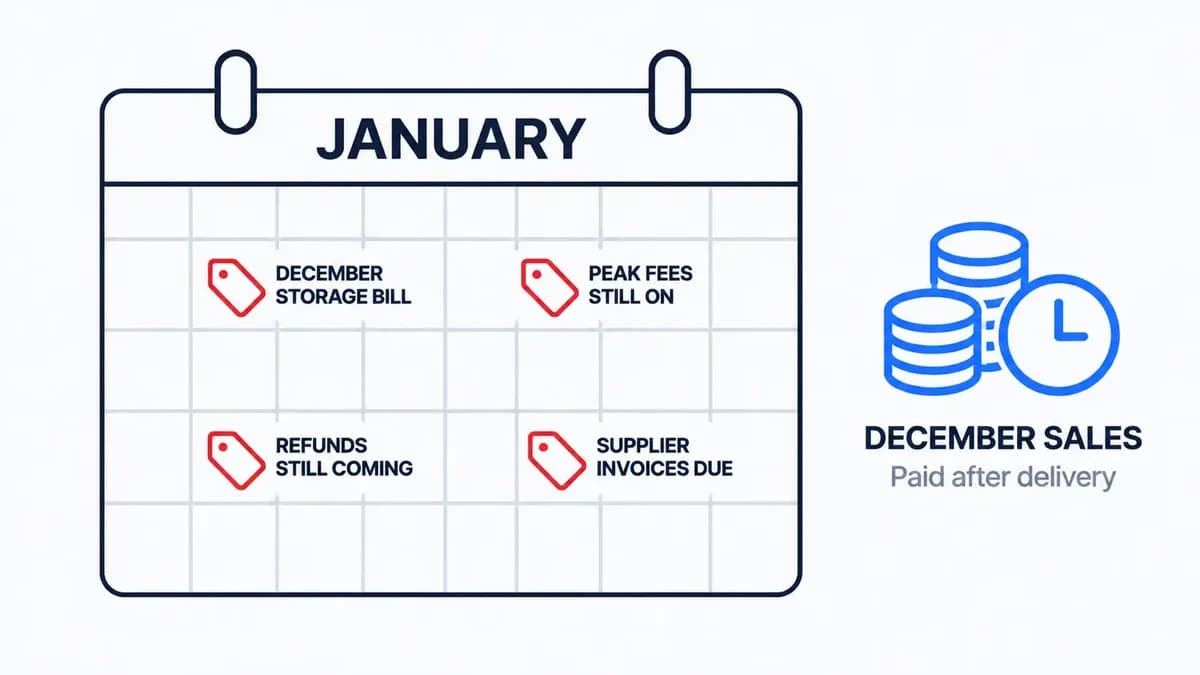
If you sell on Amazon, the January statement carries December's storage, and December is charged at the peak rate. Our storage fees guide has the numbers. Peak fulfillment fees keep running as well, on every unit that leaves a warehouse from October 15 through January 14, so the first two weeks of January sales cost the same to ship as December's. Around the middle of January, the aged inventory surcharge is assessed on the 15th and charged between the 18th and 22nd on any older stock that has sat past 180 days. Then there is the one bill almost nobody plans for. If a product's return rate goes over the threshold for its category, the returns processing fee is charged in the third month after the units shipped, which means November's fee arrives in February and December's in March.
Now add the lines that apply to whatever channel you sell on. There are the supplier invoices for your October and November orders, due somewhere between November and January depending on your terms. There are reorders for the products you sell all year, which do not stop for the holidays. And there are your fixed costs, the same as every month.
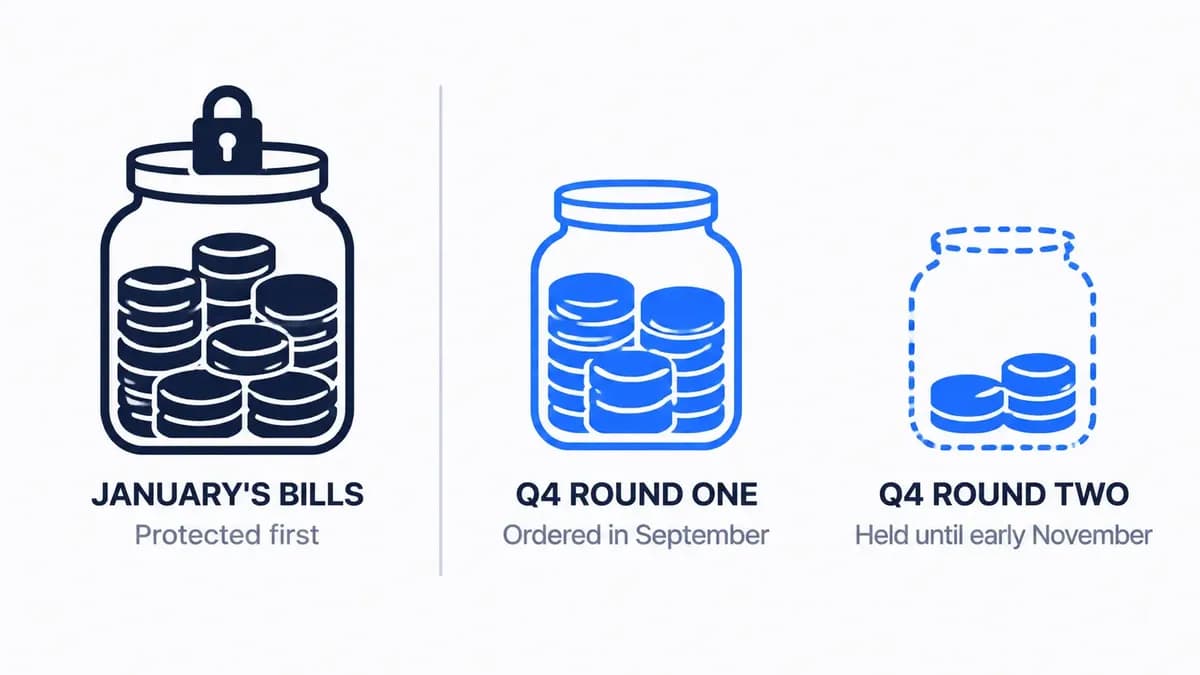
Add it all up, and that total is your Q1 floor. It gets protected first. Whatever is left after it is your Q4 inventory budget.
To see the shape of it, take an example with round numbers. Say your January and February obligations come to $40,000, and you have $90,000 available today. Your Q4 budget is not $90,000 but $50,000, and even that gets split into two rounds, which we come to below. Your figures will be different. The subtraction is the same for everyone.
For a closer look at how terms and payout timing move cash around, our cash conversion cycle post walks through it product by product.
How Much Inventory to Buy for Q4: Count Units, Not Dollars
Start from what you sold last year, in units, not what you bought. For holiday-only products, if you had stock left over in January, last year's order was too big by roughly that much, so this year's starting point is the smaller number.
Be careful with the forecasts, too. Deloitte expects holiday e-commerce sales to grow 7.5% to 8.4% this season. That is a dollar figure. Bain has warned that more than half of the retail growth it expects comes from higher prices. If prices are up, the same number of units brings in more dollars, so buying 8% more units because the forecast says 8% counts the same growth twice.
Once you have a unit number, split it into three piles. Each one carries a different level of risk. The first pile is products you sell all year. If you buy a little too much, the extra becomes January stock and sells in February. Buy these close to plan.
The second is holiday-only products. Anything left in January sits until next November, and if it arrived in September, it crosses the 180-day line in March and starts collecting surcharges. Buy these tight. Every extra unit is a bet placed with Q1's money.
The third is units you are buying for a deal. Black Friday and Cyber Monday deal submissions close on October 20, and if a deal is not accepted, you are left holding holiday-only stock without the promotion that was supposed to move it. Until the deal is confirmed, buy only what would sell without it.
If this is your first Q4, you have no last year to start from. Use your current weekly sales and the multiplier logic in the timeline post, and treat everything as pile two until you have a season of your own numbers.
Split the Budget: Hold Back a Second Round for November
You do not have to commit the whole Q4 budget in September. Decide now what share stays uncommitted until the October deal event and the first days of November show which products are really moving, then release it or cancel it in early November. Not later, because our timeline explains what happens after the middle of November: a new order mostly cannot make December.
The catch is that a second round only exists if the distributor still has stock when you come back. That makes stock depth a bigger budgeting question than price. A distributor with a great cost and thin stock in September is a first-round-only supplier. Two distributors with deep stock mean you can commit less now and top up later, with money that never left your account.
You can check this before you decide the split. Search the product for free on B2B Supplier Hub, and you see the real cost and real stock from every verified distributor in our network carrying it, with a date on each listing so you know how fresh the numbers are. Run your top Q4 products through it, and the size of your first round becomes a lot easier to set. If a product is not in our catalog yet, submit a request and our team will find an authorized distributor who carries it. It is free on every plan, and you hear back within 30 days either way.
What January Looks Like at 100%, 75%, and 50% Sell-Through
Fill this in with your own numbers for each holiday-only product. The example rows use round figures, just to show how it works.
Units bought | Sold by Dec 31 | Units left | Your return rate | Expected refunds | Still not back by Jan 15 | |
|---|---|---|---|---|---|---|
Example, sold 100% | 1,000 | 1,000 | 0 | 5% | 50 units | Refunds only |
Example: sold 75% | 1,000 | 750 | 250 | 5% | 38 units | 250 units plus refunds |
Example: sold 50% | 1,000 | 500 | 500 | 5% | 25 units | 500 units plus refunds |
Your product |
The last column is the one to watch. Even at 100% sell-through, January comes in thinner than December looked. There are three reasons for that, and a fourth if anything is left over.
The first is that you are paid after delivery, not at the sale. Under Amazon's DD+7 policy, funds become available seven days after delivery is confirmed, and then they wait for your next payout date on top of that. So a sale on December 20 is January money.
The second is refunds, which keep coming after the season ends. Last year Amazon let anything bought between November 1 and December 31 be returned until January 31, on both FBA and merchant-fulfilled orders. Walmart extended returns on purchases from October 1 to December 31 to January 31 as well. Last year, Amazon confirmed the policy in mid-October. Until this year's is announced, plan on the same window.
The third, if you sell on Amazon, is that peak fees run to January 14, and December's storage lands on the January statement.
And if the "left" column is not zero, those units are not cash at all. They are stock, and holiday stock in January is slow stock. The storage guide covers what to do with it. For budgeting, the point is simpler: every unit in that column is money you took out of Q1 back in September.
Two Dates to Put on the Calendar: Early November and January 31
The first is early November, when the held-back round gets committed or cancelled based on the October event and the first November sales. Any later, and the order cannot make December.
The second is January 31. Set aside an amount equal to your expected refunds and leave it alone until the return window closes. Everything else in your Q1 floor spends on schedule, and your year-round reorders do not wait for anything.
Two piles of money, one for January and one for Q4, and the Q4 pile split in two. That is the whole plan, and it only works if you do it in September, while you still have the choice.
Do the January List First
If you take one thing from this post, take the order. January's bills first, then the unit count, then the split. Most resellers do it the other way round. They size the orders from what they can afford and hope January works out, and sometimes it does. When it does not, the reorder for their best year-round product gets skipped in the first week of February, and that is how a good Q4 turns into a slow spring.
You can start on the second half of that today. Pick your five biggest Q4 products, search each one for free, and look at how deep the stock runs across the distributors carrying it. If the depth is there, your first round can be smaller than you were about to make it, and the difference stays in your account until you know what is actually selling.
Frequently asked questions
01How much inventory should I buy for Q4?
02Should I buy all my Q4 inventory in September?
03When do I get paid for December sales?
04Do holiday returns affect January cash?
05What Q4 costs show up after Q4 is over?
The B2B SupplierHub Team
Wholesale & sourcing
Stop hunting suppliers by hand. Type a UPC instead.
B2B Supplier Hub shows the suppliers in our network carrying a product on one page: wholesale cost, stock, and retail price side by side. Free to search, no card required.