Cash Conversion Cycle for Wholesale Resellers (2026 Formula)
The B2B SupplierHub Team··12 min read
You paid the distributor in September. The product sold in October. The money landed in your bank in November.
Count the days between the first date and the last one. That number is your cash conversion cycle. Most resellers have never counted it, and that is usually why a growing business feels like it is always short of cash even when the products are selling fine.
This blog post shows you how to count it the way a reseller should, with the payout timing that is actually in place in 2026, and where the number is really decided.
The Cash Conversion Cycle Formula, Rewritten for Resellers
The textbook formula is: cash conversion cycle equals days inventory outstanding, plus days sales outstanding, minus days payable outstanding. It was written for companies that send a customer an invoice and then wait to get paid. You do not do that. Your customer pays the marketplace, and the marketplace pays you later. So the middle part of that formula works differently for you.
So here is the same formula in reseller terms.
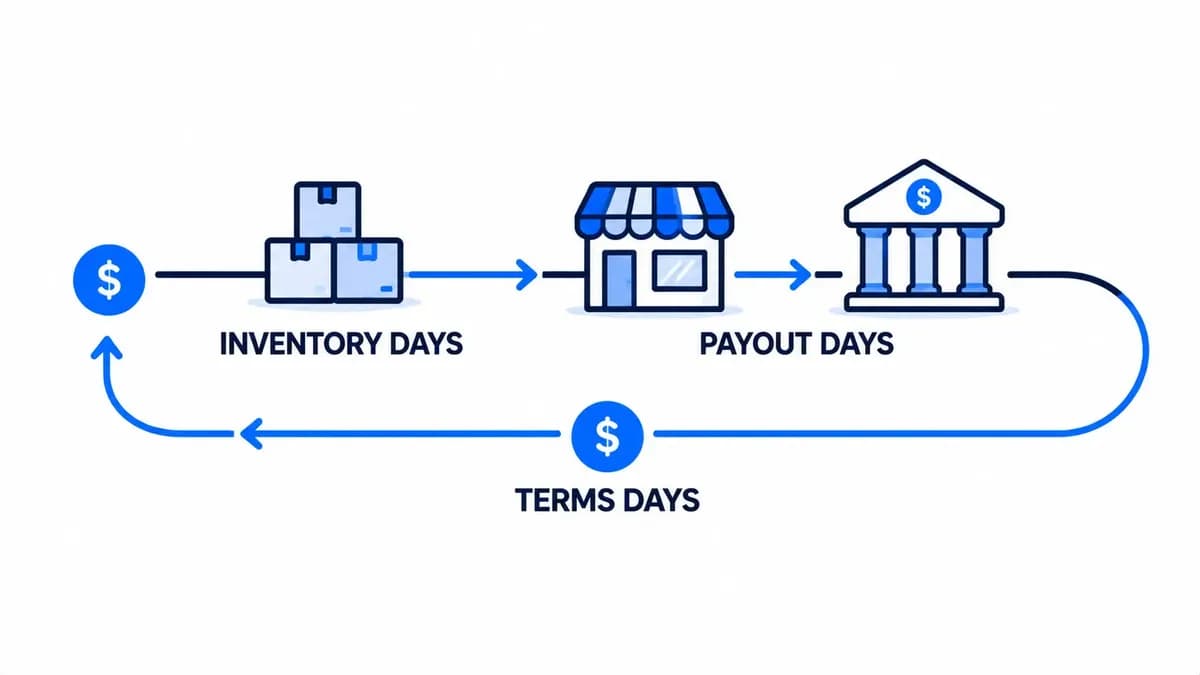
Inventory Days. From the day your payment leaves for the distributor to the day the unit sells.
Payout Days. From the day it sells to the day the money is in your bank.
Terms Days. The number of days the distributor lets you hold their money before you have to pay. Prepay is zero. Net-30 is thirty.
Inventory days plus payout days, minus terms days. That is how long each dollar is gone.
Frequently asked questions
What is a good cash conversion cycle for a wholesale reseller?
There are published ranges. One billing company says distributors typically run 40 to 80 days. But resellers vary so much by channel, terms, and product that an outside number is not very useful. Your own trend, product by product, is the benchmark that matters.
Can the cycle be negative?
Yes. If a product sells and pays out before your net-30 invoice is due, you are using the distributor's money to run that product. It is a great position, but it depends on terms the distributor can take away, so do not build your whole plan on it.
Does Amazon's DD+7 change my cycle if I ship my own orders?
Yes. The seven-day hold applies to FBA and FBM alike, and FBM often runs longer because delivery takes longer, so the clock starts later.
TB
The B2B SupplierHub Team
Wholesale & sourcing
Stop hunting suppliers by hand. Type a UPC instead.
B2B Supplier Hub shows the suppliers in our network carrying a product on one page: wholesale cost, stock, and retail price side by side. Free to search, no card required.
Two things about this version catch people out. First, inventory days start when your payment goes out, not when the boxes arrive. If the distributor takes three weeks to ship, those three weeks count. Second, the number is different for every product. One average for the whole business hides the products that are sitting on your cash.
The Same Business, Two Very Different Products
Let's count two products. The numbers below are made up to show the pattern. Use your own when you do this for real.
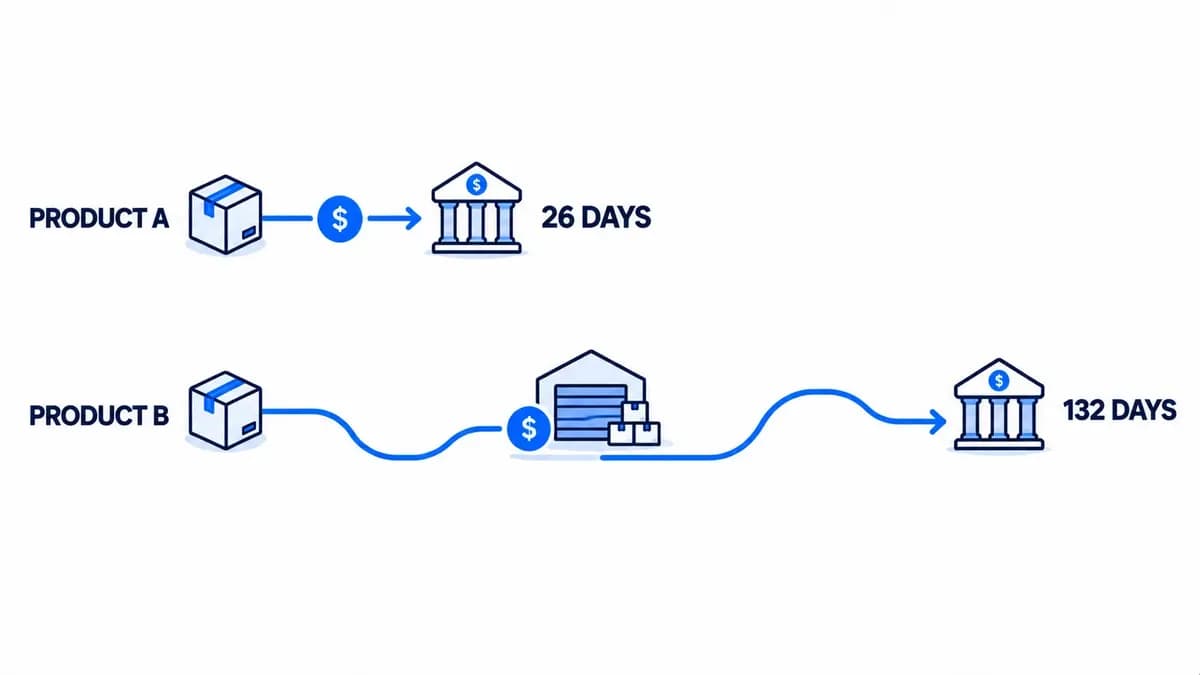
Product A is a fast seller from a distributor that gives you net-30 and has it in stock. You pay on day zero. It ships in two days and arrives four days later. Prep and check-in take eight days, so it can sell from day 14. You sent enough to cover about 30 days of sales, so the last unit sells around day 44. Payout takes about 12 more days. That is 56 days out. Now subtract the 30 days of terms. Your cash was gone for about 26 days.
Product B is a slower seller you prepay for. The distributor says in stock, but the order sits on backorder for 30 days before it ships. Add five days in transit and ten days to get checked in, and it can sell from day 45. You bought a big case to hit a price break, so you are holding about 75 days of supply. That puts the last sale around day 120. Add 12 days for payout. Subtract nothing, because you prepaid. Your cash was gone for about 132 days.
Same business, same owner, and the two products behave nothing alike. One gives your money back in under a month. The other keeps it for over four months. If you have twenty products like B and think of yourself as "a net-30 business," you will keep wondering where the cash went.
A table with six columns is all you need to do this yourself: paid to shipped, transit, prep and check-in, days of supply, payout days, terms days. Fill it in for your top twenty products and the answer is right there.
And if the first column is the problem, meaning a distributor keeps stretching a backorder and you cannot find anyone else carrying the product, that is when you submit a request to our team. We go and find a verified distributor who carries it. It is free on every plan and you get an answer within 30 days, either way.
Inventory Days: The Four Pieces and How to Fix Each
It helps to break inventory days into pieces, because each piece has a different fix.
Paid to shipped. This is the piece a stale stock number quietly stretches. A price list from last month said "in stock." You wired the money. Then the order sat. Nothing tells you the number was old until the shipping confirmation does not come. This is why a freshness timestamp on a listing is not a small detail. It tells you how old the stock figure is before you pay.
Transit. Mostly about where the distributor ships from. A cheaper cost from a warehouse across the country can be a worse deal once you add a week on the road.
Prep and check-in. Look at your own history here rather than guessing. Some resellers get this done in three days, some in fifteen.
Days of supply. How long your stock lasts once it can actually sell. This is the piece you control most directly, and the one every finance guide tells you to cut. There is a floor under it, though, and we get to that below.
The reason to split the pieces is diagnosis. A long cycle built from the first piece is a supplier problem. A long cycle built from the last piece is a buying problem. The fix for one does nothing for the other.
Payout Days in 2026: Amazon DD+7, Walmart, and eBay
This is the piece most resellers guess at, and the guess is usually optimistic. The timing changed this year for a lot of people.
If you sell on Amazon. Sellers were told that on March 12, 2026 Amazon would move accounts to the standard hold of seven days after the delivery date, often called DD+7. For example, sell a product on January 1, it is delivered on January 3, and the money becomes available for payout on January 11.
Two more things worth knowing. The hold applies to both FBA and FBM orders, so switching how you ship does not change it. And Amazon can make the hold longer than seven days depending on how it rates the risk on your account. So your payout days are specific to you. Pull your last ten payouts and count.
If you sell on Walmart. Walmart's own guide says payouts are generally every two weeks, new sellers have a payment hold, and in most cases payment for an order arrives in the payout cycle after it ships, about 28 days after the ship date.
If you sell on eBay. eBay lets you pick your payout schedule, so check your own settings rather than assuming.
If you sell to stores or on your own site. Card money usually settles in days. This is the shortest payout window most resellers will ever see.
If you sell on more than one channel, weight the numbers by how much volume goes through each one. A reseller doing 80% on Amazon and 20% to retail stores has a very different blended payout figure than the reverse.
One more timing detail that catches people. Fees do not always come out when the sale happens. Amazon, for example, bills monthly storage on your average daily volume, usually between the 7th and 15th of the following month. The storage bill for October lands in November, after the sales it relates to.
Terms Days: What a 2/10 Net 30 Discount Really Costs
Terms are the only part of the formula that shortens your cycle, so it is worth understanding them properly. How to qualify for them is a whole topic on its own, and we covered it in our net-30 post.
The part most people skip is the early payment discount. A common one is written 2/10 net 30. Pay within ten days and take 2% off, or pay the full amount by day 30. Two percent sounds small. It is not, once you see what you get for it. You are paying 2% to keep your money for 20 more days. Worked out over a full year, that comes to roughly 37%. A 1/10 net 30 works out to about 18% a year, and a 3/10 net 30 to about 56%.
We are not going to tell you which to take. That depends on what your cash could earn elsewhere and whether you have any to spare. Shortening your terms days on purpose can be the right call for one reseller and the wrong one for the reseller next door. Work out the number for your own situation first.
Every guide to this topic ends with "turn your inventory faster." For a reseller, that advice runs into a floor pretty quickly.
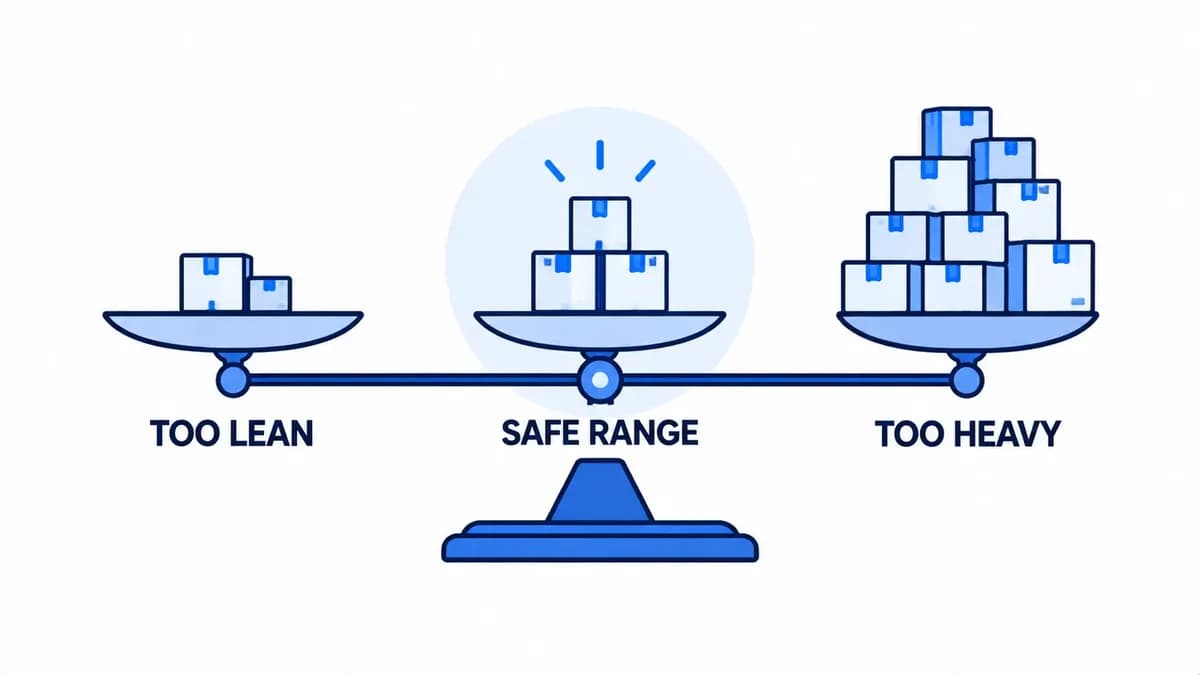
The first floor is the stockout. Run a product too lean and you do not just lose the sales you could not fill. You lose position on the listing and have to earn it back. That cost is real even though it never shows on an invoice.
The second floor is how distributors sell. Case packs and minimum orders mean you often cannot buy 30 days of supply even if you wanted to. We went into that math in the economics of minimum orders. And freight breaks can make one larger order delivered cheaper than three small ones.
So the goal for each product is not the smallest possible stock. It is a safe range: enough to avoid the stockout and any marketplace fees for running low, not so much that the money sits for months.
Walmart's fulfillment service charges storage too, so the same idea applies there. If you sell on eBay from your own space, there is no storage floor beyond your own rent.
Where the Cycle Is Really Decided: The Purchase Order
Here is the part the finance guides miss, and it is the same point that decides whether wholesale is profitable at all. The biggest number in the whole cycle is the price on the purchase order. And it is the only number that gets fixed before the clock even starts.
Three things at the PO stage move the cycle more than anything you do after.
Compare the cost before you buy. Most resellers price a product once and reorder from the same distributor for years. If another distributor in our network carries the same product for less, the gap comes out of your cash on every single order. You can search a product free and see real cost and real stock from every verified distributor in our network carrying it, side by side, before you apply to any of them.
Buy the quantity that fits the safe range, not the tier with the biggest discount. A 4% price break that pushes a product from 45 days of supply to 120 costs you far more in tied-up cash than it saves. Do the days math before the discount math.
Confirm the stock is real. The backorder in Product B above was the single biggest item in its 132 days. A fresh stock number before you pay is worth more than almost any other check. On our platform, price and restock alerts on your watchlist tell you when a distributor in our network has the product back, or at the cost you want, so you can buy in smaller lots without losing supply.
Recount It Every Quarter And Watch The Direction
The number on its own does not mean much. What matters is which way it is moving. As one working capital guide puts it, a business running 60 days might be fine, but one running the same number and drifting toward 75 over three quarters has a problem worth looking into.
Three things tend to move a reseller's number between one quarter and the next. A distributor starts shipping less of what you ordered, and the paid-to-shipped column grows. A marketplace changes its payout policy, which is exactly what happened on Amazon this year. Or a distributor pulls your terms after a late payment, and thirty days of breathing room disappears overnight. All three show up in the table before they show up in the bank, which is the whole reason to keep the table. We covered the wider review in how to audit your supplier base once a quarter.
Count The Days On Your Top Ten
Pick your ten best-selling products. For each one, fill in the six columns: paid to shipped, transit, prep and check-in, days of supply, payout days, terms days. It takes an afternoon. What you usually find is two or three products that hold more cash than the other seven put together, and at least one of them was bought on a stale stock number or a price you never re-checked.
The fastest fix for those is at the start of the cycle, not the end. Search a product free and compare real cost and real stock across the distributors in our network carrying it. If the product is not in our catalog yet, submit a request and our team will find an authorized distributor who carries it, free on every plan, with an answer within 30 days either way.
Then put the date in your calendar to count again in three months.
Is net-30 worth more than a 2% early payment discount?
It depends on what your cash could earn instead. A 2/10 net 30 discount works out to roughly 37% a year. Compare that to your own situation. It is not the same answer for everyone.
If I cut inventory days on FBA, what do I risk?
Dropping under 28 days of supply on both of Amazon's measuring windows triggers the low-inventory fee on every unit sold. The fix is a safe range per product, not the lowest possible stock.

-1200x627.webp&w=3840&q=75)