
Industry Insight
Tactical Arbitrage Alternatives for Wholesale Sellers (Not OA)
-1200x627.png&w=3840&q=75)
Tactical Arbitrage scans more than 1,400 retail sites. If you're an online arbitrage seller, that number is the entire point. If you're a wholesale seller, it's a description of capability you will never use.
That mismatch is why wholesale sellers go looking for alternatives. TA does have a real Wholesale Search module that ingests supplier manifests and matches them against Amazon data, and it works.
But the tool's center of gravity is retail scanning, and the wholesale module sits alongside it rather than driving it. Add the packaging change, since Tactical Arbitrage is now sold inside Threecolts' Seller 365 bundle rather than as a standalone product, and plenty of wholesale sellers are reassessing whether they're buying the right thing.
Here's an honest look at where TA still earns its place for wholesale, five alternatives worth comparing, and one popular recommendation you should stop chasing.
What Tactical Arbitrage Actually Does for Wholesale
Credit where it's due. The Wholesale Search module takes a distributor manifest or catalog, matches line items to Amazon listings, and calculates profitability with fees, prep, and shipping factored in. It offers basic and advanced views, supports scheduled recurring scans, and reports confidence scores on its product matching rather than presenting every match as certain.
Reverse Search is the other genuinely wholesale-relevant feature. Start from an Amazon ASIN and work outward to find where the product is sold, which is the same directional logic wholesale sellers use when they identify a proven seller and go hunting for its supplier.
So the tool is not wrong for wholesale. The question is proportion. You're paying for a platform whose largest investment is retail site coverage, and if your inventory comes from distributor relationships rather than retail arbitrage, most of that spend sits idle. Combine that with a learning curve users have flagged for years and a bundle you may not want nine other apps from, and the reassessment makes sense.
The Alternative That Shut Down
Before the list, a correction to advice was still circulating. SourceMogul was for years the most commonly recommended Tactical Arbitrage alternative, and it ceased operations in late 2025. The brand changed hands, and its site has run a waitlist for a rebuilt product, but it is not currently the drop-in replacement older blog posts and forum threads suggest.
If you've been working from a list that recommends it, that list is out of date, which is worth knowing before you spend an afternoon evaluating a product that isn't there.
Five Alternatives Worth Comparing
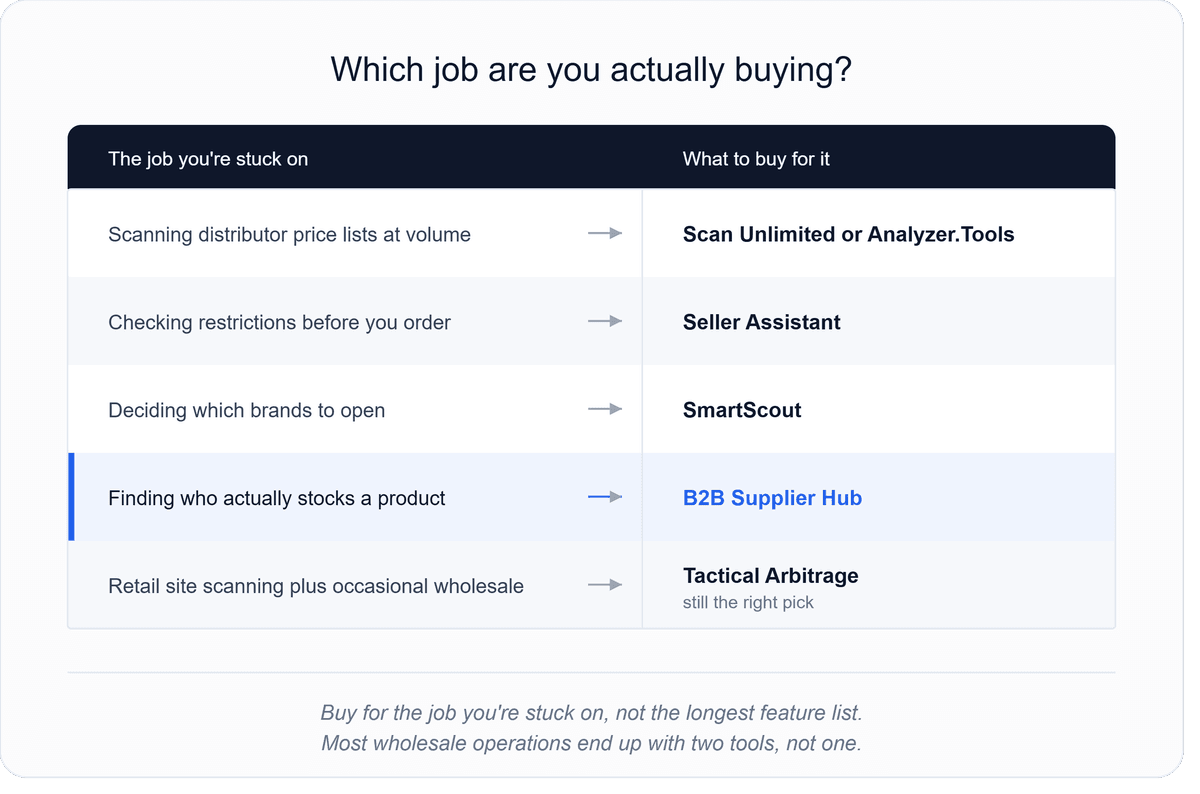
1. B2B Supplier Hub: The Supplier Side Nobody Else Covers
Disclosure first: this is our platform, so weigh this entry accordingly. It's on the list because it solves a problem none of the scanning tools address, including Tactical Arbitrage.
Every tool here analyzes products. None of them tells you which distributor carries a product, what they charge, or whether they have stock. B2B Supplier Hub does exactly that: search by UPC, MPN, name, or brand and see every verified distributor in the network carrying the item, with exact wholesale cost, live stock depth, retail price, and the date each listing was verified. Identities stay masked until you choose to reveal one, and the numbers are free with no search limit.
Where Tactical Arbitrage is stronger: manifest scanning at volume, retail site coverage, and profitability modeling across thousands of rows. We don't do those. Where this is stronger: it removes the step where you already know a product is profitable and still have to find someone who will sell it to you. Most working wholesale operations end up with one analysis tool and one supply source, because those are different datasets.
2. Scan Unlimited: Dedicated Wholesale List Scanning
If the only part of Tactical Arbitrage you use is Wholesale Search, this is the closest like-for-like swap. Scan Unlimited does one job: ingest supplier price lists, match them to Amazon, calculate profitability, and filter hard. Nothing in it is built for retail arbitrage, which means nothing in your subscription is subsidizing capability you don't need.
The tradeoff is scope. You lose retail scanning and Amazon flips entirely, so this only makes sense if you've genuinely left online arbitrage behind. Test it against TA on the same real supplier file and compare match rates before switching; matching quality on your actual distributors' files matters more than any feature list.
3. Analyzer.Tools: Bulk Scanning Plus a Reverse Sourcing Loop
Analyzer.Tools is the other dedicated bulk platform, and it pushes hardest on filter depth across large catalogs. Its differentiators for wholesale are Browser Scan, which pulls products from Amazon into the platform for analysis, and Deep Scan, which extends past Amazon's roughly 2,400-result display limit.
It suits spreadsheet-first operations processing many large lists. It's not built for on-page research while you browse Amazon, and like every tool in this category it can't identify a distributor. We covered it in depth in our Analyzer.Tools review and alternatives.
4. Seller Assistant: Wholesale Workflow Beyond Scanning
Seller Assistant is the closest thing on this list to a wholesale operations platform rather than a scanner. It combines a price list analyzer with on-Amazon page analysis, bulk restriction checking across large ASIN sets, brand research, and purchase order management.
For wholesale sellers, the restriction checking deserves specific attention. Knowing which ASINs your account can actually list before you commit to a supplier order prevents the most expensive kind of wasted purchase, and that check is a normal part of a wholesale workflow rather than an occasional need. We compare it further in our roundup of Seller Assistant alternatives.
5. SmartScout: Deciding Which Brands to Chase
SmartScout answers an earlier question than any scanner does. Instead of evaluating a supplier list you already have, it maps the marketplace itself, letting you filter brands, sellers, and categories by revenue, seller counts, and Buy Box behavior to identify which brands are worth opening an account with in the first place.
That's a strategic tool, not a daily one, and it's a heavier and pricier platform with a real learning curve. It doesn't replace list scanning, so it usually sits alongside one rather than instead of it.
When Tactical Arbitrage Is Still the Right Choice
An honest comparison has to include this. Keep TA if you run genuine hybrid sourcing, buying both retail arbitrage deals and wholesale manifests, because paying for two specialist tools to replace one platform rarely nets out cheaper.
Keep it if the bundle's other apps are things you'd otherwise buy separately, since a repricer and an inventory manager included at bundle pricing change the math considerably. And keep it if reverse search across retail sites is a core part of how you find products, which is a capability the dedicated wholesale scanners simply don't have.
The case for switching is narrower than most comparison posts admit: you've fully committed to wholesale, you use one module out of many, and the bundle's extra apps duplicate tools you already run.
Start From the Supplier Side
Whichever scanner you keep, the step it can't perform is the one that stalls most wholesale sourcing: finding a distributor who actually carries the product you've validated. B2B Supplier Hub makes that a lookup rather than a search.
Enter a product by UPC, MPN, name, or brand and see every verified distributor in the network stocking it, with exact wholesale cost, live stock depth, and the date each listing was verified, free and unlimited. Run your next shortlist through it and see who's holding the inventory before you spend anything.
Frequently asked questions
01Is Tactical Arbitrage good for wholesale sellers?
02What is the best Tactical Arbitrage alternative for wholesale?
03Is SourceMogul still a Tactical Arbitrage alternative?
04Can I replace Tactical Arbitrage with a free tool?
05Do I need both a scanner and a supplier tool?
The B2B SupplierHub Team
Wholesale & sourcing
Stop hunting suppliers by hand. Type a UPC instead.
B2B Supplier Hub shows the suppliers in our network carrying a product on one page: wholesale cost, stock, and retail price side by side. Free to search, no card required.