
Supplier Management
When Distributors Restock and Run Promotions: The Wholesale Calendar
A useful wholesale buying calendar tracks what your supplier is doing, not what shoppers are doing. US distributors run on three things: quarter-end targets, the price lists their brands hand them, and allocation. Allocation means the brand decides how much stock each distributor gets, and when.
Those three run on their own schedule, and they drive more of your cost than any selling season does.
One caution before the table. This is the shape of a year, not a timetable. The months move by category and by how big your distributor is. A rep at a small distributor may carry no quarterly target at all. Use it to know what to ask, not to predict a date.
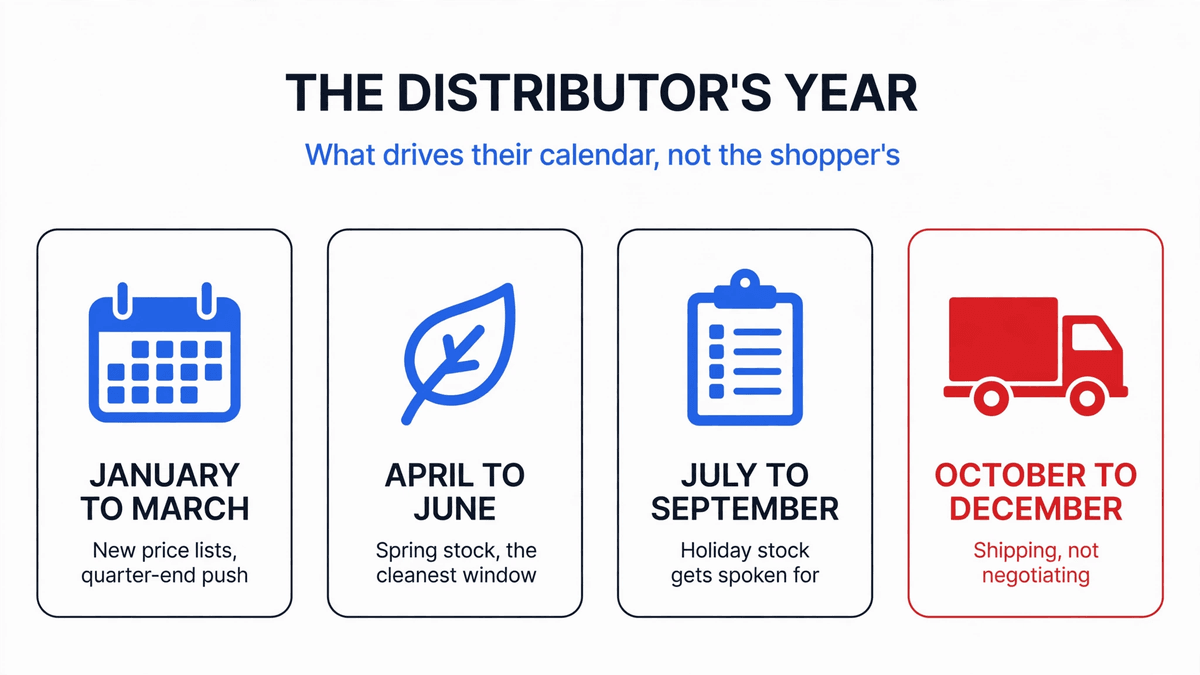
Month | What distributors are doing | What you do |
|---|---|---|
January | Many brands reset list prices. Year-end stock is still clearing. | Re-cost every repeat buy before you reorder it. |
February | Quiet month. Reps have time. New-year promotions land. | Open accounts and push approvals through while nobody is busy. |
March | Quarter-end. Reps are chasing targets and clearing slow stock. | Ask for one thing on a product you already buy. |
April | New-season stock arrives. Restocking after Q1. | Test new lines small before you commit a case count. |
May | Steady. Spring promotions run. | Lock in repeat buys. Nothing clever required. |
June | Quarter-end again, often the hardest push of the first half. | The second clean negotiating window. Same play as March. |
July | Quiet outside. Inside, they are finding out how much holiday stock each brand will give them. | Build your Q4 product list now, while stock questions still get answers. |
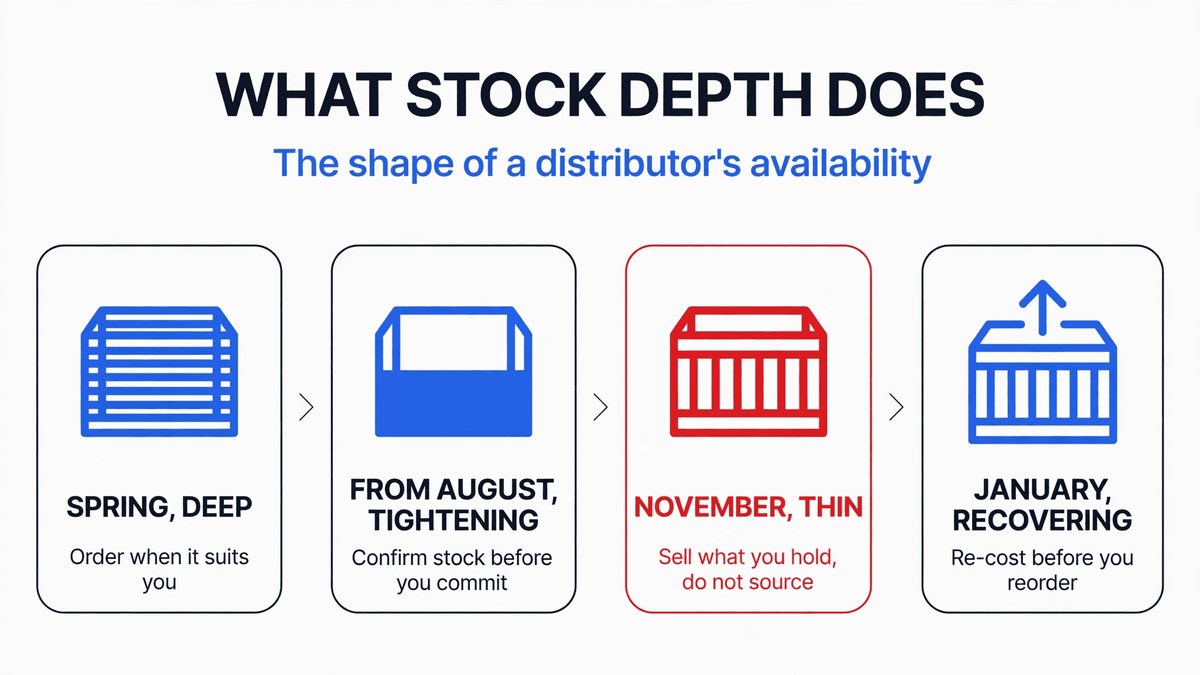
August | Backorders start appearing. Holiday allocation tightens. | Place early Q4 orders. Confirm stock before you move cash. |
September | Peak ordering. Lead times stretch. Quarter-end is buried under Q4. | Main Q4 purchase orders go in. |
October | A new quarter starts and Q4 shipping takes over. They are fulfilling, not negotiating. | Top-ups only. Stop expecting favors this month. |
November | Stock is thin. Discounting is rare. Everything is fulfilment. | Sell what you hold. Do not start new sourcing. |
December | Wind-down and stock counts. Year-end clearance starts late in the month. | Watch for clearance. Plan your January re-cost. |
The rest of this post explains why those patterns exist. Knowing the reason is what lets you tell a real window from a sales email.
Two Windows Where Asking Actually Works
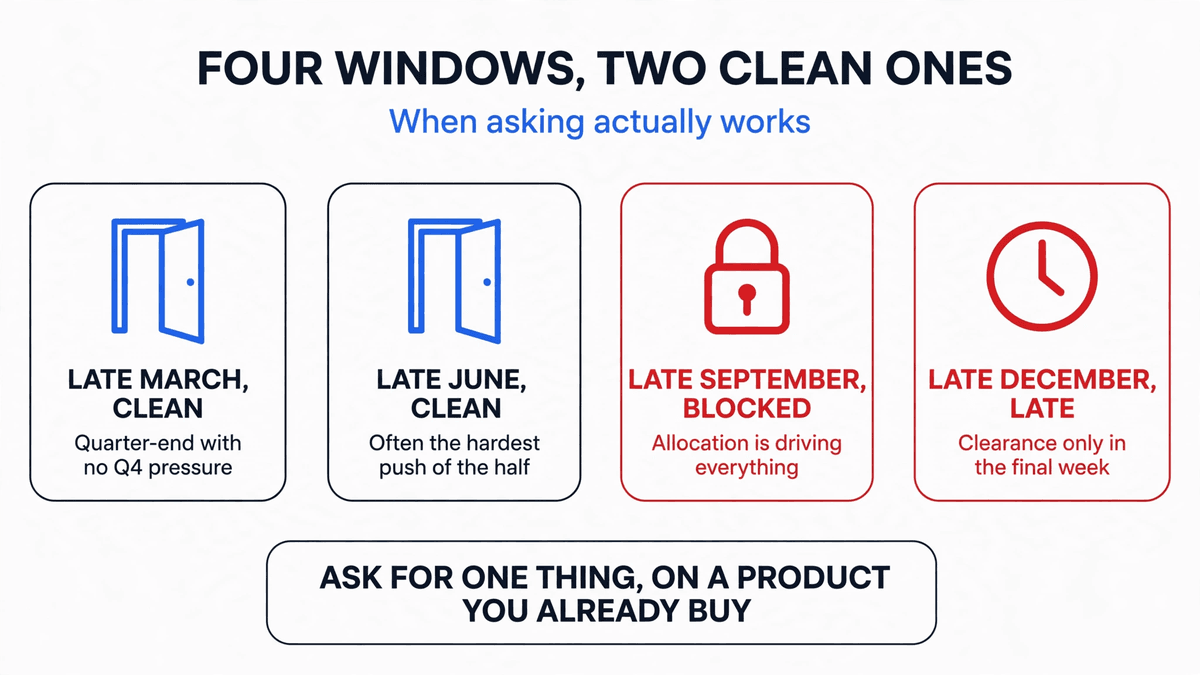
Quarter-end is the honest answer to when distributors run promotions. There are four quarters, and only two are useful to you.
The mechanism is simple. Reps carry targets. A rep who is short with two weeks left has a reason to move volume that they do not have in the middle of May. That is the whole of it, and no published wholesale promotions calendar will tell you more than that, because the pressure is internal.
Late March and late June are the clean ones. Both are quarter-ends with no holiday allocation distorting them. Stock is available, reps want volume, and nothing bigger is competing for their attention.
Late September is a quarter-end on paper only. By then holiday allocation drives everything, and nobody discounts stock they are about to run short of.
Late December is a quarter-end and a year-end, but the first three weeks are fulfilment. The clearance appears in the final week, if it appears.
What you can reasonably ask for in a clean window:
- A better price on a quantity you were going to buy anyway
- Freight terms, which often move more easily than unit cost
- Payment terms, if you have paid on time for a while
Ask for one thing, not all three. And ask on a product you already buy. What gets you a yes is being a regular customer who reorders. Not the date on the calendar. Some distributors work this way, and some do not. A large one whose reps carry quarterly targets will. A small one may not run on quarters at all.
January Is the Month That Quietly Changes Your Margin
This is the part of the year most resellers run on autopilot, and it is the most expensive place to do it. Plenty of brands reset list prices early in the year. Distributors pass those through, sometimes at once, sometimes over a few weeks. In categories where pricing tracks a product refresh rather than the calendar, such as electronics and tools, the reset may land at another time instead. Either way it lands.
Here is what that does to you. A product you have reordered every six weeks for two years can come back more expensive, and nothing in your process will tell you. The reorder goes through at the new cost. The margin shrinks. You find out at the end of the quarter, if you find out at all.
So January is a re-cost month. Pull your repeat buys, check each one against the current list, and run the profit math again at the new cost. Some products quietly stop working. It is better to find that in January than in October with a pallet already on a truck.
January is also when year-end clearance is still moving. Clearance is genuinely cheap, and it is also how people end up holding stock that was discounted for a reason. Buy clearance on products you already sell, not products you have never tested.
End of Quarter Is Also When Slow Stock Moves
Negotiating is only half of what quarter-end does. The other half is that distributors want slow-moving stock off the books before the quarter closes. That shows up as clearance lists and rep emails about specific products. It also shows up as a sudden willingness to break a case quantity that was firm a month earlier. It is not announced as a promotion. You usually have to ask what is sitting.
In the last two weeks of March and June, ask your rep one question. "What are you trying to move before the quarter closes?" The worst answer is nothing. Treat the stock the same way you treat clearance. Cheap is only cheap on a product you already know sells for you.
What a Distributor Restock Schedule Actually Looks Like
Resellers often picture a fixed restock day. Most distributors do not work that way. Replenishment follows the brand's own production and shipping cycles, which differ by category and by brand. What you can observe is the pattern for the specific products you buy, and that is worth more than any general rule.
The method you can follow is:
- Note the date whenever a product you buy goes from out of stock to available
- Do that for three or four cycles
- You now know that product's rhythm, which is the only restock schedule that matters to you
Ask your rep directly too. "When does this normally come back in?" is a question reps can usually answer, and it costs you nothing to ask.
Q4 Runs on Different Rules
From late summer the wholesale buying season inverts. Brands allocate holiday stock, every reseller orders at once, and backorders become normal rather than a warning sign. One distributor-side thing is worth knowing. Catalog availability and warehouse reality drift apart fastest in this window. Confirm stock before you commit cash rather than trusting a listing.
Our Q4 sourcing timeline for Amazon wholesale covers the ordering side month by month. That is where to look for when to order holiday inventory wholesale, including the order-by dates and when to stop placing new orders. No point writing it twice.
Fitting This to Your Own Cash Cycle
A buying calendar is only useful if your cash agrees with it. Quarter-end deals need cash in the same week. Clearance needs cash in January, which is often the month after you spent it all. Early Q4 ordering needs cash in August for revenue in December.
That lag is the real constraint on seasonal inventory planning. It is why our Q4 inventory budget post starts from January and February cash rather than from the Q4 opportunity. Work out what you must hold back first. What is left is what the calendar can spend.
if you are still in your first months with a supplier, the sequence in our guide to your first 30 days with a new wholesale distributor matters more than timing. Terms and trust come first. Bargaining power comes later.
When the Calendar Does Not Help
There are two situations where none of this applies.
The first is a product nobody you can reach carries. Timing does not solve a supply gap. If the item is not in a catalog you have access to, search a product free. You see which verified distributors in our network carry it, with real cost and real stock, before you apply anywhere. If nothing comes back, you can ask our team to find an authorized wholesale distributor for it. That is free on every plan, with an answer within 30 days either way.
The second is allocation. When a brand sets what each distributor receives, quarter-end pressure does not change that number. A rep under pressure may escalate an account request. That is a different thing. It can get you looked at sooner. It cannot create stock or override a brand's approval. Ask whether a product is allocated before you build a plan around buying more of it.
Wholesale Buying Calendar: The Takeaways
Usable whether or not you ever open our site:
- Distributors run on quarter-end targets, brand price lists and allocation.
- March and June are the two clean negotiating windows. September and December are quarter-ends that Q4 overrides.
- Ask for one thing, on a product you already buy, as a known account.
- Many brands reset list prices early in the year. Re-cost every repeat buy before reordering.
- Quarter-end is also when slow stock moves. Ask your rep what they are trying to clear.
- There is usually no fixed restock day. Track the rhythm of the products you actually buy.
- Allocation beats timing. Ask whether a product is allocated before planning around it.
Buy on the Supplier's Calendar
Your supplier is most flexible when their quarter is closing and least flexible when their warehouse is emptying. That single sentence is most of what a wholesale buying calendar is for. Re-cost in January. Ask in March and June. Order early in August. Stop expecting flexibility in November.
Frequently asked questions
01What is the slowest month for sales?
02What is the best month to purchase?
03Is it cheaper to buy wholesale or retail?
The B2B SupplierHub Team
Wholesale & sourcing
Stop hunting suppliers by hand. Type a UPC instead.
B2B Supplier Hub shows the suppliers in our network carrying a product on one page: wholesale cost, stock, and retail price side by side. Free to search, no card required.