
Wholesale Economics
Amazon Seller Insurance Requirements: When You Need $1M Coverage
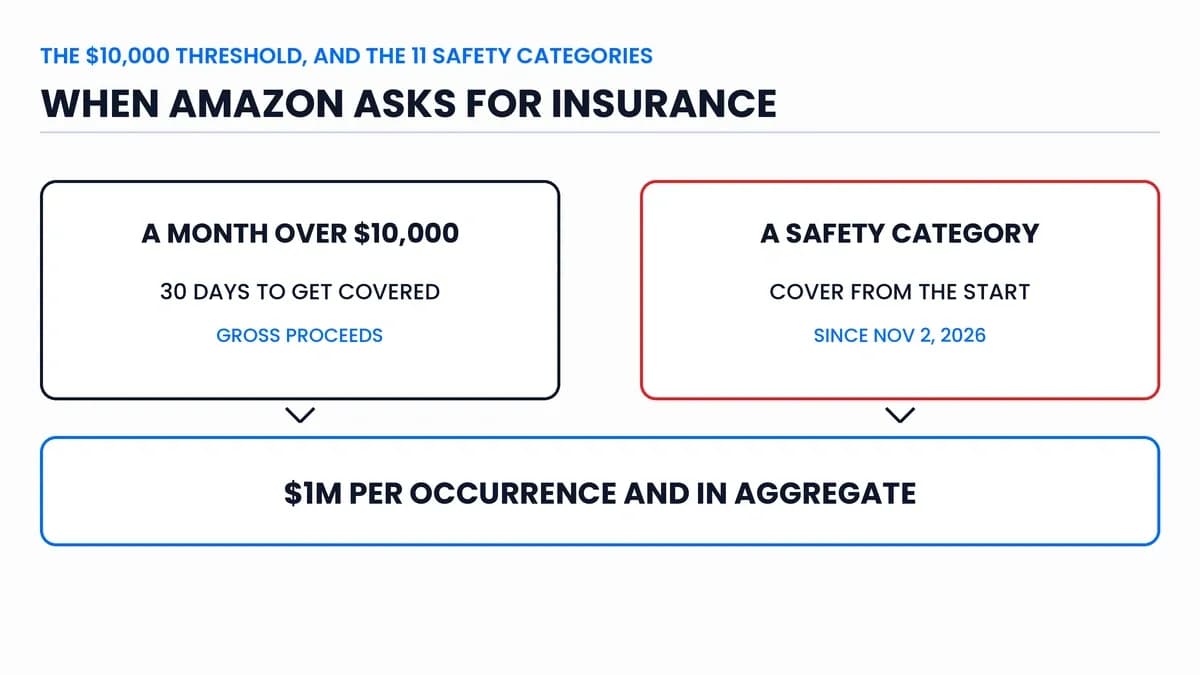
Amazon's seller insurance requirements start once your gross proceeds pass $10,000 in a month. From then, you have 30 days to carry commercial liability insurance of at least $1 million per occurrence. Since November 2, 2026, sellers in 11 safety categories need that cover from the start, however much they sell. A wholesale distributor may ask for a certificate of insurance too. One policy can cover both if it's set up right.
This is general information, not insurance advice. Talk to a licensed agent about your own policy.
What Insurance Does Amazon Require?
Amazon's terms sit in the Business Solutions Agreement, the contract you accept when you register. Amazon's help pages are behind the Seller Central login. So the wording below comes from Amazon staff posts on its own seller forums.
An Amazon staff post on commercial liability insurance requirements lays them out. You need cover "within 30 days after exceeding USD 10,000 in gross proceeds in sales in one month on Amazon.com." Then the policy has to meet these terms:
- Type. It "can be either commercial general, umbrella, or excess liability and be occurrence based."
- Limit. "The policy limit must be at least USD 1 million per occurrence and in aggregate."
- Additional insured. The policy must name "Amazon.com Services LLC and its affiliates and assignees" as additional insureds.
- Insurer. It needs "a financial rating of S&P A- and/or AM Best A- or better."
- Deductible. "The deductible for any policy(ies) must not be greater than $10,000."
- Scope. "The policy must cover all sales from products you have listed on the Amazon.com store."
A second staff post on the Amazon Canada seller forums repeats those terms and adds one more. "Your insurance provider must give Amazon at least 30 days' notice of cancellation, modification, or nonrenewal."
Two terms in that list need explanation. Occurrence-based means the policy covers an incident that happens while it's active, even if the claim comes in later. Additional insured means Amazon gets protection under your policy for claims tied to your products. Your agent adds it with a short change to the policy, called an endorsement.
The $10,000 Threshold, and How It's Counted
The trigger is gross proceeds, meaning your total sales on Amazon.com in a month. It isn't profit. A wholesale seller who sells $12,000 of product in a busy month has passed it, even if very little of that is profit.
It counts by month, so one strong December can be enough. Once you cross it, you have 30 days. You need a quote, an endorsement adding Amazon as additional insured, and a certificate to upload. That takes some back and forth with an insurer, so start early.
Amazon can also ask for proof before you reach $10,000. A seller posted an Amazon email on the US seller forums. It says cover is needed "once you reach $10,000 in gross proceeds in any month, or if requested by Amazon."
Does Amazon Require Insurance Before $10,000 Now?
For some products, yes. Amazon told sellers about the change in a September 3 notice. Sellers in enhanced safety categories need liability cover however much they sell, starting November 2, 2026. We couldn't link an Amazon page for it. So what follows comes from two trade publications that reported it.
PPC Land quotes the notice directly. Sellers in these categories "will now be required to maintain a commercial liability insurance policy that covers those products." That holds "regardless of whether they meet the USD 10,000 gross proceeds in a month threshold." My Amazon Guy reports that the rule "applies to listings already live as well as new ones." It also says sellers get "45 days to submit proof before their enhanced safety listings can be deactivated."
Both list the same 11 categories:
- General household devices, including small kitchen appliances
- Lithium battery products
- Personal safety equipment
- Transport-related products
- Sleep products
- Outdoor power and heating equipment
- Home medical devices
- Fire-related products
- Water and marine safety products
- Children's products
- Consumable and ingestible products
If you resell anything with a lithium battery, or anything for kids, the $10,000 threshold may no longer be the date that matters for you. The same reports cover a second rule. Sellers based in Mainland China now have to buy new policies through Amazon's Insurance Accelerator. Sellers elsewhere can still use any insurer that meets Amazon's terms.
How Much Does Amazon Seller Insurance Cost?
There's no single price. It depends on what you sell, how much you sell, and your claims history. Amazon doesn't publish rates.
Insureon, a broker, publishes figures from its own customers. For general liability, it says "annual policy costs range from around $250 to over $3,000 per year." That's for small businesses in general, not only Amazon sellers. Use it as a rough budget range, not a quote.
When you get quotes, ask about product liability. That's the part that pays if a product you sold hurts someone. Ask your agent whether the policy includes "products-completed operations" cover, or sells it separately.
If you're still setting a first-year budget, our post on how much money you need to start Amazon wholesale covers the other startup costs.
Amazon vs a Distributor: Same Policy, Different Terms
Amazon isn't the only one who might ask. Some wholesale distributors want a certificate of insurance before they open your account. The two sets of terms overlap.
Amazon | A distributor that asks for a COI | |
|---|---|---|
When | Within 30 days of a $10,000 month, or from the start in a safety category | At account setup, if their form asks |
Limit | $1M per occurrence and $1M aggregate | Whatever their form says |
Additional insured | Amazon.com Services LLC and its affiliates and assignees | The distributor, if the form asks |
Deductible | No more than $10,000 | Only if their form sets one |
Proof | Upload to Seller Central | A certificate emailed with your application |
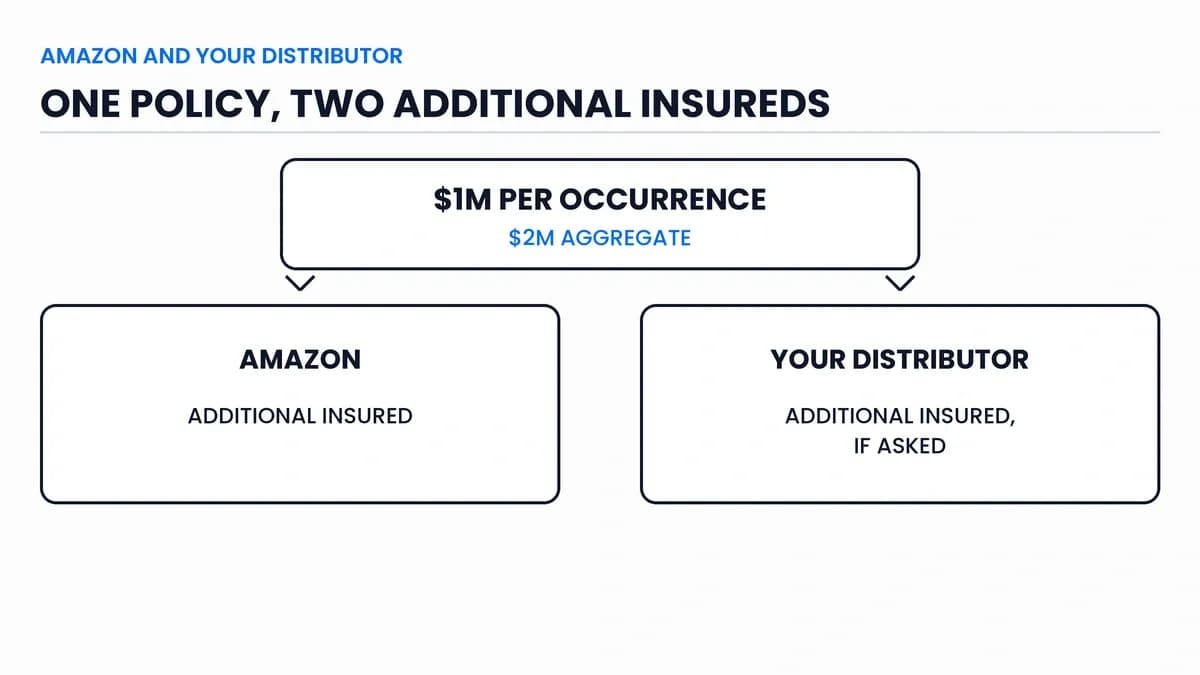
Insureon, the same broker, says most small business owners (85%) choose general liability policy limits of $1 million / $2 million. A $1M/$2M policy is above Amazon's $1M floor on both counts. Check each distributor's form to see if it meets theirs too.
So one policy can cover both, if it meets Amazon's deductible, insurer rating and scope terms. Amazon and each distributor who asks also need to be named as additional insured. Ask your agent to add each one. Or check whether your policy has a blanket additional insured endorsement that already covers them.
Our post on the Certificate of Insurance for Wholesale Accounts covers the distributor side in detail. Before you buy cover for a new account, search a product free. You'll see real cost and real stock from every verified distributor in our network that carries it.
How to Upload Proof of Insurance in Seller Central
Once your policy is active, you send Amazon the certificate. Amazon's own instructions are behind the login. Marsh, a broker that works with Amazon on its Insurance Accelerator, describes the step in its guide to Amazon's requirements. On the Business Insurance page in Seller Central, you click "Step 2: Upload Proof of Insurance." Marsh says "acceptable submission formats include.pdf,.doc, or.docx."
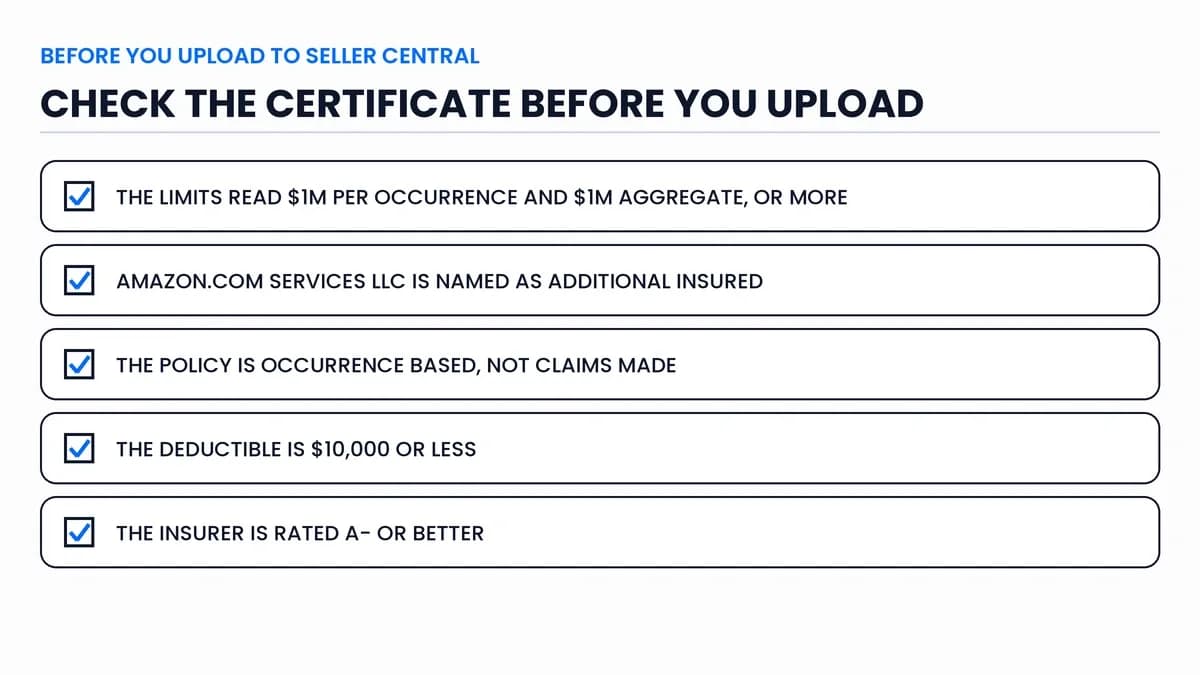
Before you upload, check the certificate against Amazon's list:
- The limits read at least $1 million per occurrence and $1 million aggregate.
- Amazon.com Services LLC and its affiliates and assignees are listed as additional insured.
- The deductible is shown and is $10,000 or less.
- The named insured matches the business on your seller account.
- The policy is occurrence based and covers all your Amazon products.
The fourth one isn't in the Amazon staff wording we could read. It comes from My Amazon Guy, a seller-service agency. Its list of policy terms includes "an insured name identical to the legal entity on the seller account." So a policy in your personal name won't match a seller account in an LLC's name. If you're still deciding how to set up the business, our post on Do You Need an LLC to Buy Wholesale? covers that choice.
The Insurance Accelerator, and Whether You Have to Use It
Amazon launched the Insurance Accelerator in 2021. Its announcement says the program helps "sellers buy insurance at competitive rates from trusted providers." It also says sellers "can continue to obtain insurance from any qualified insurance provider of their choice."
So unless you're based in Mainland China, the Accelerator is just one option. A local agent works too. An agent may suit you better if you also need cover a distributor will accept. Either way, make sure Amazon's terms are written into the policy.
Amazon Seller Insurance Requirements: The Takeaways
- Amazon requires $1 million per occurrence and in aggregate within 30 days of a month over $10,000 in gross proceeds.
- Since November 2, 2026, 11 safety categories need cover from the start, including lithium battery and children's products.
- The policy must name Amazon.com Services LLC as additional insured, with a deductible of $10,000 or less.
- A $1M/$2M policy is above Amazon's limit. Check each distributor's form for theirs.
- Make sure Amazon and each distributor who asks are covered as additional insured.
- You don't have to use the Insurance Accelerator unless you're based in Mainland China.
Get the Policy Before the Clock Starts
Amazon's seller insurance requirements count from the month you first cross $10,000, or the day you list in a safety category. Don't wait for Amazon's email. If you start after that, you have 30 days, or 45 for a safety listing, to get quotes, endorsements and a certificate in order.
So talk to an agent now if you expect to pass $10,000 this Q4, or if you sell batteries or kids' products. Set the policy up once, with Amazon and your distributors on it. Then you won't be doing it twice. If you're still early, our Amazon wholesale for beginners roadmap covers the setup steps around this one. When you're ready to add accounts, open a free account and compare distributors before you apply. If a product you want has no distributor in our network, you can Request a Supplier and our team will look for one.
Frequently asked questions
01Do I need insurance to sell on Amazon?
02What insurance does Amazon require?
03How much does Amazon seller insurance cost?
The B2B SupplierHub Team
Wholesale & sourcing
Stop hunting suppliers by hand. Type a UPC instead.
B2B Supplier Hub shows the suppliers in our network carrying a product on one page: wholesale cost, stock, and retail price side by side. Free to search, no card required.