
Wholesale Economics
Do You Need an LLC to Buy Wholesale?
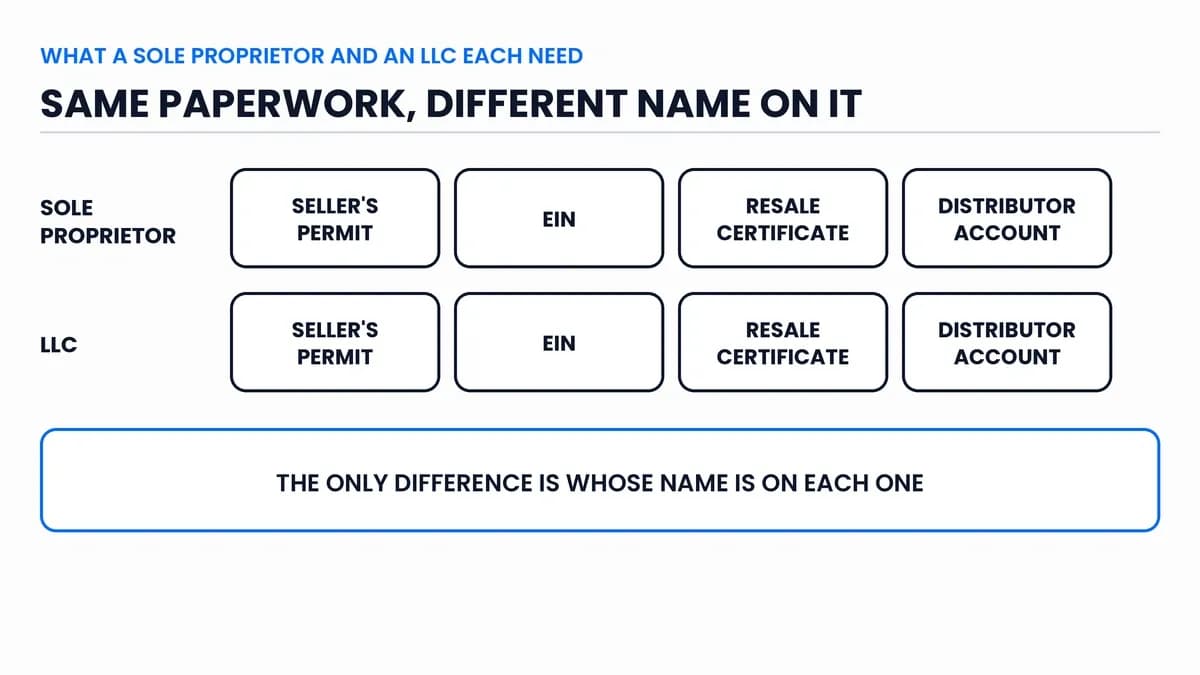
No. You don't need an LLC to buy wholesale. The states we checked give the seller's permit to sole proprietors, and that permit is what a resale certificate needs. The distributor credit applications we've read also list "sole proprietor" as a business type. An LLC changes what happens to your personal assets if something goes wrong. It doesn't decide whether a distributor approves you.
So the better question is when an LLC is worth having. And what it costs if you set one up later instead of now. The law itself is the easy part, so start there.
What the Law Asks For, and What It Doesn't
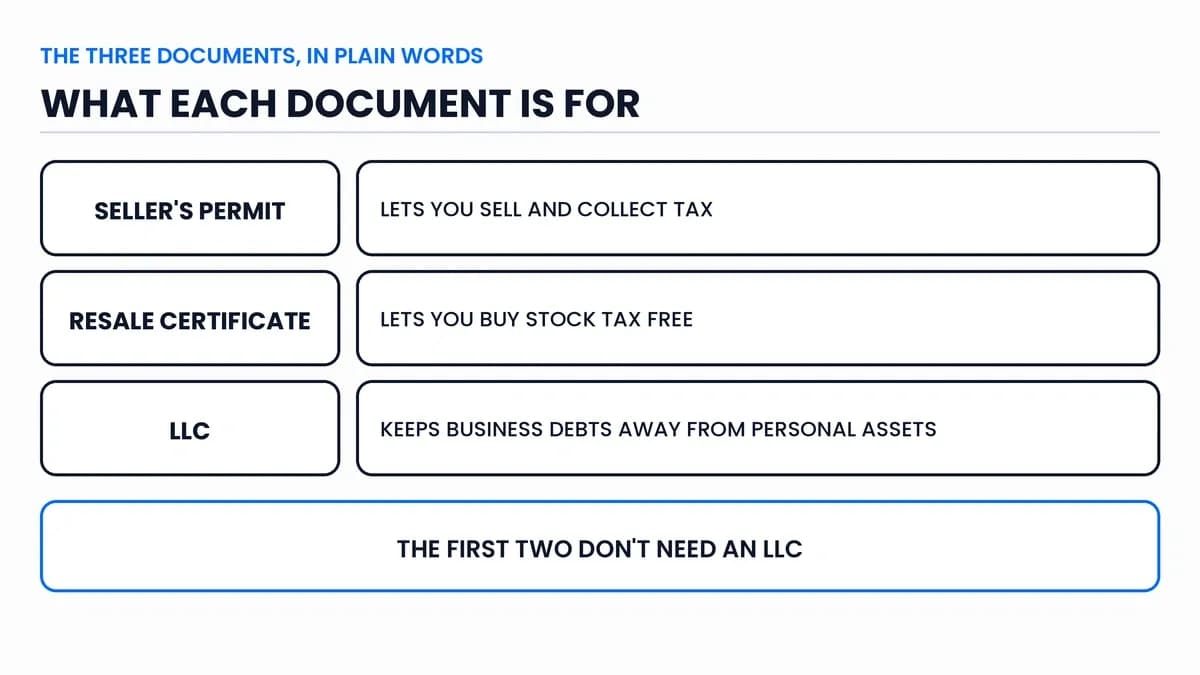
To sell to you tax free, a distributor needs a resale certificate from you. To fill one in, you need a seller's permit from your state. Some states call it a sales tax registration. Our post on whether you need a wholesale license to buy wholesale walks through each of those documents.
None of them asks for an LLC. Texas says in its permit FAQ that you need a permit if you're "an individual, partnership, corporation or other legal entity" doing business there. Its permit application asks a sole owner for their "Social Security number." California's seller's permit FAQ is just as clear. The rule "applies to individuals as well as corporations, partnerships, and limited liability companies." Neither state charges a fee for the permit itself.
A federal tax ID works the same way. The IRS defines a sole proprietor as "someone who owns an unincorporated business by themselves." That's you, if you trade alone and haven't formed a company. You may not need an EIN for federal taxes. Even so, the IRS EIN page says "you can still request one for banking or state tax purposes." It's free, and it takes minutes online. Our post on EIN versus resale certificate explains which one distributors actually ask for.
Can You Buy Wholesale as a Sole Proprietor?
Yes. The distributor forms we've read are built with sole proprietors in mind.
We read four real distributor credit applications for our post on what a wholesale credit application asks for. They ask for your business type: LLC, corporation, partnership or sole proprietor. If sole proprietor is a box on the form, the distributor expects applications from them.
The forms do ask a sole proprietor for different things, though. As a sole proprietor, you are the business. So the forms ask about you personally. You may need to give your home address, and some forms ask for your Social Security number. Your personal credit may be checked too.
The bank account matters as well. A business checking account in your trading name looks like a business. A personal account looks like someone shopping for themselves.
Amazon is the same. Its registration guide says it plainly: "You don't need to be an LLC or registered business, or be otherwise incorporated, to sell in the Amazon store." You pick "None, I am an individual" as your business type. Then you register with your ID and a bank account in your name.
What an LLC Actually Changes
An LLC won't get you approved. Its main job is to keep the business's debts away from your personal assets.
The SBA's guide to business structures explains the difference. A sole proprietorship isn't a separate business. In the SBA's words, "your business assets and liabilities are not separate from your personal assets and liabilities." So "you can be held personally liable for the debts and obligations of the business." An LLC, on the other hand, protects you "from personal liability in most instances."
That protection is real. But in wholesale, two things make it smaller.
The first is the personal guarantee. Three of the four credit applications we read asked the owner to sign one. When you sign it, you promise to pay that distributor yourself if the business doesn't. So for that account, your LLC no longer protects you. As long as an account carries a guarantee, the LLC does little to shield you from that supplier's bill.
The second is product liability. If a product you sold hurts someone, a claim could come to you as the seller. An LLC may keep that claim away from your house. Insurance is what pays it. Some distributors ask for a certificate of insurance anyway, and Amazon requires cover once your sales pass a set level. Our post on Certificate of Insurance for Wholesale Accounts covers what distributors ask for.
Taxes are a separate question. The SBA's comparison table lists "self-employment tax" and "personal tax" for a sole proprietorship. For an LLC it lists the same self-employment tax, and "personal tax or corporate tax." Which one fits you is a question for an accountant. It isn't a reason to form an LLC on day one.
What an LLC Costs
You form an LLC by filing with your state, and each state sets its own fee.
The fees vary a lot. Kentucky's filing fee schedule lists Articles of Organization at "$40.00." Texas charges $300 for a certificate of formation, according to its fee schedule. Massachusetts charges $500 to file. Its LLC filing page adds that "the filing fee for an annual report is five hundred dollars ($500.00)."
That yearly fee is easy to miss. Some states charge every year to keep an LLC active, so it's not a one-time cost. Before you decide, check your state's Secretary of State page. Look for the annual report fee as well as the filing fee.
The Real Cost Is Switching Later
The filing fee is the small cost. For a wholesale reseller, the bigger cost is changing everything over later.
Every document in your setup carries your legal name and number. That includes your seller's permit, your EIN, your resale certificates and your bank account. It includes each distributor account and your Amazon account too. If you start as a sole proprietor and form an LLC a year later, the LLC is a new legal business. Each of those has to change.
Texas spells this out. Its permit FAQ says that if a sole proprietor decides to incorporate, "the corporation will have to obtain a new permit." It treats forming an LLC the same way, as a change in ownership. Check your own state's rule. If it works like Texas, switching means a new state registration and possibly a new EIN for the LLC. It also means new resale certificates for each distributor, and new details on each account.
Amazon is where this can hurt. A name that doesn't match your Seller Central account is one of the seven reasons we cover in why Amazon rejects invoices. If your distributors bill the LLC and Amazon still shows your personal name, that's a mismatch you created.
None of these jobs is hard. There are just a lot of them, all at once, while you're trying to keep stock moving. So it helps to know what a supplier will charge you before you start any of it. You can search a product free and see real cost and real stock from the verified distributors in our network that carry it.
So Which Should You Start With?
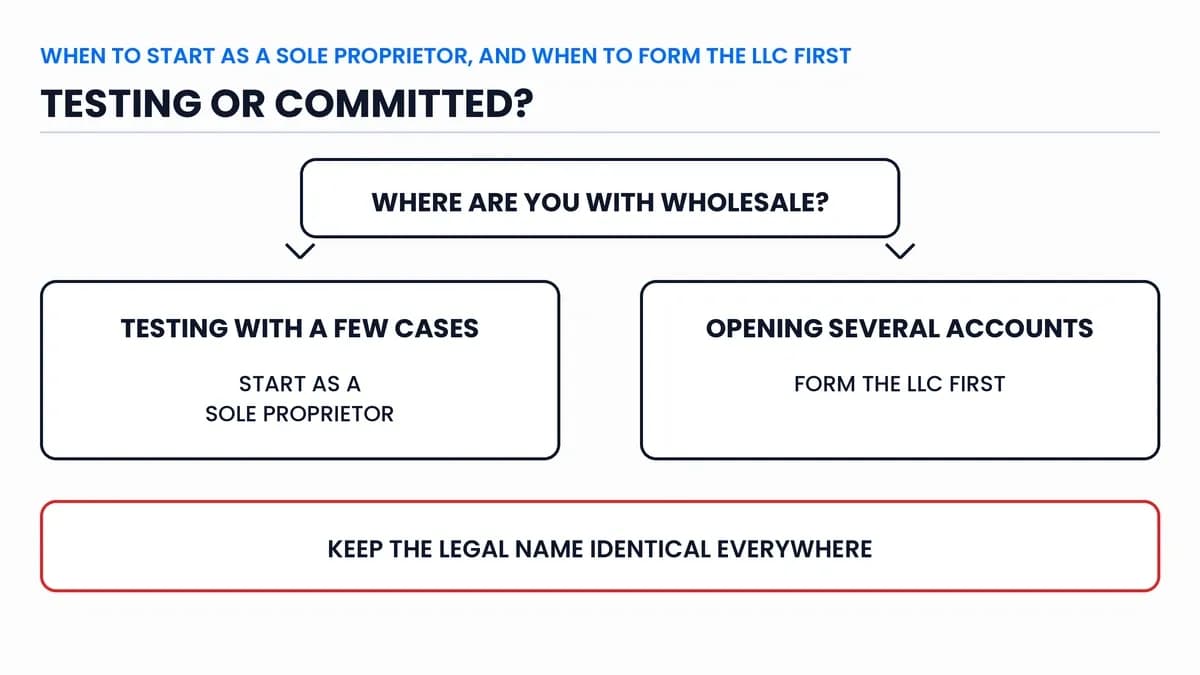
The answer depends on how sure you are about wholesale. Start as a sole proprietor if you're testing. Maybe you're buying a few cases to see if wholesale works for you. The paperwork is lighter and the cost is lower. And you can stop without having to close a company.
If you already know you'll open several distributor accounts and sell on Amazon, form the LLC first. Set it up before any of those accounts. Register it with the state, get its EIN and open its bank account. Then apply everywhere in its name. That way you do the paperwork once, not twice. Either way, use the same name everywhere. Don't put a trading name on one form and your legal name on another. And don't give a personal bank account where a business one should be. Our guide to what distributors look for before approving a seller covers the rest of what they check.
Do You Need a Business to Buy Wholesale at All?
To buy from a distributor for resale, you need a seller's permit and a resale certificate. In that sense, yes, you need a business. But it doesn't have to be an LLC. It can be you, registered as a sole proprietor.
You can't use a resale certificate to buy things for yourself, though. It only covers stock you'll sell. Georgia's resale form says so in capitals: tax-free treatment "does not extend to any purchase to be used by the purchaser." Washington's reseller permit page says anyone who misuses a permit "will owe the tax due and a 50% penalty." That applies even if there was no fraud intended. So a resale certificate won't get you tax-free shopping for yourself.
Sometimes the paperwork is fine, but nobody you can reach carries the product. When that happens, you can ask our team to find an authorized wholesale distributor for it. It's free on every plan, with an answer within 30 days either way.
Do You Need an LLC to Buy Wholesale? The Takeaways
- No state permit or resale certificate we checked requires an LLC. Texas and California both register individuals.
- The distributor credit applications we read list sole proprietor as a business type.
- Amazon says you don't need an LLC to sell.
- An LLC protects personal assets "in most instances." But if you sign a personal guarantee, it doesn't protect you on that account.
- Insurance pays product liability claims. Your business structure doesn't.
- In the states we checked, LLC filing fees ran from $40 to $500, and some states add a yearly fee.
- The biggest cost is switching later, because every permit, certificate and account carries your legal name.
Start With the Name You'll Keep
You don't need an LLC to buy wholesale. You need a state registration, a resale certificate and a bank account, all in the same name. Whether that name is yours or an LLC's is a choice about liability and cost. It has nothing to do with approval.
That name ends up on every permit, certificate and account you open. So pick the structure you expect to keep. Set it up once, and apply everywhere in that name. You can open a free account and see real cost and real stock from the verified distributors in our network. Do it before you open a single wholesale account.
Note: This is general information, not legal or tax advice. Business structure affects liability and taxes, and for your situation you should talk to an accountant or lawyer.
Frequently asked questions
01Can a normal person buy from a wholesaler?
02Do I need an LLC to start wholesaling?
03Is it worth getting a wholesale license?
04Is it illegal to order wholesale for personal use?
The B2B SupplierHub Team
Wholesale & sourcing
Stop hunting suppliers by hand. Type a UPC instead.
B2B Supplier Hub shows the suppliers in our network carrying a product on one page: wholesale cost, stock, and retail price side by side. Free to search, no card required.