You can't look up who supplies a competitor. There's no record of it. A US distributor selling to a US reseller doesn't get filed anywhere, so no tool, paid or free, can show you that name. Most guides skip past this and send you to their storefront anyway.
What you can do is more useful. You can tell whether a competitor even has a repeat supplier, which brands they buy the most of, and whether those brands let new sellers in. And there's one direct step that gets you distributor names. This post covers each of those, in the order you'd actually do them.
Step 1: Read the Listing Before You Research (Stock Patterns)
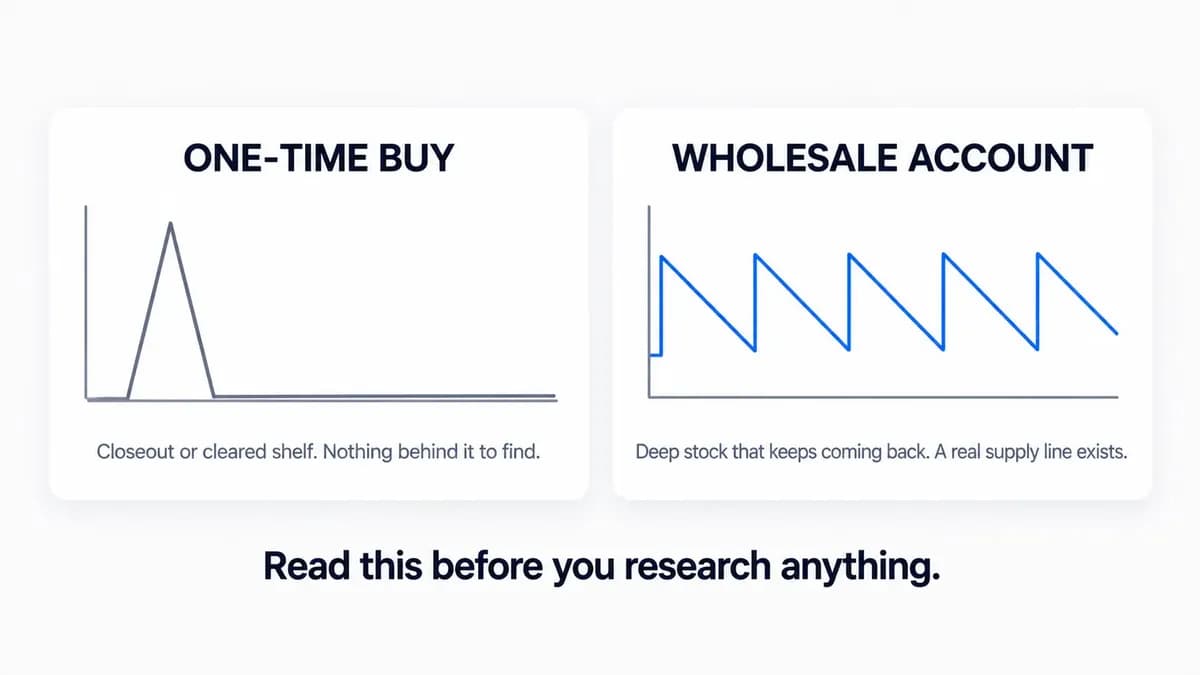
Before you open any tool, look at how the competitor holds stock. A lot of research time gets wasted on products that never had a regular supplier in the first place.
That second pattern is the one you want. If their stock comes back every few weeks, they have a wholesale account.
Frequently asked questions
Is it legal to find out who supplies your competitor?
Yes, when you work from public information. Reading storefronts, seller profiles, and public records is normal business research, and a reseller who sells genuine product they bought lawfully is protected by the first-sale doctrine. You cross the line when you pretend to be someone else to a distributor, misrepresent yourself to a brand, or set up fake buyer accounts.
Does Amazon show who a seller buys from?
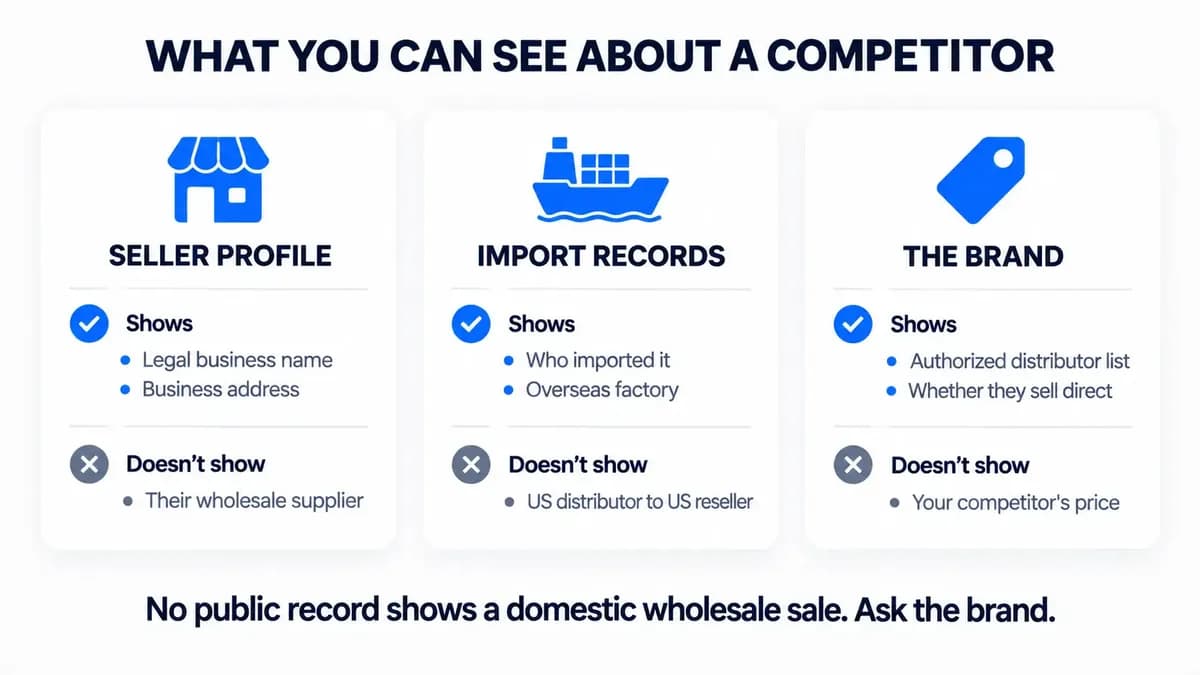
It shows who the seller is. Under the INFORM Consumers Act, sellers above the revenue threshold have their name and business address on their profile. Their wholesale source isn't shown anywhere.
Can import records show a competitor's US distributor?
No. Public import data covers ocean shipments into the US and names the company that imported them. A distributor selling to a reseller inside the US leaves no record in that data.
TB
The B2B SupplierHub Team
Wholesale & sourcing
Stop hunting suppliers by hand. Type a UPC instead.
B2B Supplier Hub shows the suppliers in our network carrying a product on one page: wholesale cost, stock, and retail price side by side. Free to search, no card required.
Next, count how many sellers are on the listing. Look at the past year, not just today.
As a rough rule, 6 or more steady sellers all have real stock usually means a few authorized distributors carry the product, and you can probably get in. If there are only two or three sellers and one of them has led for a year, supply is tight. If it's one seller plus the brand, it's most likely closed. Our post onbrands that restrict Amazon resellers explains what that looks like.
If you're already on the listing, our freeChrome extension shows how many distributors in our network carry that product and the lowest wholesale cost. It takes a few seconds and tells you if the rest of this is worth doing.
Sort it by brand and ask which three or four brands they restock the hardest. Those are their real accounts. Everything else is a test buy, a leftover, or a one-off deal.
Then look at how concentrated they are. A seller who's deep in one category usually doesn't have thirty brand relationships. They have two or three broadline distributor accounts that carry the whole category. That changes what you're looking for. You aren't hunting for a supplier per brand. You're hunting for a distributor that carries the category.
What the storefront can't tell you is where the stock came from. A distributor account, a brand-direct account, and a pallet of diverted closeouts all look the same on a listing page. The depth read in Step 1 narrows it down. Nothing on the page confirms it. We covered the single-listing version of this in how to find who supplies an Amazon product.
Step 3: Can Public Records Reveal a Competitor's Supplier?
Here's where most guides go vague, so let's be exact. Imports leave a public trail, because ocean shipments into the US get filed with Customs. A wholesale sale between two US companies doesn't get filed anywhere. That one difference explains everything below.
So you get the real company behind a storefront nickname, plus an address. A warehouse address tells you one thing about the operation. A home address tells you another. Neither one tells you their supplier.
If you need to identify the company behind a product itself, the barcode prefix and trademark records are the right tools, and we walked them through how to find the manufacturer of a product.
Step 4: Ask the Brand (the Step That Gets Names)
After all of that, here's the one move that reliably gets you distributor names. Ask the brand.
Nobody knows a brand's authorized distributor list better than the brand, and a short, professional request gets answered more often than most sellers expect. Say who you are: your legal business name, how long you've been trading, where you sell. Ask for their authorized distributors in your region, or whether they sell direct. Show what you bring, meaning your account health, the volume you can commit to, and a plain statement that you follow their pricing rules. Don't ask for a price list in the first email, and don't hint that you plan to compete on price.
This question matters more now than it did two years ago. Getting authorized used to be an invoice problem. It's turning into a list problem. Brands enrolled in Brand Registry can add outside sellers as authorized sources by giving them a Reseller role, tied to a formal selling agreement. Once a brand keeps a list like that, the useful question is no longer "who supplies my competitor." It's "what gets me onto the list." That's a different conversation with different people.
Sometimes the brand writes back and says the list is closed. That's a fine outcome. An honest no in a few days beats weeks of applications that go nowhere. That's the whole idea behind reverse sourcing: start from the product that already sells and work back to a source you can actually use.
Step 5: Why Their Cost Isn't Your Cost
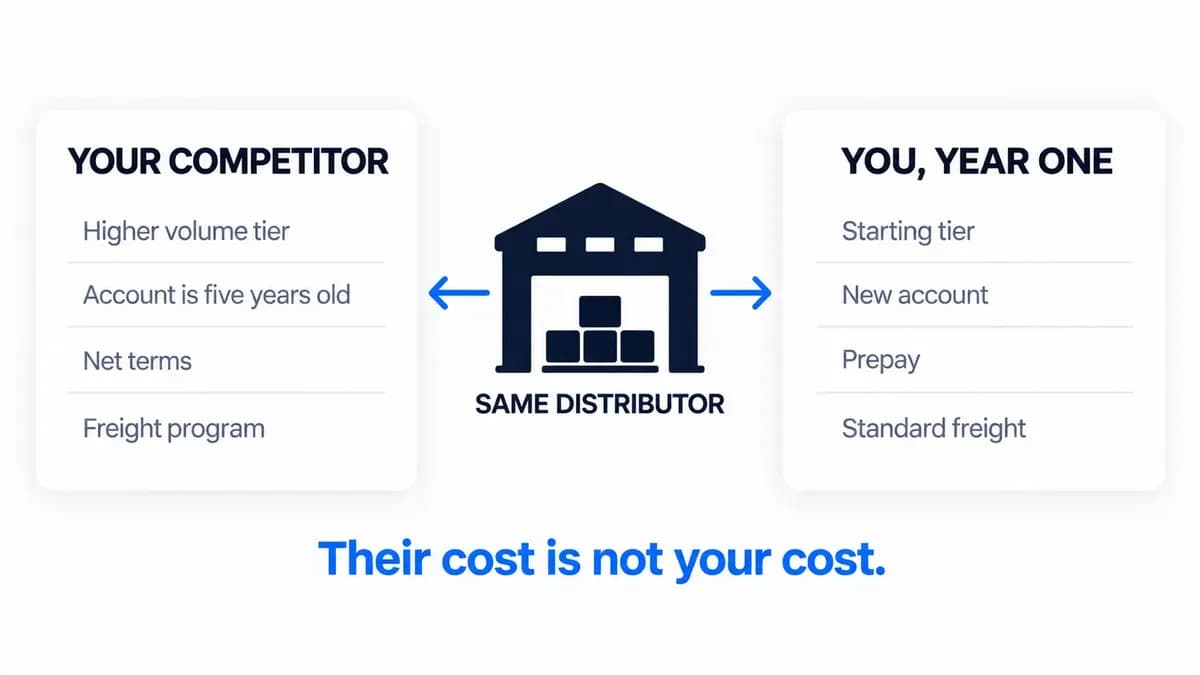
Say you do all of this and land on the exact distributor your competitor uses. You'll still get a different number. They're on a higher volume tier. Their account is five years old. They have net terms and a freight program you don't have yet. You're buying from the same building at a different price.
So finding their supplier was never the goal worth chasing. The goal is an authorized source where the numbers work at your volume. And that's a comparison job, not detective work.
It's the part we built B2B Supplier Hub for. Search a product free by UPC, name, or MPN and you'll see the real cost and real stock from every verified distributor in our network that carries it, with a freshness timestamp on every listing. Retail Insights sits on the same page and shows the retail price, sales rank, how many sellers you'd compete with, and what you'd actually make after selling fees. The supplier's name costs a credit when you decide to connect, and once you unlock a supplier they're yours for good, even if you cancel.
Some products are dead ends: a brand gated with no approval path, or a single importer with a closed circle of sub-distributors. Finding that out in an afternoon beats finding it out in week three.
Aim for Your Own Source, Not Theirs
A year from now, someone is going to be looking at your listing and wondering the same thing about you. They'll be able to see your legal name, your address, the brands you lean on, and how deep you buy them. They still won't see your distributor, because nothing publishes that. What they'll see is a reseller who found a source where the numbers worked and kept buying.
That's the position to aim for. Not their supplier, but a source of your own.
If the product you're after isn't in B2B Supplier Hub catalog yet, submit a request and our team will find an authorized distributor who carries it, verify them, and bring them onto the platform. It's free on every plan, and you get an answer within 30 days, either way.
What if the distributor won't sell to me?
It happens, and it's usually about volume tiers, account age, or a brand-controlled list rather than anything you did. The practical move is a second authorized source for the same product, which is exactly what comparing before you apply is for.