
Sourcing
How to Get Brand Approval on Amazon: The Reseller Path (2026)
-1200x627.webp&w=3840&q=75)
Ask ten sellers how to get approved for a brand and you'll hear the same answer ten times: buy ten units from a distributor, submit the invoice, wait a few days. And for most brands, that's genuinely all it takes. We cover that standard path in our guide to getting ungated on Amazon.
Then you meet the other kind. The invoice is real, the distributor is authorized, and the application still comes back rejected. Or there's no application at all. Nothing the usual advice taught you explains what's happening, because the decision isn't only Amazon's anymore. The brand is in the room.
This guide is for those brands. The path looks different: less paperwork, more relationship, and four steps that only work in one order.
First, Which Gate Are You Facing?
Start by figuring out which version of the problem you actually have, because the fixes are completely different.
Open the application screen and read what Amazon is asking for. If it wants purchase invoices and nothing else, you're on the standard path, and the ungating guide above walks you through it. But if the screen asks for authorization from the brand, or your genuine invoices keep bouncing for no clear reason, or there's no way to apply at all, then the brand itself has a say in who sells its products. Some brands keep lists of sellers they've approved. Some want to sign off on every new seller personally. And some have decided they don't want new sellers at all.
While you're checking, look at a few products from the brand rather than just one, since brands are often gated selectively. Our guide on how to check if a brand is gated shows the free one-minute method.
If you've confirmed you're facing the harder version, the next four steps are the way through.
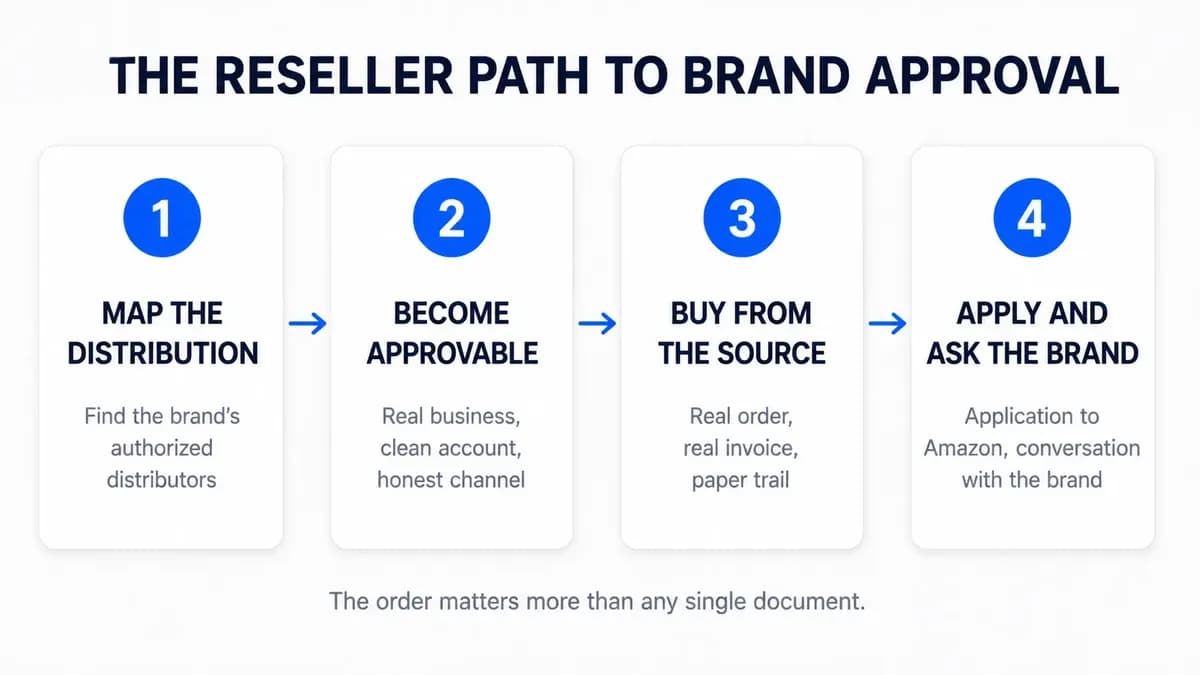
Step 1: Map the Brand's Distribution Before You Spend Anything
Most sellers do this backwards. They find someone selling the product at a good price, buy inventory, and then discover the approval wall after the money is spent, when their options have already shrunk.
So begin with a question instead of a purchase: how does this brand move its products? Every brand has a distribution map. The brand sells to a set of authorized distributors, those distributors sell to approved resellers, and everyone outside that chain is just someone who happens to have the product. Approval only ever comes from inside the map, which means your first job is finding out where the inside is. We wrote a full guide on how to find the authorized distributors for any brand, and it's the natural place to start.
What you find will vary a lot by category. Some brands have a deep bench of authorized distributors, while others run their whole program through a handful, and that difference tells you something before you spend a dollar. Many distributors means several doors to knock on. Two barely gives you any, and knowing which situation you're in is the whole point of doing this step first.
Step 2: Become the Account Brands Say Yes To
This is the part most guides skip entirely, and it explains more rejections than any invoice error. Brands and distributors don't really approve applications. They approve businesses, and somewhere in the process a person decides whether yours looks like an account worth having.
The good news is that most of what they check is within your control. They want to see a real business entity rather than a personal name, a resale certificate in order, an Amazon account with clean health and some history behind it, and a straight answer to the question every distributor eventually asks: where do you plan to sell this?
That last one matters more than sellers think. It's tempting to be vague about the Amazon part, but distributors approve on behalf of the brands they carry, and a seller who hides their channel usually gets found out and dropped. We covered what distributors look for before approving an Amazon seller in detail, and it's worth reading before your first application, because a first impression with a distributor is hard to redo.
There's also a quieter advantage in this step, which is time. One clean order can satisfy Amazon's application, but months of order history is what makes the brand itself say yes. Those run on different clocks, and the second one only starts counting the day you become a customer.
Step 3: Buy From the Authorized Source and Build the Paper Trail
Once a distributor on the authorized side has approved you, place a real order. That purchase does two jobs at the same time: it's inventory you'll sell once approved, and it creates the document that proves your supply chain, an invoice from a source Amazon can trace back to the brand.
The invoice has to pass some strict checks, and in 2026 most of them are run by software before a human ever looks at your file. We broke down the full invoice requirements and what actually passes separately, but the short version is that it needs to be recent, itemized, show ten or more units, and carry your business name exactly as it appears in Seller Central.
For some brands, the invoice is only half the package. The other half is a letter of authorization, which is a document from the brand itself saying you're allowed to sell its products on Amazon. Your distributor can't write this one no matter how official their letterhead looks, because they don't own the trademark, and only the trademark owner can grant permission to use it. We explained the whole document in our guide to the brand letter of authorization, including who can issue it and how resellers actually get one.
Most applications won't need both documents. But an invoice from the authorized side plus a letter from the brand is the strongest package a reseller can hold, and the brands worth building a business on are often exactly the ones that ask for it.
Step 4: Apply, and Ask the Brand in Parallel
With the paper trail in place, submit the application through Seller Central the normal way.
Then do the thing most sellers never think to do: while the application sits in review, talk to the brand directly. Some brands, including big ones, hand Amazon a list of sellers they've approved, and if the brand runs one, no invoice gets you past it from the outside. The only way onto that list is asking to be on it. Since you're already a customer of one of their authorized distributors by this point, that conversation starts warm instead of cold. Introduce your business, say plainly where you sell, and ask what their process is for approving Amazon sellers.
If there was no application option at all, this conversation stops being the parallel track and becomes the only track. Closed listings usually open from the brand's side rather than yours, and you'll know it worked when the brand tells you you're cleared, or when the listing quietly becomes available to your account.
Either way, the two efforts feed each other. The application proves your supply chain to Amazon while the conversation gets you known by the brand, and each one makes the other more likely to land.
Whitelists, Second Gates, and Dead Ends
There are a few walls in brand approval that paperwork can't climb, and it's better to know about them now than to discover them with money on the shelf.
Whitelists
When a brand gives Amazon a list of approved sellers, that list decides everything, and a perfect invoice changes nothing if you're not on it. The frustrating part is that the rejection won't tell you a whitelist is the reason. What it looks like from your side is genuine invoices from genuinely authorized distributors getting rejected again and again with no clear cause. When you see that pattern, stop improving your paperwork, because paperwork was never the problem. Go back to the Step 4 conversation with the brand, or accept that this brand is closed to you for now.
Second Gates
Sellers report getting approved, listing, and then hitting another wall when the same brand asks for more, sometimes invoices showing far larger quantities than the first application required. It feels like moving goalposts, and honestly, sometimes it is. Amazon doesn't publish its criteria, and approval at one level doesn't promise the next. The practical protection is in how you buy: don't bet a huge first order on an approval that might have another gate hiding behind it.
Dead Ends
Some brands are simply not open to new third-party sellers, and no invoice, letter, or application will change that. Nobody will tell you directly either. You have to read the pattern yourself: almost no distributors willing to take new accounts for the brand, every approach ignored, clean paperwork rejected without explanation. Learning to recognize that after two attempts instead of ten is worth real money, and there are always other brands. The ones that actually want resellers tend to be better business anyway.
Rejected? The 3 Problems and Their Fixes
A rejection is one of three problems, and each has a different fix.
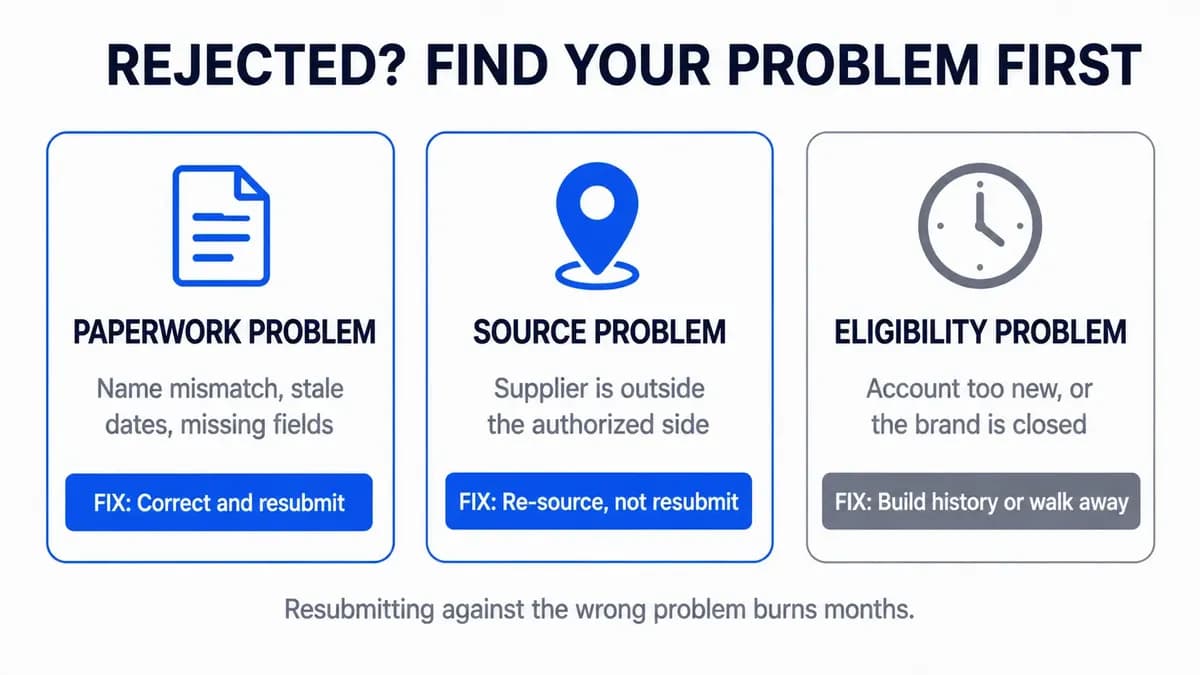
A paperwork problem.
Name mismatch, stale dates, missing fields. This is the easy one, fixable in days, and the invoice requirements guide covers what passes and how to escalate when a good invoice bounces.
A source problem.
Your supplier isn't on the authorized side of the brand's map, which means no version of their invoice will ever pass. Resubmitting won't help here. The fix is going back to Step 1 and finding a supplier on the right side of the map.
An eligibility problem.
Your account is too new, or the brand is closed. No document fixes this one, so the real choice is between building account history and trying again later or putting your energy into a brand you can actually reach.
The reason this matter is simple: resubmitting the same package against the wrong problem is how sellers lose months without getting an inch closer.
The Real Shape of Brand Approval
Strip away the screens and the paperwork, and brand approval comes down to something almost old-fashioned. Amazon approves supply chains, but brands approve people. The invoice handles the first part. Nothing handles the second part except being a business the brand is glad to have selling its products.
That's why the order of these steps matters more than any single document inside them. Sellers who map the distribution first, become real customers second, and apply third walk through gates that stop everyone who did it in reverse. The approval was never really about the application. It was about everything you did before it.
Frequently asked questions
01What's the difference between brand approval and ungating?
02Why was I approved for the category but not the brand?
03Do I need the brand's permission to sell its products on Amazon?
The B2B SupplierHub Team
Wholesale & sourcing
Stop hunting suppliers by hand. Type a UPC instead.
B2B Supplier Hub shows the suppliers in our network carrying a product on one page: wholesale cost, stock, and retail price side by side. Free to search, no card required.