
Supplier Management
Supplier Concentration Risk: Is One Distributor Too Much?
You probably know which distributor you buy the most from. But do you know how many of your best-selling products come from that one company? Most resellers have never checked.
And most find out the hard way. The distributor closes your account, or raises prices, or runs out of a product you sell every day. By then you know the number, but it is too late to fix it.
This post shows you how to check. You need two numbers from your own records, which takes about an afternoon, and one simple test that tells you if those numbers are safe. You do not need anyone else's percentage. If you want the bigger picture on why relying on one supplier goes wrong, read why single-supplier dependency kills wholesale businesses first. This post takes it from there and shows you how to work out your own number.
Why the 10% Vendor Concentration Rule Doesn't Fit Resellers
If you search "supplier concentration risk," most of the results are written for finance teams at big companies. They usually give a rule like this: if one supplier is more than 10% of what you spend, keep an eye on it. If it goes past 20%, make a backup plan. These numbers are just rules of thumb. We could not find any study behind them.
They also assume something that is not true for a wholesale reseller. They assume that if you lose a supplier, you can find a new one in a few days.
You can't. You have to find a distributor, apply, send your resale certificate and business details, and wait. A few weeks is normal. Sometimes it takes longer. And after all that, they can still say no. That waiting period is the approval wall, and it is why the 10% rule does not work for you.
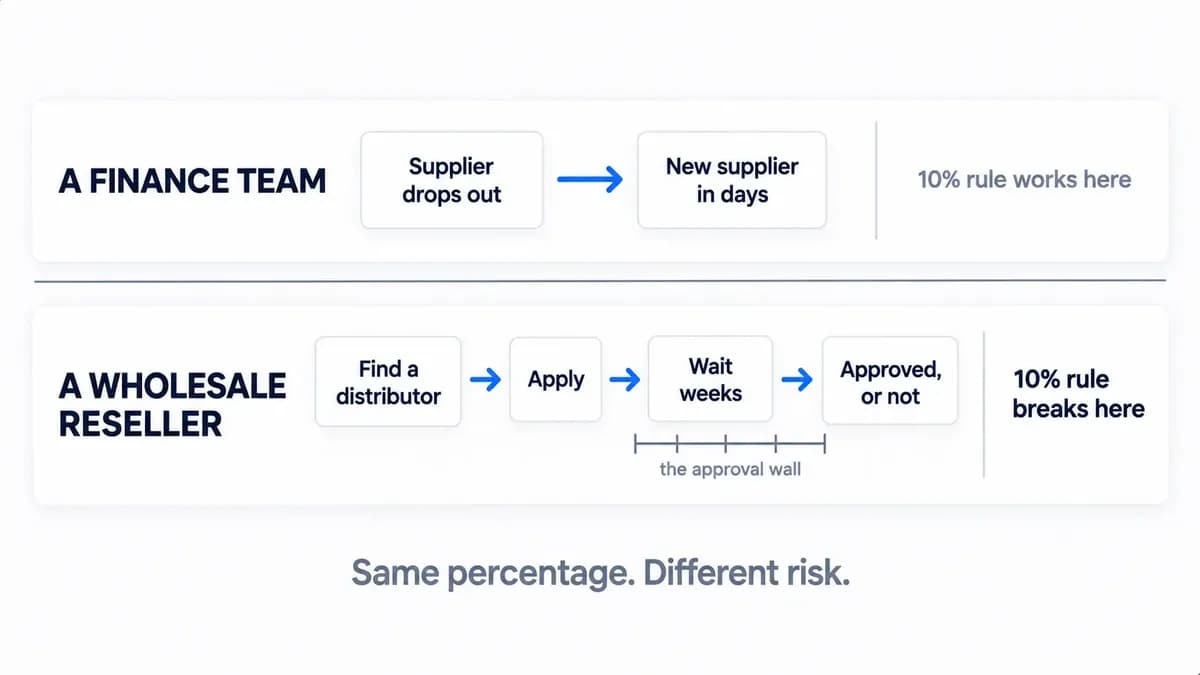
So this post uses a different rule. Concentration risk is how much you buy from one distributor, weighed against how long it would take to replace them. A big share you could replace in a week is a small risk. A small share you could not replace for two months might be a large one.
How to Calculate Your Supplier Dependency Percentage: The 2 Numbers
For each distributor you buy from, you need two numbers. Both come from your own purchase and sales records.
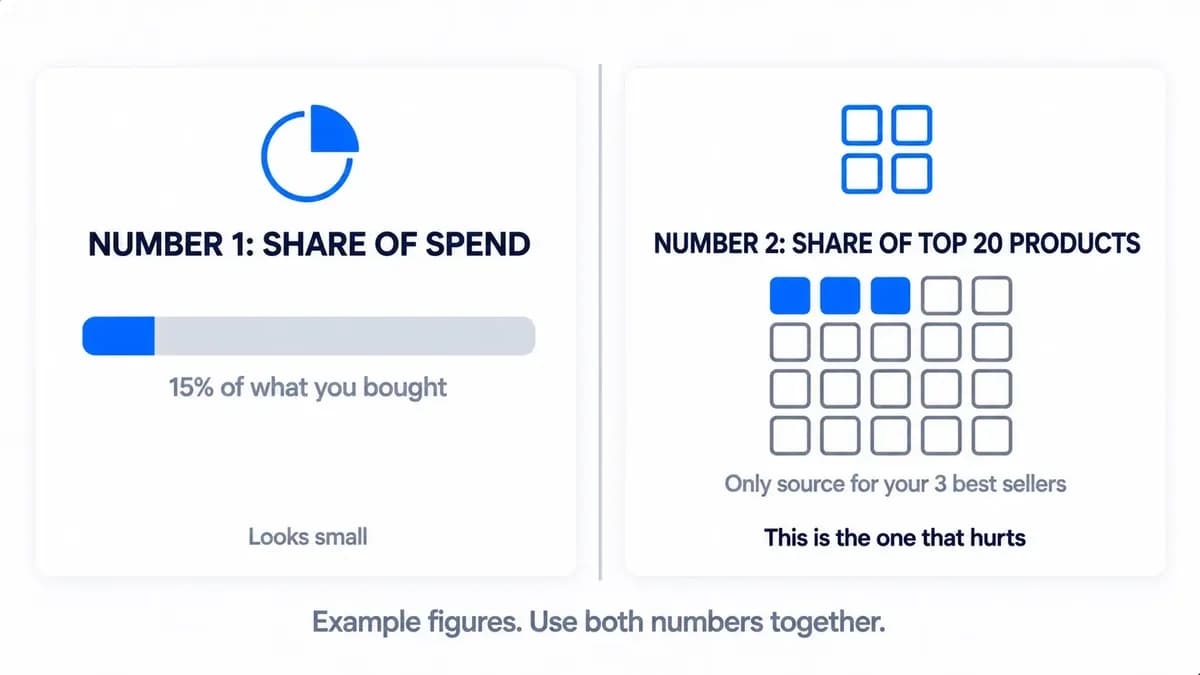
The first number is how much of your total buying goes to them. Add up everything you bought in the last twelve months. Then work out what share came from each distributor. If two of your accounts are actually the same company under different names, count them as one. This is the number most people look at, but on its own it does not tell you much.
The second number is how many of your best sellers come from them. List your top twenty products by units sold. Next to each one, write down which distributor supplies it. Then count how many of the twenty come from each distributor.
The second number is where the surprises are. A distributor might be only 15% of your spending but still be the only supplier for your three best products. They look small on paper. But if they stop shipping, your best products stop selling.
If you sell on Amazon, you have to consider whether your next ungating application will rely on invoices from a single distributor. It is not a supply problem in the usual sense, but it is still a dependency.
None of this means concentration is always wrong. Buying a lot from one distributor can earn you a better price tier, or first call on stock when it runs short. Our post on dual sourcing versus single sourcing covers when that trade is worth making and when it isn't.
The Cover vs Replace Test: Weeks of Stock Against Weeks to Approve
Here is the test. For each distributor, put two figures side by side.
One is how many weeks of stock you hold for the products they supply. The other is your best estimate of how many weeks it would take to have a replacement distributor approved and shipping. Use the realistic figure, not the hopeful one.
If your cover is shorter than the replacement time, that distributor is too much, whatever percentage they represent. If your cover is longer, the share can be high and you are still in a reasonable position.
A made-up example shows how this plays out. Say Distributor A is 30% of your purchases. You hold six weeks of their stock, and a replacement would take about ten weeks to approve. That leaves a four-week hole with nothing coming in. Distributor B is 55% of your purchases, nearly double. But you hold twenty weeks of their stock, and two other distributors already carry the same products, so a switch would take about three weeks. B looks like the bigger risk, but A is the one that can hurt you.
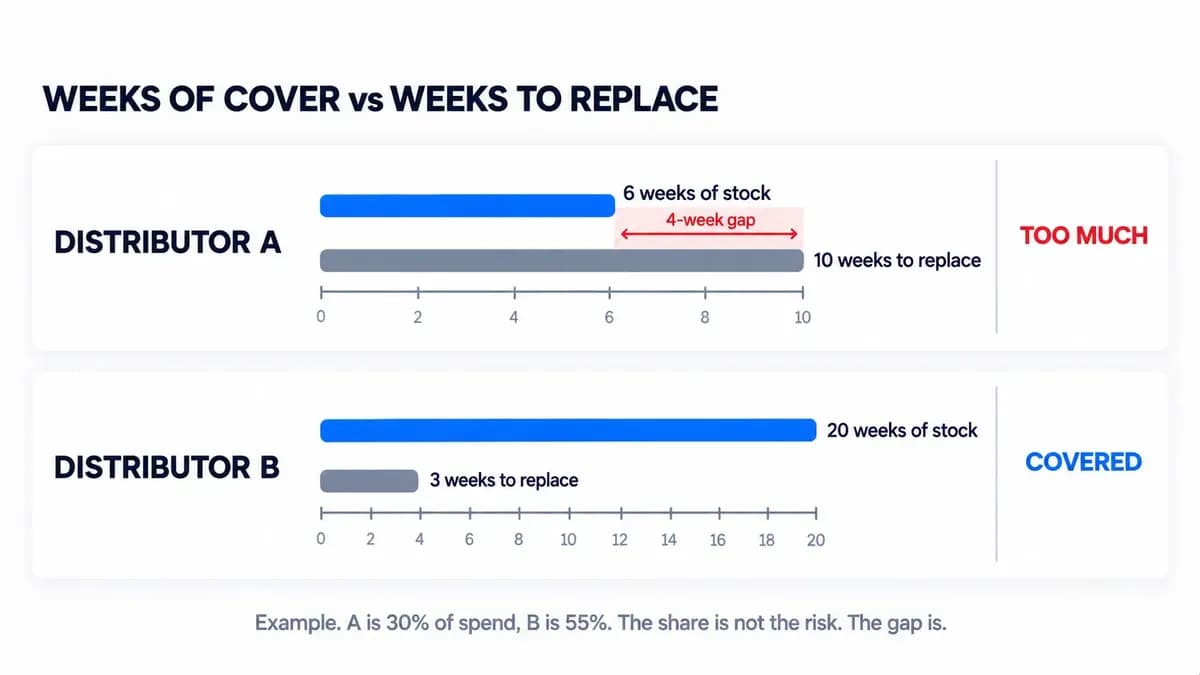
A fixed percentage cannot catch this. What matters is the gap between how long you can hold out and how long a replacement takes to arrive.
Larger companies have been moving in the same direction. In a McKinsey survey published in December 2025, 82% of the 100 companies asked said new tariffs had affected their supply chains, and 39% were adding a second source for components and materials in response. If businesses with full procurement teams are building backups, a reseller who waits weeks for every approval has at least as much reason to.
How to Reduce Supplier Concentration Risk: 3 Moves
Once you know which distributors fail the cover vs replace test, three things bring the risk down.
Check the numbers again every quarter. They change more than you expect. A product starts selling faster, a distributor runs low on stock, or a backup you were counting on drops the product. Add the two numbers to your quarterly supplier audit so you update them on a fixed schedule instead of after something has already gone wrong.
Find a backup for the risky products first. Trying to find a second supplier for everything you sell is too big a job, and most people give up halfway. Start with the products that failed the test. Our guide to building a three-supplier bench shows you how to do this for one product at a time.
Only apply to a distributor when you already know their numbers work. This is where most resellers used to give up. To add a backup distributor, you had to apply to two or three of them, wait weeks for each answer, and often find out their cost was no better than what you already had. So many resellers never did it.
The application still takes as long as it always did. What has changed is what you can see before you apply. You can now search a product free on B2B Supplier Hub and see the real cost and stock from every verified distributor in our network that carries it, before you apply to anyone. Run your exposed listings through it, compare, and apply only to the one whose numbers hold up. The same products can be added to the watchlist, so you hear when a distributor in the network restocks or changes cost.
When Only One Distributor Carries It
Sometimes you search an exposed product and only one distributor in the network carries it, or none at all. Some products are like that.
When that happens, submit a request through Request a Supplier. Our team looks for an authorized distributor who carries the product, reviews their business and catalog, and brings them onto the platform. It is free on every plan, and you get an answer within 30 days either way.
Start With Your Top Twenty
You do not need a model for this. You need a list of your twenty best products, the distributor behind each one, and two honest numbers per distributor: weeks of cover and weeks to replace. Doing it once may show you a distributor carrying more weight than you realized.
Once you have that name, pick the product you would miss most if they stopped shipping tomorrow. Search it free and see who else in our network carries it, and at what cost. If nobody does, send us the request. Either way, by the end of the week you will know your number, and that is a better place to be than guessing.
Frequently asked questions
01What is supplier concentration risk?
02Is there a safe supplier dependency percentage?
03How do you calculate vendor concentration?
04Is single sourcing ever the right choice?
The B2B SupplierHub Team
Wholesale & sourcing
Stop hunting suppliers by hand. Type a UPC instead.
B2B Supplier Hub shows the suppliers in our network carrying a product on one page: wholesale cost, stock, and retail price side by side. Free to search, no card required.