
Sourcing
Dual Sourcing vs Single Sourcing: When Each One Wins
Most advice about supply risk ends with the same line: get a second supplier. For a few of your products, that is good advice. For the rest, it would cost you your price tier and your standing with the distributor, and take up a good part of your week, all to protect you from something that was never likely to happen.
Nobody says that part out loud. Single sourcing and dual sourcing are not a good habit and a bad one. They are two different tools, each with its own cost, and if you run a real catalog you will end up using both at the same time on different products.
We have already written about why depending on one supplier is risky, and we still think so. This post is the other half of that story. It gives you the case for one supplier, the case for two, and the two questions that decide it for any product. When you know which products need a backup, our post on building a three-supplier bench shows how to set one up.
Single, Sole, and Dual Sourcing: What Each Term Means
Three terms get mixed up here, and one of the mix-ups changes the answer.
Single sourcing means you chose one supplier for a product even though others were available. Sole sourcing means there was only one supplier to choose from. The difference, as CIPS puts it, is choice. That matters for resellers because a lot of what looks like single sourcing is really sole sourcing. The brand has one authorized distributor, and that distributor is the only way in. If that is your situation, the question in this post does not apply, and we have a separate one on what to do when a brand has no distributor for you.
Dual sourcing means splitting purchases of one product between two qualified suppliers, usually in a set share like 70/30 or 60/40, so that neither one is a single point of failure. There is also multiple sourcing, which is three or more suppliers for the same item, but almost no wholesale reseller does that for one product on purpose, so we will leave it there. So for most of your catalog, the single sourcing vs dual sourcing question is the one that counts. Here is the case for each, with a side-by-side after the two sections.
When Single Sourcing Wins: Price Tier and Standing
Start with the side that gets less attention, which is the side most resellers are already on.
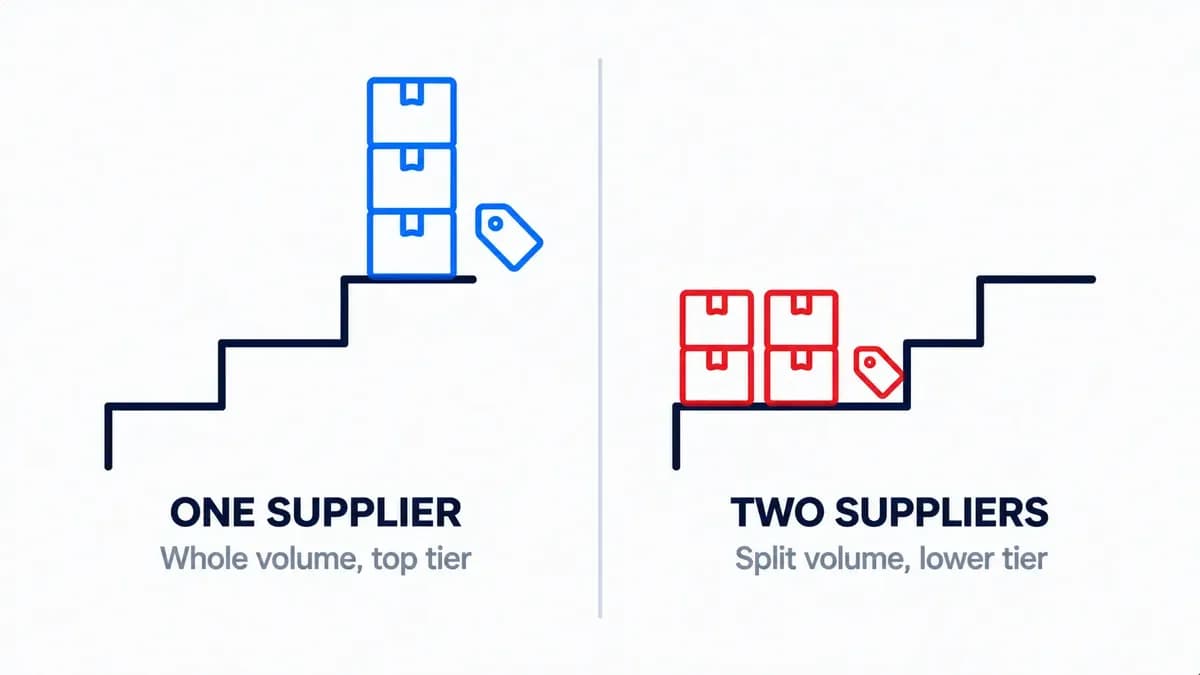
Buy a product from one distributor and you get easier negotiation, steadier pricing, shorter lead times, a stronger relationship and less admin. None of that is small when two or three people are running every supplier account. But the biggest benefit is the price. The volume discount comes from putting all your volume in one place, and once you split the order you often lose it.
It helps to know how that discount is built, because it is more fragile than it looks. Distributors set their tiers in a few different ways. Some go by order quantity, so a bigger order gets a lower unit cost. Some sort customers into classes by how much they buy, and review those classes every quarter or every year. Some tie pricing to an annual spend commitment, and if you drop below it, the price goes back up. So moving a third of a product to a second distributor does not only cost you on that order. It can cost you your tier at the next review, on everything you buy from that supplier.
Not every product is priced this way, though. Distributors often give commodity products steep volume discounts while specialty products carry flatter pricing, so on some products a split costs you almost nothing. Our post on reading a distributor's price sheet shows how to find your own tier breaks and see which kind you are looking at.
There is a second reason, and it matters more this year than most. When stock gets tight, distributors look after their larger customers first, and splitting your orders makes you a smaller customer to each of them. And stock is tight right now. The latest wholesale trade report says distributors are getting more orders, paying more for products and shipping, and dealing with supply shortages and slower deliveries. In a year like that, being high on one distributor's list is worth something, and being halfway up two lists may not be.
There is one more reason resellers stay with one supplier, and it is a less flattering one. The longer you buy from a distributor, the more it costs to leave: new applications, a new invoice history, a new rep who does not know you. Procurement people call this the lock-in effect. It is worth naming, because a lot of single sourcing was never decided. It just happened. If that is your situation, our post on switching wholesale suppliers is the one to read.
Still, for a product that is a small part of your business, with steady demand and a wide gap between your tier and the next one, one supplier usually wins.
When a Second Source Supplier Wins: Continuity and Benchmarking
Now the case for two suppliers, and one point the usual arguments leave out.
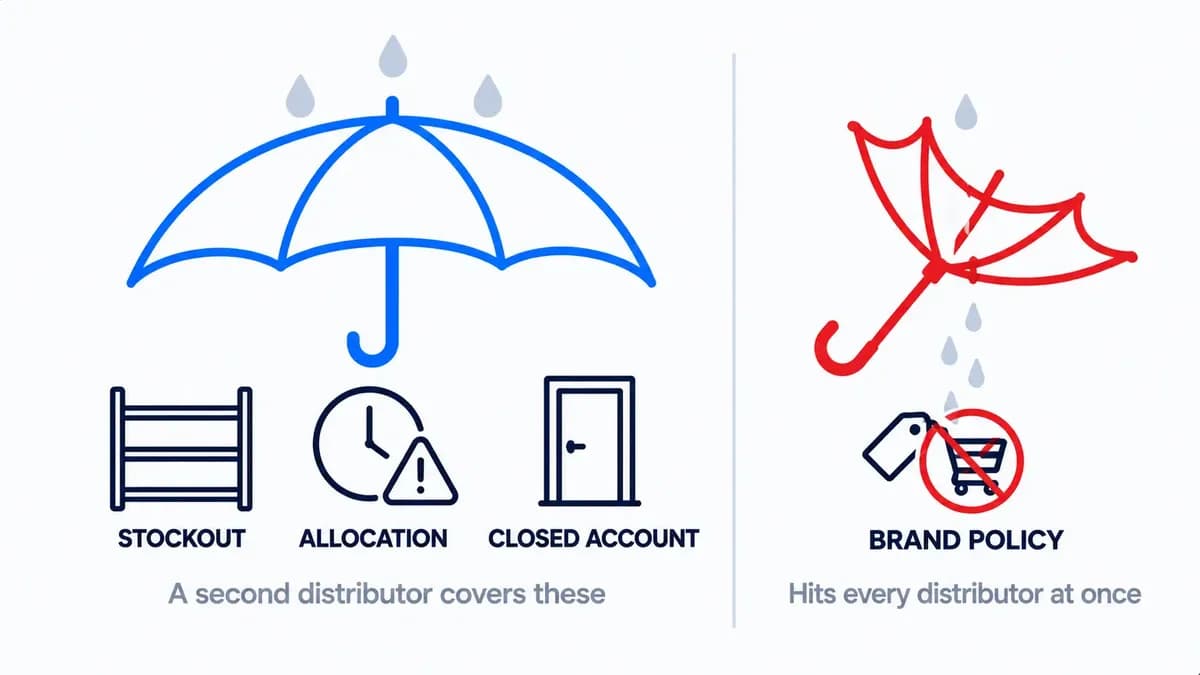
The main thing a second source gives you is continuity. When the primary cannot deliver, the product keeps selling. That covers a stockout, an allocation you did not get, or a closed account.
But a second distributor only protects you from problems at the distributor, not problems at the brand. If a brand decides it no longer wants marketplace resellers, every authorized distributor of that brand ends up under the same rule, and your second source goes quiet at the same time as your first. So dual sourcing insures you against distributor trouble, not against brand policy, and that is worth knowing before you pay for it.
The second benefit is a quieter one. CIPS lists the need for regular market benchmarking as a cost of single sourcing, because when you only see one price, you never know if it is a good one. A second source is the benchmark. Every order you place with them tells you what the product really costs in the market, which is useful to know before the primary's next price increase.
Two smaller benefits deserve a line each. A second source can take some of the load when demand spikes, which is the Q4 top-up problem we covered in budgeting Q4 inventory. And two distributors in two different places means two ship-from locations, which can change your freight costs more than you would expect. Our post on FOB vs delivered pricing has that arithmetic.
The costs are real, and they are the last section's advantages turned the other way round. Split volume means a higher unit price, more accounts to manage and a weaker standing with each supplier. A common mistake is dual sourcing a low-risk product, where it adds cost and protects you from nothing.
That is also why the split is rarely even. The usual reference points are 80/20, 70/30 or 60/40, and the point of keeping it lopsided is that the primary keeps the volume discount. The premium you pay on the smaller share is the price of the insurance. It is not a loss, but it is not free either. The bench post covers how to keep that smaller share active without upsetting your primary.
Single Sourcing Vs Dual Sourcing At A Glance
Single sourcing | Dual sourcing | |
|---|---|---|
Price | Whole volume in one place, so you hold the best tier | Split volume, so you often lose part of the discount |
Admin | One account, one rep, one invoice trail | Two of everything |
Standing with the supplier | Bigger customer, served first when stock is tight | Smaller customer to each |
Stockout or closed account | Product stops selling | Product keeps selling through the second source |
Brand pulls marketplace resellers | Product stops selling | Product stops selling anyway |
Price benchmark | You only see one price | You always know a second price |
Demand spike | One supplier absorbs it, or does not | Two suppliers share it |
Best for | Small share of sales, steady demand, wide tier gap | Top earners, thin primary stock, flat pricing |
How to Decide Product by Product: 2 Questions
This decision usually goes wrong because people make it once, for the whole business. It is really a decision about each product, and two questions settle most of it.
First, how much price break would a split cost you? Not roughly, in dollars. Look at your primary's tier structure for that product, work out where you sit, and work out what moving a share of the volume elsewhere would do to the tier. If the answer is a few cents a unit, the insurance is cheap. If it drops you a whole tier across the account, it is expensive, and you would need a good reason to pay it.
Second, how deep is the primary's stock? A distributor that carries the product in several warehouses is a very different risk from one that has it in one place. Our post on the first 72 hours of a supplier stockout shows how much can be solved inside one account when the stock is spread out. If your primary is thin on the product, a second source stops being optional.
There is a third signal, which is how much of your total buying sits with one distributor. That is a bigger topic than we can fit here, and the pillar covers it.
Both questions share one problem. You cannot weigh the premium on a second source until you know whether one exists and what it charges, and finding that out used to mean applying to each distributor and waiting for approval just to see a price. Now the numbers come first. Search the product free on B2B Supplier Hub and you see the real cost and real stock from every verified distributor in our network carrying it, with a date on each listing so you know how fresh the numbers are. Put those next to what you pay today, and the decision becomes a comparison instead of a guess. If the search comes back empty, no distributor in our network carries it yet, so submit a request and our team will go and find an authorized distributor who does. It is free on every plan, and you hear back within 30 days either way.
Keep Most Of Your Catalog On One Supplier, On Purpose
This post is not saying single sourcing is fine after all. It is saying the choice is different for every product, and the businesses that come through a bad supply year are usually the ones that chose on purpose.
So keep most of your catalog with one distributor and keep your price tier. Then pick out the few products where a split would cost you little and your main supplier does not hold much stock. Those are the ones that need a second source, and that is where the extra cost is worth it.
You do not have to guess which products those are. Search your top ten free, see whether a second source even exists for each one and what it would cost, and then decide whether the premium is worth paying. Checking takes less time than the argument does, and it usually settles it.
Frequently asked questions
01What is the difference between single sourcing and sole sourcing?
02Does dual sourcing always cost more?
03What share of orders should a second source get?
04Which products should a wholesale reseller dual-source?
The B2B SupplierHub Team
Wholesale & sourcing
Stop hunting suppliers by hand. Type a UPC instead.
B2B Supplier Hub shows the suppliers in our network carrying a product on one page: wholesale cost, stock, and retail price side by side. Free to search, no card required.