
Supplier Management
Supplier Price Increase: How to Respond and When to Walk
A supplier price increase rarely comes as a letter. It comes as a new price sheet with no note attached. Or you don't see it at all until an invoice doesn't match the quote you've been reordering against for two years. You look at the number, do the math in your head, and feel it land. That product was fine last month. Now it isn't.
Most resellers get two things wrong in the first hour. They treat it as a question about the supplier, when it's really a question about SKUs. And they react to the size of the increase. Six percent feels bad, three percent feels fine, but neither number means anything on its own. What matters is where your new cost sits next to everyone else who carries the same product.
Get those two things right, and this is an afternoon's work. You make a clean decision, and you keep a relationship you may still need.
Step 1: Send This Reply Before You Decide Anything
Don't argue yet, and don't accept yet. Get the facts in writing first. Here's the reply to send, or to hand to whoever does your sourcing:
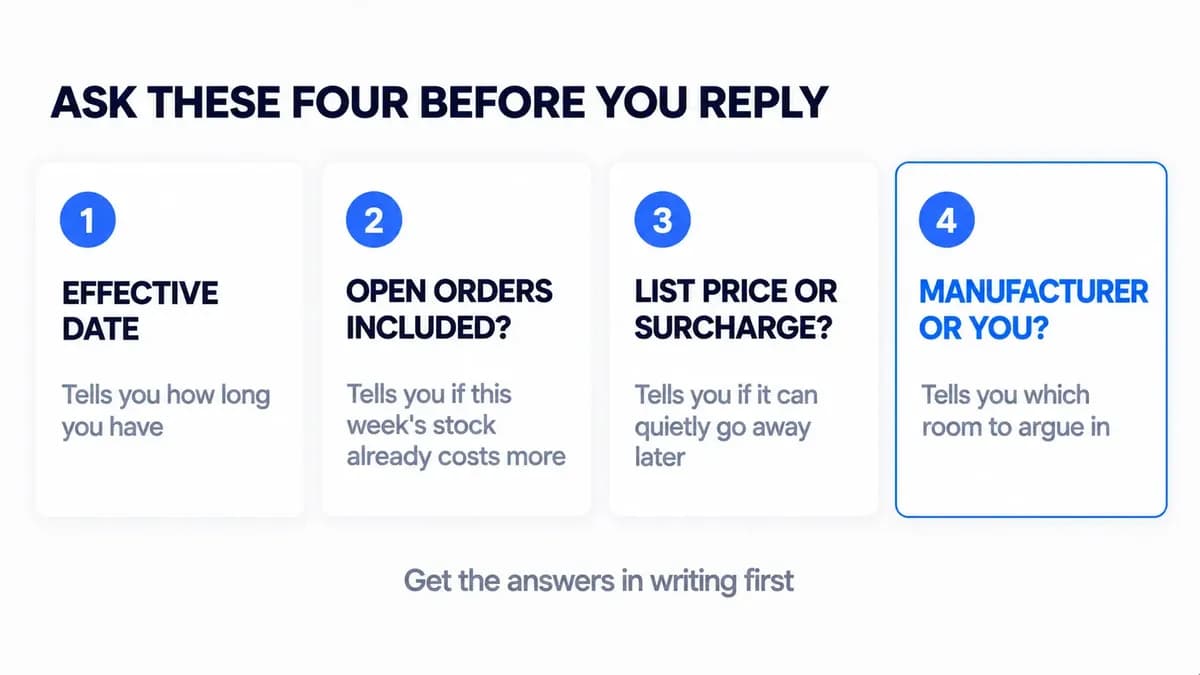
Thanks. Before we plan around the new pricing, can you confirm four things?
- The effective date.
- Whether open purchase orders and backorders are included.
- Whether this is a change to list price or a separate surcharge line.
- Whether this is coming from the manufacturer or is a change on your end.
Each answer changes what you do next. The date tells you how long you have. Open orders tell you whether this week's stock already costs more. List price versus surcharge tells you whether it could quietly go away later. The last question is the one most resellers never ask, and it's the one that matters most. If the manufacturer raised the price, every distributor is about to move, and arguing the increase with yours puts you in the wrong room. If it's the distributor's own change, you have something to work with.
While you wait for the reply, put the old quote, the new price sheet, and your last invoice next to each other and compare them line by line. An increase doesn't always show up in the unit price. Sometimes the price is the same but you now need a bigger order to get it. Sometimes freight that used to be included is now charged on top. If the sheet is hard to read, this guide to distributor price sheets shows you where to look.
Step 2: Check Whether the Reason Still Holds (Tariffs Included)
Most increases have a real reason behind them. Manufacturers are cutting the discounts they give distributors. Freight and labor cost more. Some products still carry tariffs that are very much in force. Many distributors also treat big and small accounts differently now. A large account negotiates how costs pass through. A smaller one gets priced on whatever it costs to land the product today. Which one you are decides what's on the table before you say a word.
Then there's the reason that may no longer be true. A lot of 2025 increases were blamed on tariffs. In February 2026, the Supreme Court struck down a large set of those tariffs. Any refunds go to whoever imported the goods, and importers are not required to pass that money down the chain. So the reason for your increase may be gone while the increase itself is still sitting on your invoice.
You don't need a legal position here. You need one question. If your increase came with a tariff label, ask whether that reason still holds. A good supplier will give you a straight answer. None of this is tax or legal advice.
Step 3: Find Where Your New Cost Sits Against Other Distributors
Search the product and look at the cost and stock from every verified distributor in our network that carries it. Compare like for like, delivered cost against delivered cost, same case pack. Then stop looking at the percentage and look at where you sit.
Where your new cost sits | Your move |
|---|---|
Still the lowest, and they have stock | Absorb it or reprice. Nothing to fix yet. |
Middle of the pack | Renegotiate with the numbers in hand. |
Highest, and others show stock | Re-source that SKU. |
Highest, but nobody else shows stock | Stay. Set a restock alert and re-check instead of assuming. |
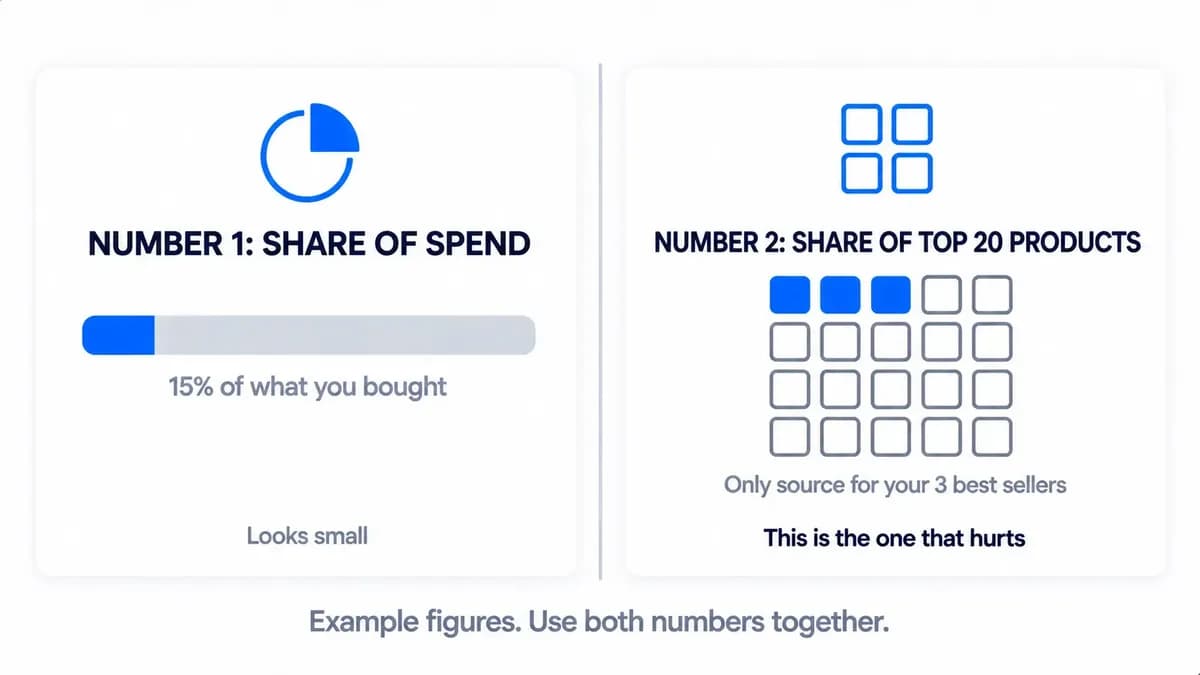
That's the whole decision. A six percent increase that still leaves you lowest is nothing to act on. A three percent increase that makes you the highest cost in the room is a reason to act. You can search a product for free and see where you stand before you reply to the supplier at all.
How to Respond to a Supplier Price Increase: 5 Moves
Absorb it. This is the right call more often than it feels. If the product is still profitable after fees and this supplier is the one with stock, you stay. Stock is a reason to stay that no price sheet shows you. Just don't let "the only one with stock" turn into something you remember instead of something you check. A watchlist with a restock alert does the checking for you.
Reprice. Run the numbers after fees, not before, because the fees moved too. On Amazon, a 3.5 percent fuel and logistics surcharge has applied to FBA orders since April 17, and holiday peak fulfillment rates run from October 15 to January 14. An October cost increase is really an October-plus-peak increase. Same math on Walmart or your own store, with their fee lines instead. And if the brand enforces MAP, there's no repricing up at all. The increase comes straight out of your margin. So before you decide, re-run the per-unit profit with the new cost. Retail Insights on every product page shows what you'd make after selling fees, so you're not guessing.
Renegotiate. This isn't the same as negotiating a first order. Mid-relationship, you have two things you didn't have on day one: order history, and a clear view of where you sit. Lead with the number, not a threat. Then trade something real. Consolidate your orders, commit to a longer window, offer prepayment, or ask what it takes to move up a tier. Distributors give better deals to accounts that make their life easier. Be that account on the brands that matter to you.
Buy ahead. This is the reflex, and in October it's a trap. A big order before the effective date ties up cash into January, when payouts already lag. Anything that doesn't sell through sits in storage getting more expensive. And sometimes the increase gets walked back, and now you're holding stock bought at a price that no longer exists. Buy ahead only on products with proven velocity, and only with a confirmed effective date in writing.
Re-source. Done right, this isn't a threat you make. It's a number you already hold, because you saw what other distributors charge before you replied. When the numbers work, you unlock the distributor and apply. Be honest with yourself about timing, though. The numbers are instant. The approval still takes as long as it takes, because a distributor has to say yes to you first.
Walk On Skus, Not On Suppliers
Increases are almost never flat across a catalog. So sort your products from this supplier into three buckets: still competitive, no longer competitive, and nobody else carries it.
Move the second bucket. Keep the first and the third. Then tell the supplier, plainly. They keep the volume that still makes sense, and you keep the relationship for the day their stock is the only stock there is. A supplier would rather hear this than watch an account go quiet.
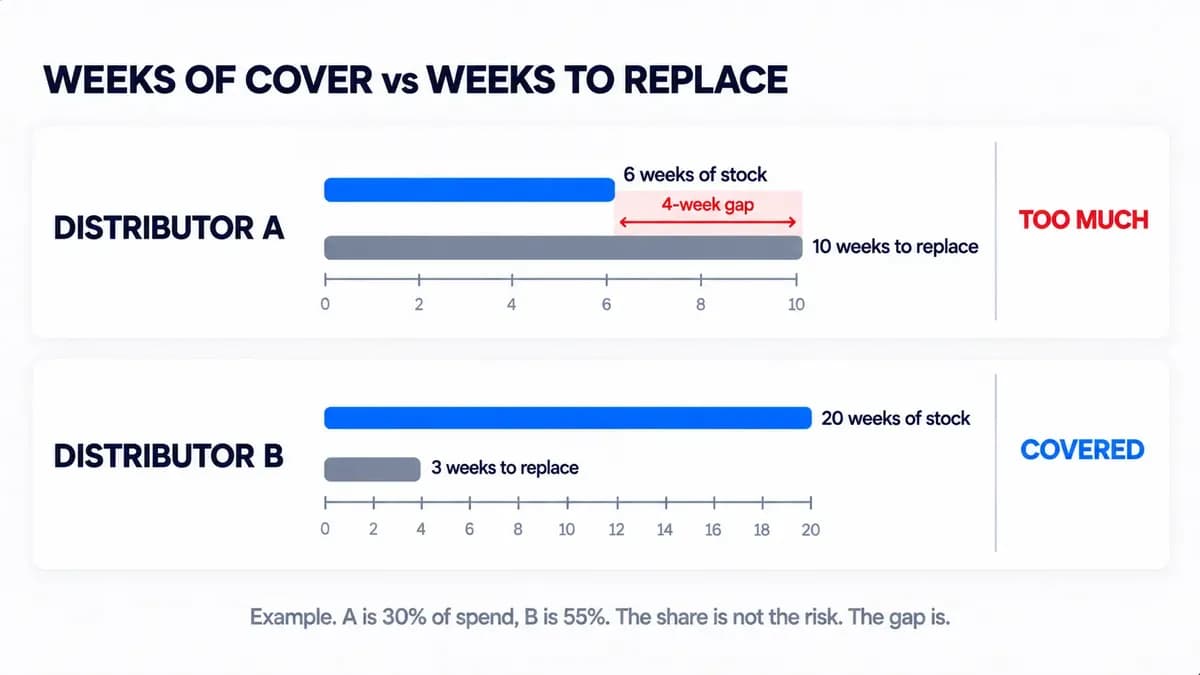
Walking away from the whole account is a bigger decision. Do it only when most of your volume is in the second bucket, the replacement distributor has already approved you, and your ungated listings have an invoice path that won't break. How to switch wholesale suppliers without breaking supply covers the handover.
And don't walk at all on a first increase in years from a supplier that still fills your orders, or when the alternatives show a lower cost but no stock. Cheaper and unavailable isn't cheaper. Whatever you decide, write it down. Date, size, reason given, what you did. The next increase is a lot easier to read when the last one is on paper.
When The Search Comes Back Empty
Sometimes you search the product and nothing comes back, or everything that does shows no stock. You still have a path. Submit a request and our team finds a verified distributor who carries it. Request a Supplier is free on every plan, and you get an answer within 30 days either way.
The Increase Is Information
A supplier price increase isn't a verdict on the supplier. It's information about the market, and it tells you whether the cost you've been reordering on autopilot is still a good cost. You needed to know that anyway. The reseller who knows where their cost sits replies in an hour, calmly, with a number. The reseller who doesn't replies from fear, and fear either overpays or walks away from a supplier they'll need again in March.
So before you type the reply, look. Search the product free, see every number, and decide from there. For the bigger picture on finding suppliers for products that already sell, start with reverse sourcing for wholesale resellers.
Frequently asked questions
01How do I respond to a price increase from a supplier?
02My supplier blamed tariffs that were later struck down. Can I ask for a reduction?
The B2B SupplierHub Team
Wholesale & sourcing
Stop hunting suppliers by hand. Type a UPC instead.
B2B Supplier Hub shows the suppliers in our network carrying a product on one page: wholesale cost, stock, and retail price side by side. Free to search, no card required.