
Wholesale Economics
How Tariffs Reach a US Distributor's Price List (and What Resellers Can Do)
This blog post is about pricing, not customs rules. It is not legal, customs or tax advice.
"Pricing on the attached list is revised, effective the first of the month." That is the whole email a distributor sends when a tariff pushes their cost up. One line, and a new file with bigger numbers in it.
It does not say which products went up, or whether the extra money is the tariff or the distributor rebuilding its own margin, or whether it covers the stock they already have in the building.
How tariffs affect wholesale prices comes down to three things. First, the increase arrives in one of two ways: a higher cost on the list, where you cannot see how much of it was the tariff, or a separate tariff line on the invoice, where you can. Second, it arrives weeks after the news, because a tariff is charged on a shipment when it reaches the country, so goods already in a US warehouse still carry the old cost. Third, it does not reach every distributor on the same day, so the same product can sit at two different prices for weeks.
Where the tariff gets paid, and when
A tariff is not charged on the day it is announced. It is charged when a shipment clears customs, and the paperwork puts a date on that. The June 2026 order on metals applied its rates to goods entered, or withdrawn from warehouse for consumption, on or after June 8, 2026. In plain words: the charge sticks to that shipment, on that day.
Most of what follows comes from that one rule. Goods already in a US warehouse came in at the old rate and still cost what they cost, whatever the news says this week. Your distributor's cost does not move when a tariff is announced. It moves when their next shipment lands.
The other thing worth knowing is who pays. The company that brings the goods into the country pays the tariff, and that may not be your distributor. Many of them buy from a US importer, or from the brand's own American arm, so the tariff was already inside the price they were quoted. They are passing on somebody else's increase. That is usually why they cannot explain the number when you ask.
How tariffs affect wholesale prices: two shapes on the list
Once the cost lands, it shows up in one of two ways, and the difference matters more than most resellers think.
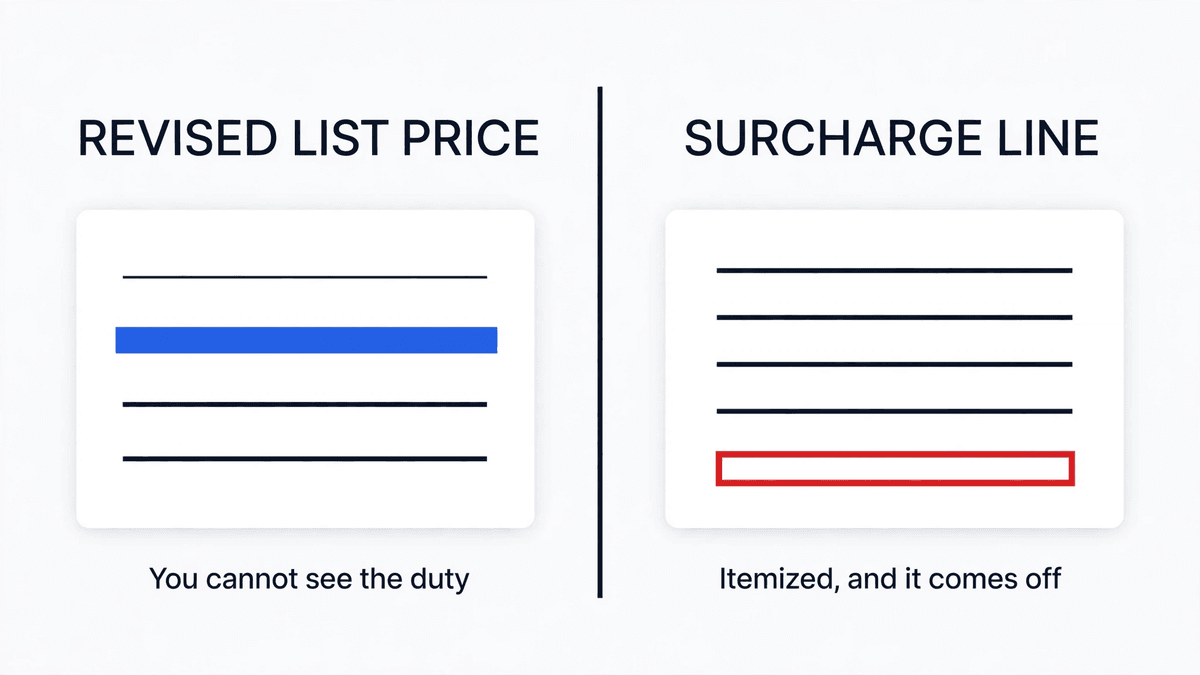
The first is a new list price. The higher cost is folded into the cost column and the old file is replaced. You cannot tell how much was the tariff and how much was the distributor rebuilding its own margin. It is tidy for them and invisible to you, and it almost never comes back down.
The second is a tariff line. The cost column stays where it was and a separate charge appears, usually a percentage of the order or of the products affected. You can see it, question it, and watch it go away when the tariff does.
Given the choice, ask for the tariff line. Then ask two more questions whenever a price change arrives. Is this the tariff, or a general increase? And does it apply to the stock already on their floor, or only to new arrivals? That second question catches the case where a tariff charge gets added to goods that came in before the tariff existed. It happens, it is rarely deliberate, and it usually gets fixed as soon as somebody asks.
Why two distributors of the same brand reprice weeks apart
No news story covers this, and it is the piece a reseller can work with. Two authorized distributors selling the same product will not raise their price on the same day, for four reasons.
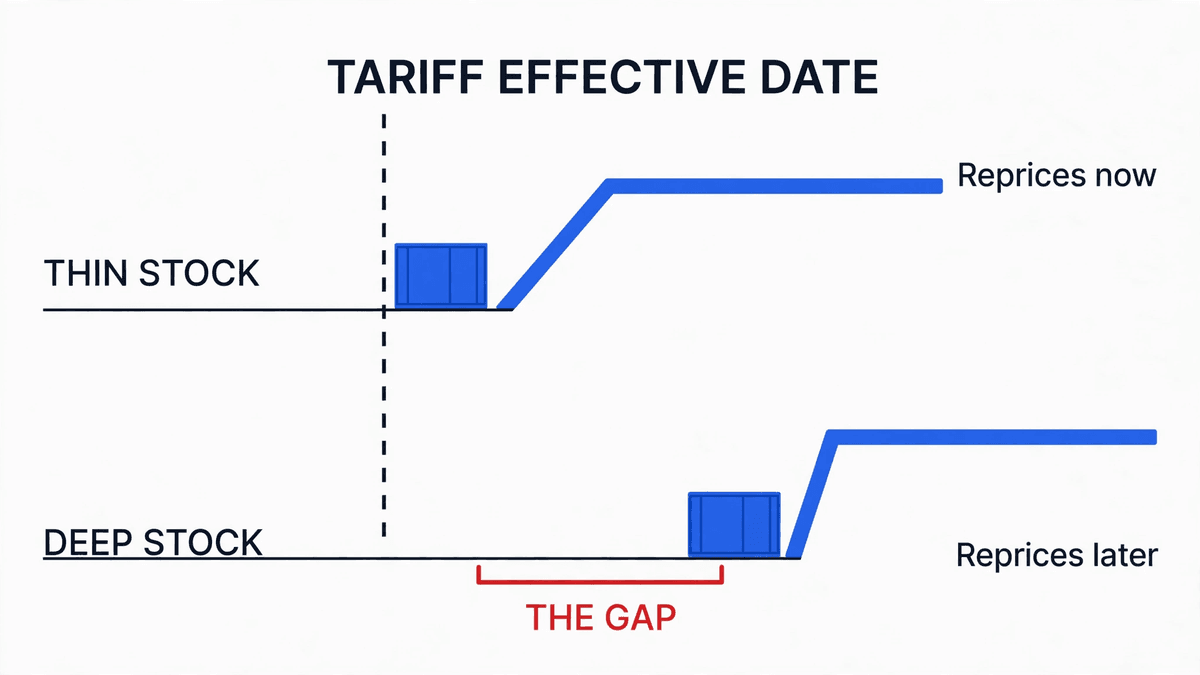
- How much stock they hold. A distributor sitting on four months of a product is still selling pre-tariff units long after a thinner competitor has run out. Their cost honestly has not changed yet.
- When their next shipment lands. The tariff is charged at the border, so a distributor with a container arriving next week reprices next week. One with nothing arriving until the quarter turns has nothing to reprice. The lead times you already watch for stock also tell you roughly when a price change is due.
- How they price their stock. Some work from what the goods actually cost them, which creeps up slowly as old stock sells through. Others work from what the same goods would cost to buy today, which jumps as soon as the new number is known. Same tariff, same product, weeks apart on the sheet. The math behind it is in how distributors set prices.
- Whether they import. A distributor bringing goods in itself feels the tariff first. One buying from a US importer feels it when that importer passes it on, which adds a step and more delay.
Put those together and the same product can sit at two different prices for weeks, with both distributors behaving normally. Most resellers never see that gap, because seeing it means being approved at both distributors and holding both price files at once.
How much of it actually reaches you
Less than the headline rate, and never all at once. Wholesale prices in general have been climbing: the government's measure of wholesale prices was up 6.3 percent over the 12 months to September 2026, and up 1.3 percent in September alone, the biggest single month since early 2022. That is the background, though, not your product.
The research on tariffs themselves is more useful. Harvard Business School's pricing lab, which tracks daily prices on hundreds of thousands of products, found prices moving within days of a tariff announcement but rising by less than the tariff itself, because sellers absorb part of it, buy ahead of the date, or change where they buy from. The same work found prices on US-made goods drifting up too, which answers a question resellers ask a lot: yes, tariffs reach American-made goods as well, through imported parts and through more people buying American.
It also helps to run the numbers on a made-up unit, because the headline rate is never applied to the price you pay. Say a distributor brings a product in at a $10 import value and sells it to you at $16. A 15 percent tariff adds $1.50 to the $10, not to the $16. Pass all of it on and your cost goes to $17.50, which is a 9 percent rise, not 15. Freight moves it again. So treat any announced percentage as a ceiling, not a forecast.
Three things a reseller can actually do
- Buy ahead of a published date, but only on fast sellers. These dates are published before they bite. If a category you buy gets named, the question for your distributor is not whether prices are going up. It is when their next shipment of that product arrives, and whether that is before or after the date. A year of stock on a slow seller costs more in cash and storage than the tariff ever would.
- Ask for the pre-tariff stock by name. Not "is there any old pricing left," which gets a no. Ask which products are still being sold from stock that came in before the change, and how many units are left at that price. Expect some friction. Distributors keep that stock for accounts that buy steadily, and a new account rarely gets first call on it. Ask anyway, early, and in writing.
- Check the same product at a second distributor while the gap is open. This is where the delay turns into money. The catch is the approval wall. Comparing has always meant applying to several distributors and waiting weeks for each one.
One warning on all three. A tariff or freight change also moves the delivered versus FOB math on an order, so work out the full cost to your door again rather than comparing cost columns on their own.
Three things not to do
Do not raise your own prices off a news story. Your cost has not changed until your invoice changes, and moving early hands the sale to someone still selling pre-tariff stock.
Do not treat a tariff line as permanent. These charges move in both directions, sometimes fast. In Learning Resources, Inc. v. Trump, decided February 20, 2026, the Supreme Court held that the emergency law behind a broad set of 2025 tariffs did not allow tariffs at all, which removed that layer while charges under other laws carried on. The practical lesson has nothing to do with politics: a charge that appeared on your invoice can also disappear from it, and not every distributor takes it off without being asked. Check your invoices against the current list.
Do not fix a price increase by leaning harder on one supplier. The instinct is to send more volume to whoever held their price longest, which quietly builds supplier concentration risk at exactly the moment supply is least predictable.
What to work out when a price change lands
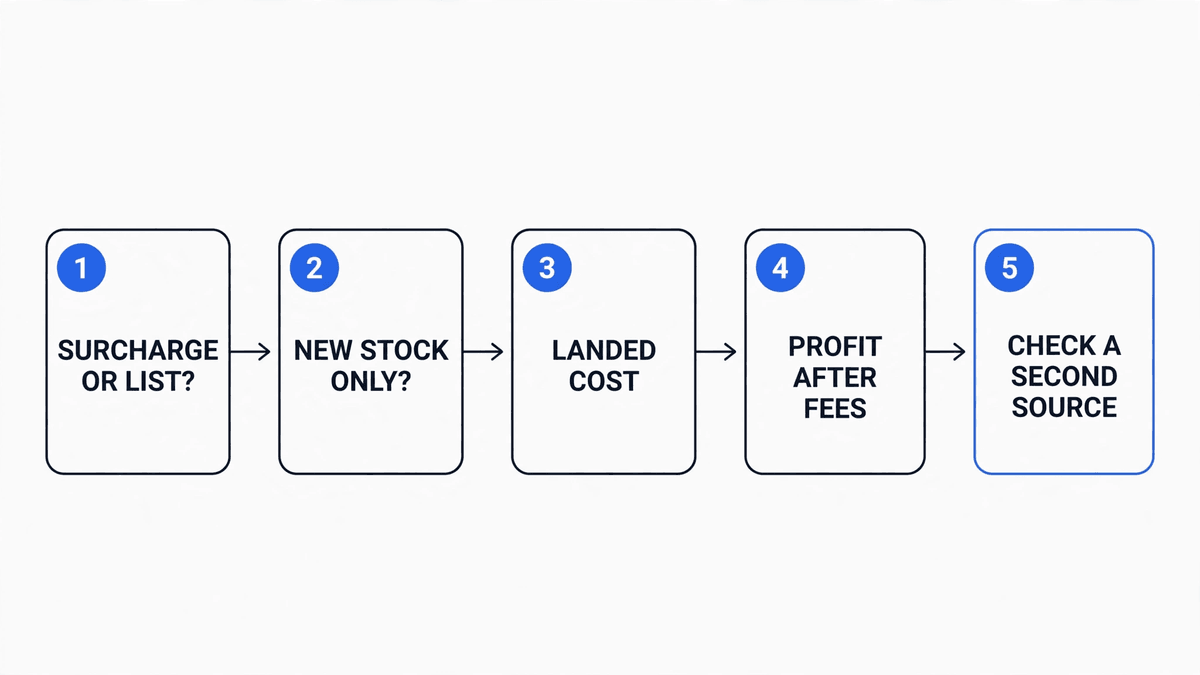
- Which products moved, and whether it is a tariff line or a new list price.
- Whether it covers new arrivals only, or stock already in the warehouse.
- Your full cost per unit to your door, freight included, not just the cost column.
- Your profit after selling fees on every product affected, before you reorder.
- The same product at a second distributor, while the gap is still open.
The number that counts is on your invoice
Most tariff coverage is written for economists and importers. Neither of them buys wholesale to resell, which is why so little of it tells you what to do on Monday.
The reseller version of how tariffs affect wholesale prices is small and practical. Work out whether the increase is the tariff or margin. Find out whether it covers everything or only new arrivals. Learn when each distributor's next shipment lands, because that is the day their cost really changes. Then check the same product somewhere else while the gap is open.
That last step used to be the slow one. You can search a product free and see real cost and stock from the verified distributors in our network carrying it, with a freshness timestamp on every listing, before you apply anywhere. If nothing in the catalog carries it, ask our team to find an authorized wholesale distributor and hear back within 30 days.
Related reading: [LINK: How to Read a Distributor Price Sheet]
Frequently asked questions
01How do tariffs impact pricing on products?
02Which products are most affected by tariffs?
03What businesses will be most affected by tariffs?
04Do tariffs affect domestic goods?
The B2B SupplierHub Team
Wholesale & sourcing
Stop hunting suppliers by hand. Type a UPC instead.
B2B Supplier Hub shows the suppliers in our network carrying a product on one page: wholesale cost, stock, and retail price side by side. Free to search, no card required.