
Wholesale Economics
How Distributors Set Prices: From Landed Cost to the Number on Your Invoice
Nobody explains how distributors set prices. The price sheet just shows up. The numbers look high, and you are left guessing why.
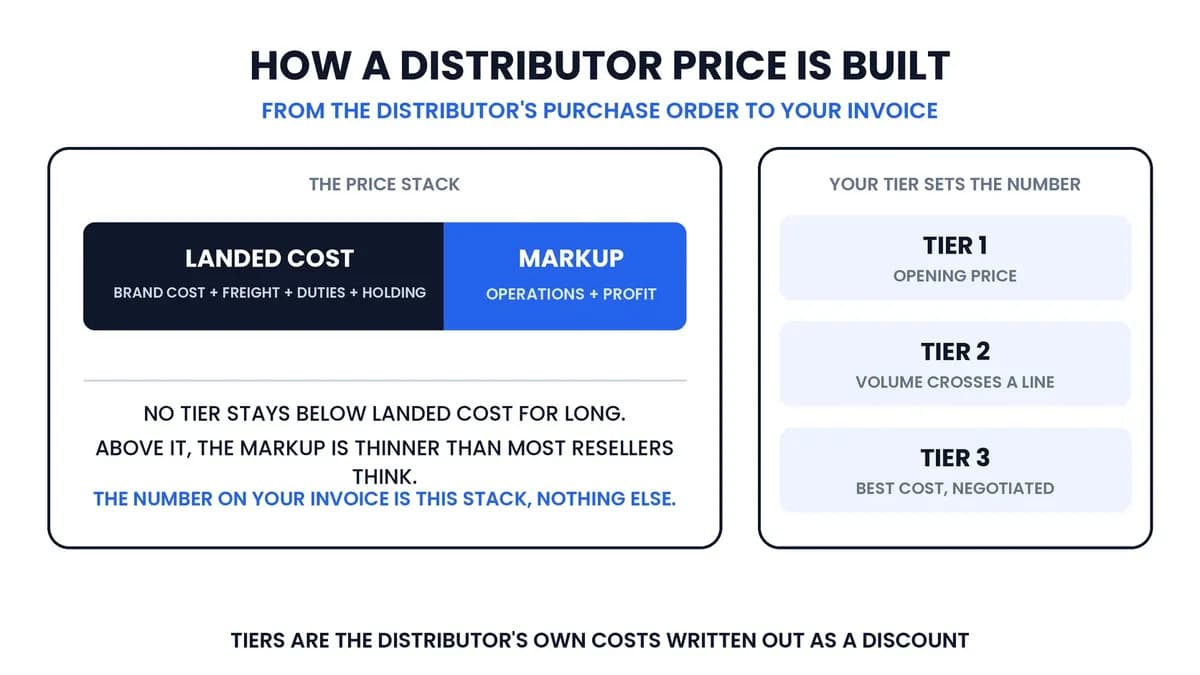
Here is the simple answer. A distributor adds up what a product costs them. Then they add a bit on top. That is their markup. Then they split the price into steps, called tiers. Buy a little and you pay the top step. Buy more and you pay a lower one. That is the whole system.
Tier | What it means | Who pays it |
|---|---|---|
Tier 1 | The highest price. For small or first orders. | New accounts. Most resellers. |
Tier 2 | A lower price once you buy enough. | Resellers who buy more, or combine their orders. |
Tier 3 | The lowest price. Usually agreed with the rep. | Big accounts. |
Most resellers sit on Tier 1 for years and never ask how to move. This post follows one product from the distributor's own purchase all the way to your invoice. By the end you will know which parts of the price can move, and which cannot.
Step 1: Landed Cost, What the Product Costs the Distributor
Every price starts with a number the distributor cannot control. The brand sells the product to the distributor at a set cost.
Then the distributor pays more on top of that:
- Shipping to get the goods into their warehouse.
- Duties, if the goods come from another country.
- The cost of holding the stock until someone buys it.
Add all of that together and you get the landed cost. That is the true cost of one unit sitting on the distributor's shelf. No price on your sheet can stay below it. If it did, the distributor would lose money on every case.
Here is why this matters to you. Two distributors carry the same product. One is cheaper. That is almost never because the cheaper one is being kind. It is because they got a better deal from the brand, or they ship in bigger loads, or they buy straight from the factory. Their landed cost is lower, so your price is lower.
So when a price looks high, do not ask "why is this distributor greedy." Ask "where did their cost come from, and does someone else get it cheaper?"
Step 2: Distributor Markup, and Why It Moves
Now the distributor adds a percentage on top of the landed cost. This is the markup. It pays for the warehouse, the staff, the sales reps, the credit they give you on net 30, and the profit they keep. This is what cost-plus pricing means for a distributor. Cost, plus a percentage. Nothing more.
How much do distributors mark up? Less than you might think. One industry guide puts typical distributor margins between 3% and 30%, depending on what they sell. Electronics sit at the low end. Sporting goods sit nearer the middle. For large US wholesalers on the stock market, the average gross margin was 12.82% over the twelve months to Q3 2026. Your distributor may be higher or lower. The point is that distributors do not make money on big margins. They make it on moving a lot of product, fast.
The markup is not the same on every product. It moves for a few reasons:
- Speed. Products that sell fast get a smaller markup. The distributor moves them quickly and has to stay competitive. Slow products get a bigger markup, to pay for the time they sit on the shelf.
- Brand rules. Some brands control how low their products can be advertised. That leaves the distributor less room to discount, and leaves you less room too.
- Competition. If three distributors nearby carry the same product, the price is set to win your order. If only one carries it, the price is set to make money.
- You. Do you pay on time? Do you order often? Do you take a lot of the rep's time? All of that quietly affects your number, even when the sheet says it is fixed.
Distributor Margin vs Markup: Not the Same Number.
This one mix-up costs resellers real money.
A rep says, "We're at 20 on that line." Twenty what?
- Markup is the percentage added to the distributor's cost.
- Margin is the profit as a percentage of the selling price.
Same dollars, two different numbers. Say a distributor buys a product for $100 and sells it for $140. That is $40 of profit. As a markup, $40 on $100 is 40%. As a margin, $40 on $140 is about 29%.
So when you negotiate, ask which one the rep means. Get it in writing. Five points off the margin is a bigger price cut than five points off the markup.
The same mix-up happens on your side. If you sell on Amazon, your margin is worked out on the sale price after Amazon's fees, not on what you paid. A deal that looks like 50% on the price sheet can shrink to the teens once referral fees, fulfillment, storage and shipping come out. The sheet number alone tells you very little. You need the real cost from more than one distributor before you decide.
Step 3: List Price vs Net Price
Open almost any price sheet and you will see two prices for each product.
- List price is the public price. Sometimes it is called MSRP. It is the number the distributor wants everyone to see.
- Net price is what your account really pays, after your discount.
In wholesale, the difference between list price and net price is where the whole pricing game is played.
Why do distributors do it this way? One public list price keeps the brand happy. Then the distributor gives each account its own discount off that list. A big reseller gets a bigger discount. A new reseller gets a small one or none. Same sheet, different real prices. Your discount off list is your tier.
Three things to check every time you read a sheet:
- Which price the tier applies to. Some sheets show tiers as a discount off list. Others show the net price straight out. If you are comparing two distributors, turn both into net price first.
- Shipping. A net price without shipping is not your real cost. A cheaper sheet can turn into a more expensive invoice once shipping is added. Always compare the delivered cost.
- Payment terms. Net 30 means the distributor is lending you money for 30 days. They price that risk into your number, and they only give it when you have earned it. How to Qualify for Net-30 Terms shows what they look for.
If you want to go through a sheet column by column, read How to Read a Distributor Price Sheet. This post is about why the columns say what they say.
Step 4: How Wholesale Price Tiers Are Built
Tiers look like a thank-you for being a good customer. They are not. They are the distributor's own costs, turned into a discount.
Think about what it costs a distributor to handle one order. A rep takes the call. Someone picks the boxes. Someone packs them. Someone sends the invoice. Someone chases the payment. Those costs are about the same whether you order 12 units or 240.
On 12 units, those costs are a big slice of each unit's price. On 240 units, they are tiny. So the distributor can charge less per unit on the bigger order and still make the same money. They pass some of that saving to you as a lower tier. They keep the rest.
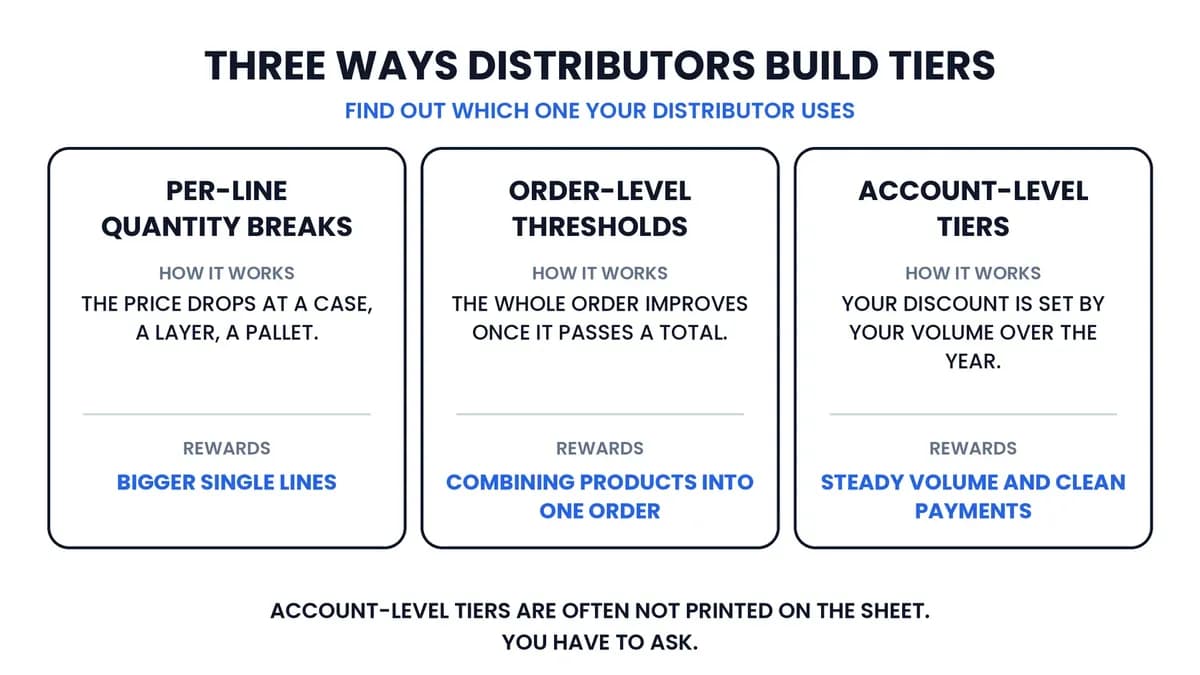
Tiered pricing in wholesale works in one of three ways. Find out which one your distributor uses. It is the most useful thing you can learn from this post.
- Breaks on one product. The price drops when you buy a case, then a layer, then a pallet of the same item. For example, 1 to 11 units at one price, 12 to 47 at a lower price. This is the most common kind, and it is easy to see on the sheet.
- Breaks on the whole order. Everything in the order gets a better price once the total passes a certain amount of dollars or units. It does not matter how many different products are in it. This rewards putting more products into one order.
- Breaks on your account. Your discount off list is set by how much you bought over the past year. It applies to everything you buy. This is where the best prices are, and it is often not printed on the sheet at all. You have to ask.
One thing you need to be cautious about is a lower price on the next break is not a reason to buy more than you can sell. Extra stock means storage fees and cash stuck on a shelf. Those can cost more than you save. The Economics of MOQ does the maths.
How to move up a tier without buying more
You do not set these prices. You live inside them. So here is how resellers actually move from Tier 1 to Tier 2.
Put your orders together. Say you buy six brands from one distributor, and you place six separate orders a month. You are paying the distributor's handling costs six times, and you are on Tier 1 for all six. Now place one order a month with everything in it. Same units, same spend. That one order often crosses the whole-order break by itself. You did not negotiate. You just stopped paying six times.
Ask about the account tier. Many distributors have a yearly volume discount they never print. A rep will not offer it to a new account. After a few months of clean orders and on-time payments, ask the rep a plain question: "What yearly volume would move my account to the next level?" That question goes better when the first weeks went well, which is what your first 30 days with a new distributor are for.
Offer a plan, not a big order. Distributors like to know what is coming. If you can tell them "I will buy about this much of these products every quarter," that is worth more to them than one big order, because it helps them plan their own buying. This is how mid-size resellers get Tier 3 prices without placing Tier 3 orders. Keep the right to adjust. How to Negotiate Wholesale Pricing Without Burning the Relationship shows how to ask.
Check what the next tier is worth first. Take the saving per unit. Multiply it by what you really sell in a month. If it comes to a few hundred dollars, the cash you tie up to get there may cost you more. If it comes to thousands, it is the cheapest extra margin you will find all year.
Compare distributors, not just tiers. Tier 2 from a distributor with a high landed cost can still be more expensive than Tier 1 from one with a low landed cost. The tier name means nothing on its own. The only number that matters is your delivered net cost next to the retail price.
That last point is why search on B2B Supplier Hub works the way it does. You can search a product free and see the real cost and real stock from every verified distributor in our network that carries it, side by side, before you apply to anyone. If the product is not in our catalog yet, our team will find an authorized wholesale distributor for it. That is free on every plan, and you get an answer within 30 days either way. You still wait for the distributor to approve you. You no longer wait to see the numbers.
How to Compare Two Price Sheets on Your Desk.
Now you know the model. Here is how to use it when you are comparing two distributors.
Start with the price. Work out what one unit costs you from each distributor, with shipping included and your discount taken off. Use the quantity you will actually order, because the lowest tier on the sheet only helps if you can sell that many.
Then check the date on each sheet. Prices change during the year, and an old sheet can be wrong by a long way.
Then look at the things the sheet does not show. How much stock do they hold? When you order 100, do you get 100? Will they give you payment terms? And where do they sit in the chain? A distributor that buys straight from the brand usually keeps its price steady longer than one that buys from another distributor. If the cheaper distributor leaves you short of stock in Q4, the lower price cost you money.
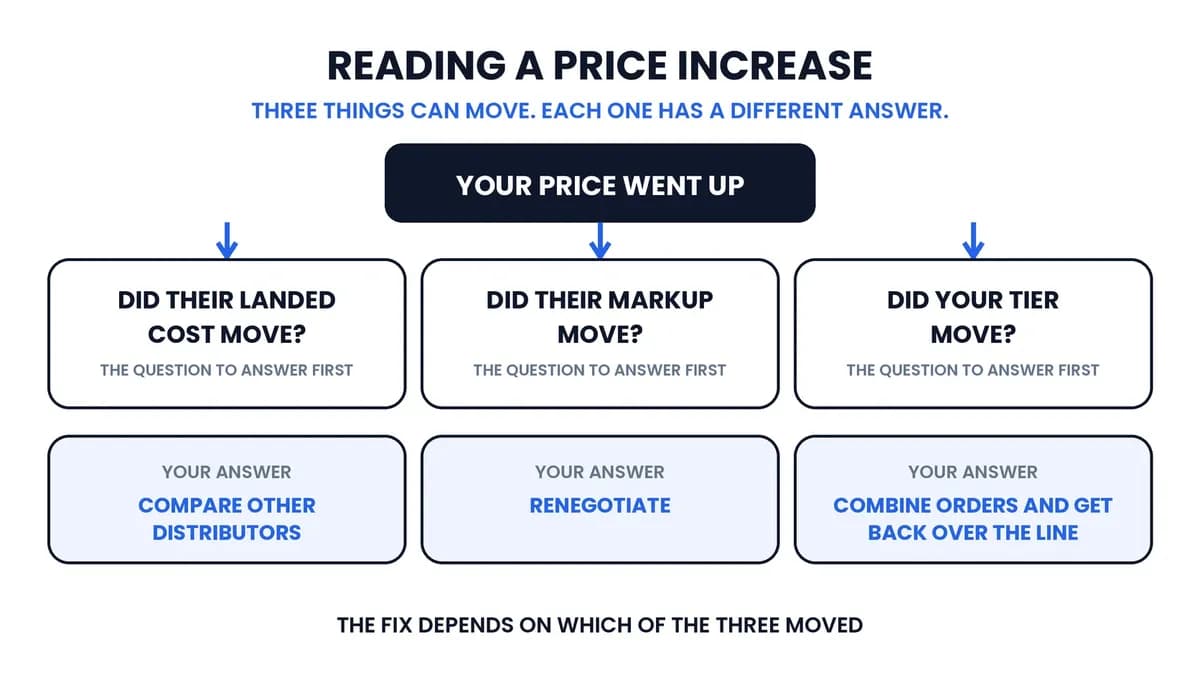
The same model explains a price rise, too. If your distributor puts prices up, one of three things happened. Their landed cost went up, their markup went up, or your tier changed. Each one has a different fix. If landed cost went up, check other distributors, because theirs may not have. If markup went up, talk to the rep. If your tier dropped, put your orders together and get back over the line.
Takeaways You Can Use Without Any Tool
- A distributor price is landed cost, plus markup, split into tiers. The markup is smaller than you think. The big differences hide in the landed cost.
- Markup and margin are different numbers for the same dollars. Ask which one the rep means before you negotiate.
- Compare delivered net cost, at the quantity you will really buy. List price and prices without shipping both mislead.
- Find out if your distributor's tiers work by product, by order, or by account. Putting orders together is the cheapest way to move up.
- The account tier is often not printed. Ask for the volume number after a few months of clean orders.
- A better tier from the wrong distributor can still be a worse price. Compare across distributors, not just across tiers.
Tiers Are the Distributor’s Costs in Disguise
Once you know how distributors set prices, you stop asking "why is this so expensive?" and start asking "which part of this number can move, and who else carries this product for less?" The tiers are just the distributor's costs in disguise. Change what you cost them, and the tier changes with it.
Before your next reorder, search the product free and compare real cost and real stock across every verified distributor in our network that carries it. Connect when the numbers work for you.
Frequently asked questions
01How much do distributors mark up?
02What is cost-plus pricing for a distributor?
03What is the difference between distributor margin and markup?
04What is list price vs net price in wholesale?
05How do I get better wholesale pricing from a distributor?
The B2B SupplierHub Team
Wholesale & sourcing
Stop hunting suppliers by hand. Type a UPC instead.
B2B Supplier Hub shows the suppliers in our network carrying a product on one page: wholesale cost, stock, and retail price side by side. Free to search, no card required.