
Supplier Management
Distributor Lead Times: What Is Normal and How to Plan Around Them
For an item in stock at a US distributor, a normal distributor lead time is counted in days. The distributor packs your order and hands it to the carrier, and FedEx quotes ground shipping at 1 to 5 business days in the contiguous US. For an item on backorder, the wait is counted in weeks, sometimes months. It depends on when the distributor gets its own next delivery from the brand.
Neither number is the total waiting time. Once the boxes arrive, you still have to check them in and get the stock ready to sell. Plan a reorder on shipping time alone, and you can run out before the new stock is ready.
What a Distributor Lead Time Is Made Of
Lead time is the time between placing an order and having stock you can sell. Shipping, also called transit time, is only one piece of it. An in-stock order goes through four steps.
- The distributor packs it. This is called handling time. Every distributor has a daily cutoff, and an order placed after it waits until the next business day. Ask for the cutoff time during your first 30 days with a new distributor.
- The carrier moves it. Small orders go by parcel and take a few business days, depending on how far the warehouse is from you. Bigger orders go on a pallet by truck, which runs on its own schedule and may need a delivery appointment.
- You check it in. Someone counts the boxes, matches them to the invoice and notes anything missing. In a busy week, this can take days. If something is missing, our guide to supplier short shipments covers what to do next.
- You get it ready to sell. Labels, bundles and repacking all happen here.
If you sell through FBA: add the time it takes your shipment to reach Amazon and get checked in. Arriving and being checked in happen on different days, and the gap grows in Q4. Our Q4 sourcing timeline covers the dates.
That is the real difference in lead time vs transit time. Transit is step 2. Lead time is all four steps added together, and it's the number to plan with.
What Is a Normal Lead Time for Wholesale Orders?
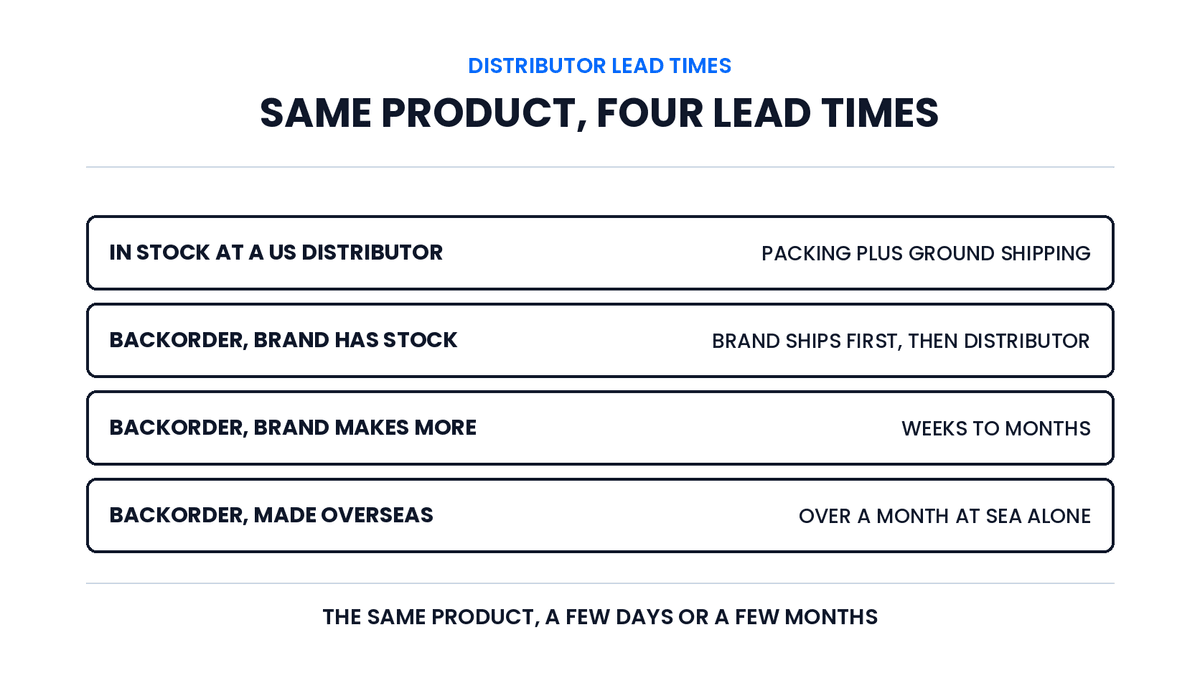
It depends mostly on one thing: where the item is when you order. The same product can be a few days away or a few months away.
Where the item is | What decides the wait | What to plan with |
|---|---|---|
In stock at a US distributor | Packing, then ground shipping | Packing time plus 1 to 5 business days by ground |
On backorder, but the brand has stock | The brand ships to the distributor first, then the distributor ships to you | The date the distributor expects the brand's shipment |
On backorder, and the brand has to make more | The brand's production, then shipping to the distributor | Weeks to months. Ask for the production date, not just "on backorder" |
On backorder, and the item is made overseas | Production, then ocean shipping, then trucking | Over a month for the sea trip alone |
Bought direct from the brand | The brand's own shipping schedule | Whatever the brand confirms in writing |
The overseas row is the one that catches people out. Flexport tracks how long cargo takes from a factory in China until the container leaves a US port. In the week to August 10, 2026, the median was 37.6 days to the West Coast and 66.1 days to the East Coast. After that, the distributor still has to receive the stock and ship your order.
Factories are waiting longer too. In September 2026, US factory buyers reported an average lead time of 84 days for the materials they build products with, and deliveries slowing for the tenth month in a row. If a brand has to make more of an item before it can restock your distributor, those delays sit behind your backorder date.
With waits that differ, the most useful thing to know before you order is who has the item on the shelf today.
Backorder Lead Time: Whose Date Is It?
When a distributor shows a backorder date, that date usually belongs to the distributor. It is when they expect stock to arrive from the brand. Your stock comes later, after they check it in, pack your order, and ship it.
The date can also slip. If the brand ships late or sends less than ordered, the distributor's date moves too, and nobody may tell you. Even when the stock arrives, some of it may already be promised. Distributors fill older backorders first, and they share scarce items out across their accounts. This sharing out is called allocation.
So for any backorder that matters, ask your distributor three things:
- When does your shipment from the brand arrive?
- How much of it is already promised to other accounts?
- Will my order ship from that shipment or a later one?
Your rep can usually answer all three. Ask for the date in writing, and ask them to email you if it moves. Our guide to working with a distributor sales rep shows you how to ask for a straight answer. If the date is later than your stock will last, read what to do in the first 72 hours after a supplier stockout.
Before you accept one distributor's date, check whether another distributor has the item in stock, and how old that stock number is.
Check the Date on the Stock Number
A stock number only tells you what was true when someone counted. A count from this morning is useful. The stock column in a catalog emailed last month only tells you about last month.
So look at the date before you look at the number. If the date is recent and there's plenty of stock, plan with the in-stock row of the table. If the date is old or the stock is close to your order size, plan as if the item could go on backorder. Confirm with the distributor before you spend the money or promise the stock to anyone.
You can do this anywhere you see stock: a distributor's online account, a catalog file or a search result. On B2B Supplier Hub, every listing shows a freshness timestamp, so you can see how recent each stock number is before you plan around it.
The Lead Time Formula and Your Reorder Point
Here is the lead time formula for a wholesale order:
Lead time = packing + any backorder wait + shipping + checking in + getting it ready to sell
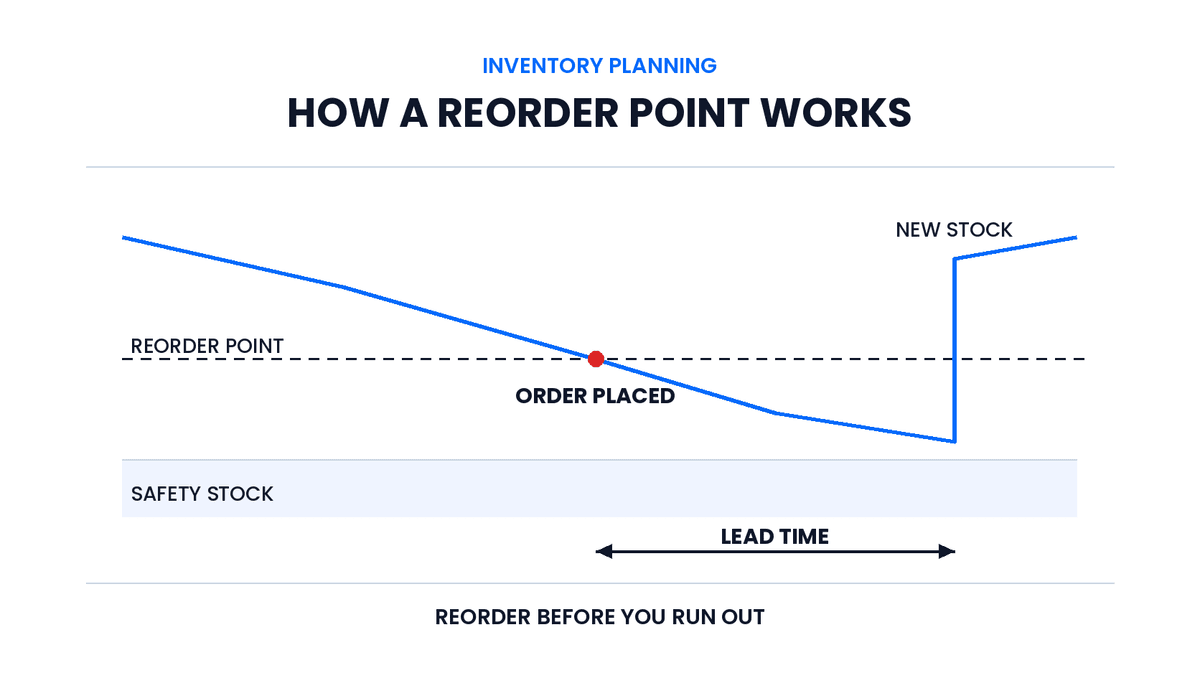
Use it to find your reorder point, the stock level at which you place the next order:
Reorder point = units sold per day × lead time in days + safety stock
Safety stock is the extra you keep to cover late deliveries. Count lead time in calendar days for this math, because you keep selling on weekends.
A quick example with round numbers. An item sells 6 units a day, and your full lead time from a distributor with stock is 8 days. That covers 48 units. Your last few orders came up to 3 days late, so you keep 3 extra days of sales, or 18 units, as safety stock. Add them up, and you get 66. When you're down to 66 units, you reorder.
Set your safety stock from the delays you’ve actually had with that distributor. If two distributors sell you the same item, work out a separate reorder point for each, because their lead times won’t match. And redo the math before your busy season, when every step takes longer.
How to Reduce Lead Time Without Paying for Faster Shipping
You can't make a brand produce faster. You can control most of the other steps.
- Order before the distributor's cutoff time. Missing it costs you a full business day.
- Ask which warehouse ships to you. Many distributors have more than one, and another location may have stock when yours doesn't.
- Reorder when you hit your reorder point instead of when you run out, so a short backorder doesn't leave you empty.
- Ask about allocation early. When a brand starts rationing an item, accounts that asked ahead have a better chance of getting some.
- Keep a second distributor for your best sellers. If one distributor's date slips, the other may ship from stock. Our post on dual sourcing vs single sourcing explains when a second source is worth it.
If you can't find a second distributor that carries the item, submit a request and our team will find an authorized wholesale distributor for it. It's free on every plan, and you get an answer within 30 days either way.
6 Takeaways for Planning Around Lead Times
- Plan with the full lead time: packing, shipping, checking in and prep, plus FBA check-in if you use it.
- Treat a backorder date as the distributor's date, not yours.
- Ask how much of an incoming shipment is already promised to other accounts.
- Look at the date on a stock number before you trust it.
- Set your reorder point from real daily sales and the delays you've actually had.
- Keep a second distributor for items you can't afford to wait on.
Plan With the Distributor Lead Time You Can See
A ship date only tells you when the box leaves the warehouse. For a reorder, you need to know when you can sell what's inside it. That distributor lead time depends on where the stock is today and how recently someone counted it, so check both before you order.
Before your next reorder, search a product free. You'll see stock from every verified distributor in our network carrying it, and when each stock number was last updated.
Frequently asked questions
01What is the typical lead time for ordering inventory?
02What does lead time mean for orders?
03What is the standard lead time for delivery?
04What is the difference between lead time and transit time?
The B2B SupplierHub Team
Wholesale & sourcing
Stop hunting suppliers by hand. Type a UPC instead.
B2B Supplier Hub shows the suppliers in our network carrying a product on one page: wholesale cost, stock, and retail price side by side. Free to search, no card required.