
Supplier Management
How to Test a Wholesale Supplier's Operational Reliability Before Your First Big Order
Every reseller has done this count at least once. Boxes on the dock, packing list in hand, and the numbers stop matching. You take a deep breath and count again, this time more slowly, wishing you might have overlooked a pallet. You didn't. The order is short, nobody warned you, and the invoice asks for the full amount. The supplier was real, verified, and fully legit. None of that meant they would actually deliver.
That gap is where most first-big-order disasters happen. We covered scams and identity checks in How to verify a wholesale supplier before you wire money. This post covers the question that comes after a supplier passes verification: Can you trust them with a five-figure PO?
"Verified" is not the same as "reliable."
Verification is a background check. Reliability is a track record. A verified supplier has proven who they are. A reliable supplier has proven they ship what they confirm when they say they will and that they warn you early when they can't.
You will not find a track record on their website, in a phone call, or on a price list. There is only one way to get it: order small and measure everything.
The Test Order Method: How to Evaluate a Supplier Before Committing
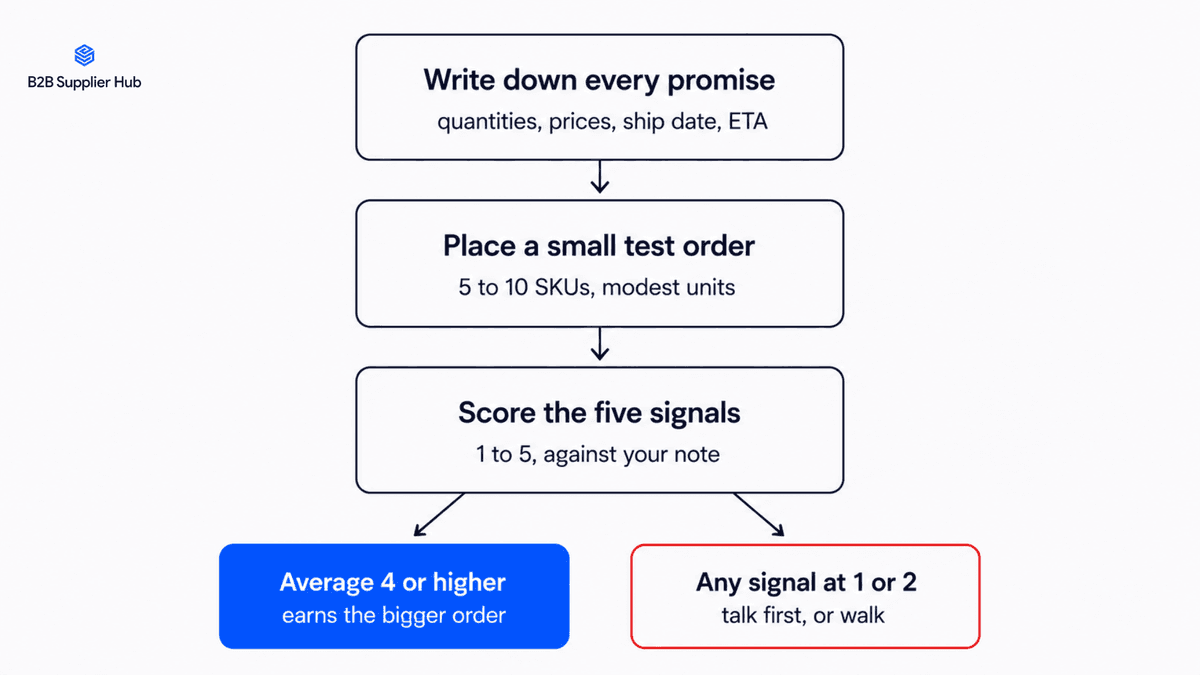
Before any large commitment, place one or two small orders on purpose. Not sample-sized, but rather small enough that if things go wrong, it’s just a minor hassle instead of a major hit to your account. By testing out 5 to 10 SKUs in modest quantities, you can gather a wealth of information.
There’s one crucial rule to make this test effective: jot down what the supplier promised before anything leaves their facility. This includes quantities, prices, shipping dates, and estimated arrival times. Then, compare what actually happened to your notes. If you skip this step, you’ll end up relying on your memory, and memory is always too generous.
Here are the five things to measure.
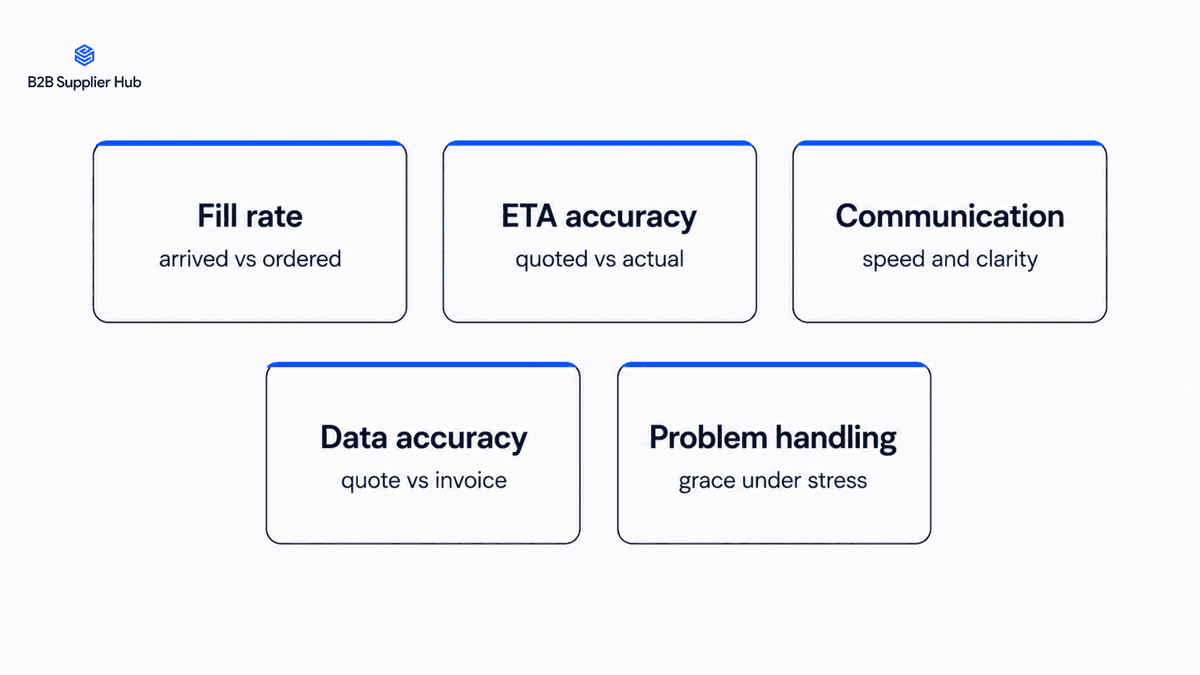
Metric 1: Fill Rate, Whether You Got What You Ordered
The fill rate is the percentage of units you ordered that actually arrive. For instance, if you order 500 units and only receive 470, that gives you a fill rate of 94%.
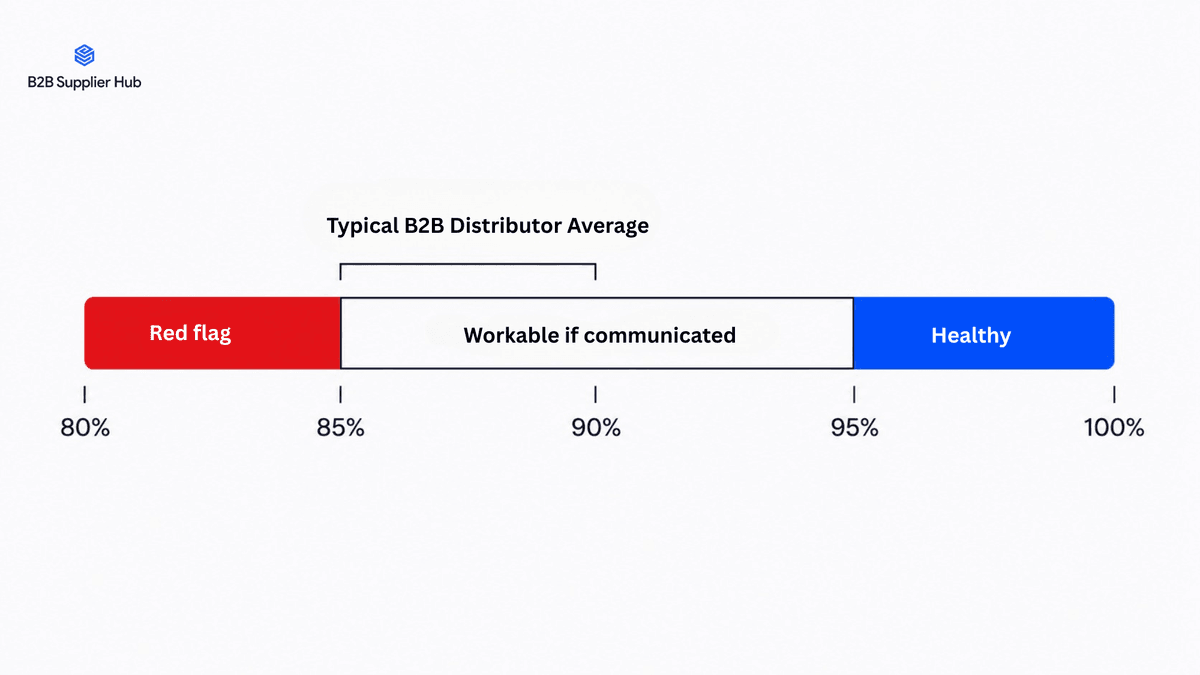
So, what is considered a good fill rate? Industry benchmarks put a healthy fill rate at 92 to 98%, and logistics research shows traditional B2B distributors averaging 85 to 90%. Set your bar from that: 95%+ on in-stock items is healthy for an established distributor. 85 to 95% is workable if they tell you about shortages before shipping, not at receiving. Below 85% is where analysts say performance becomes a real problem, and on a small test order, it's a loud warning. Fill rates rarely improve as orders grow. If they short you on 500 units, expect worse on 5,000.
This matters more than it looks. Their shortfall becomes your stockout, and research on out-of-stocks puts the average sales loss at around 4% of revenue, with much of that demand going straight to a competing seller. In the world of tight wholesale margins, losing a few percentage points is the difference between a good SKU and a dead one.
And watch when you find out, not just the number. A supplier who emails "We can only fill 470 of the 500. Want us to hold or ship partial?" is handling things well, even at 94%. On the other hand, a supplier who quietly ships short and invoices you for the full amount is giving you a glimpse of how they might handle larger orders in the future.
Metric 2: ETA Accuracy, Whether They Deliver When They Say
Compare the quoted lead time to the actual one. Big supply chains track this as OTIF, on-time and in-full, and the standard is strict: 95% or better is excellent, below 85% signals real problems. Major retailers now hold their own suppliers to 95 to 98% OTIF, with penalties below that. You don’t necessarily need a formal program to track this, but the concept is definitely worth adopting.
A supplier who quotes 5 days and delivers in 6 is fine. But if a supplier quotes 5 days and takes 14, it’s not just about being slow; it’s about being unpredictable, and that unpredictability is far more problematic than just a delay. You can plan around a steady 14-day lead time. You can't plan around a coin flip.
Run the same check on any backorder promises. If you hear "Back in stock next week," but it turns into next month, that’s a trend you want to identify when you’re dealing with 50 units, not 5,000.
Metric 3: Communication Quality Before Anything Goes Wrong
How a supplier communicates when everything is normal tells you how they'll act when something breaks. During quoting and ordering, watch three things:
How Fast They Respond to a Basic Question
Ideally, you want same-day or next-business-day responses to your order inquiries. If you’re facing three days of silence before the sale, expect that to stretch into a week after you place your order.
Whether the Answer Actually Solves Your Question
Ask something specific, like "What's your current fill rate on this brand?" A straightforward number is a great indicator. If they say, "We don't track it that way, but here's what I can tell you," that’s acceptable too. But if they start dodging, that’s a red flag.
Whether You're Talking to a Decision Maker or a Bottleneck
Do you have a dedicated representative, or does every email land with someone new? Continuity matters a lot once a shipment goes sideways. Our guide to questions to ask a distributor before your first order covers this conversation in full.
Metric 4: Data Accuracy, Whether Their Sheet Matches Reality
Check that what they quoted matches what was actually shipped and invoiced. Go through the test order line by line: the prices should match what was quoted, the right SKUs and variants are included, and that the quantities on the packing list correspond with the invoice. When paperwork is messy at a small scale, it can lead to a chaotic reconciliation process when things scale up, and it’s also what can turn marketplace invoice reviews into a real headache.
Stock honesty belongs here, too. If items they confirmed as in stock come back short or are substituted, their inventory data is incorrect. This is especially important if you plan to reorder from their catalog on a regular basis, and it's why any data you use to judge a supplier should show its age. It's the reason every listing on B2B Supplier Hub carries a freshness timestamp so you're reading current numbers, not last quarter's price sheet.
Metric 5: Problem Handling, What Happens When Something Goes Wrong
A perfect test order teaches you less than you think because you never saw them under stress. If a small issue does surface, a shorted line, a damaged carton, or a wrong variant, pay close attention. Did they own it fast? Fix it without a fight? Send the credit promptly?
A supplier who handles a $200 problem gracefully will usually handle a $20,000 problem gracefully. A supplier who fights you over $200 has answered your real question.
Score It, Don't Feel It: Turning the Test Order Into a Number
After the test, put the five signals on a simple scorecard: fill rate, ETA accuracy, communication, data accuracy, and problem handling. Score each from 1 to 5 against your written note, not your memory. A supplier averaging 4+ earns a bigger order. A supplier with any signal at 1 or 2 doesn't get a bigger order. They have a conversation, and only if the price advantage is worth it.
The scorecard also gives you a fair way to compare two candidates for the same SKUs instead of defaulting to the lowest quote. The full framework is in our pillar guide, how to Compare Wholesale Suppliers, and if you sell on Amazon, it pairs well with what distributors look for before approving a seller because evaluation runs in both directions.
One more thing. Even a supplier who scores perfectly shouldn't be your only source for a top SKU. Reliable today is not reliable forever, which is why we recommend building a three-supplier bench for your top SKUs.
The Bottom Line: Test Before You Trust a Supplier With Volume
You can't just rely on interviews or verification to find a trustworthy supplier; you need to dive in and make a transaction. Start with a small order, jot down every promise they make before it ships, and then compare what arrives to what was promised. Pay attention to the fill rate, lead time, communication, paperwork, and how they handle issues when things go wrong. These five signals from one small order will give you more insight into that supplier than a month of back-and-forth emails ever could. The sellers who get burned on big first orders almost always skip this step because the price looked too good to wait. Remember that a test order might cost you a few weeks, but a bad supplier at scale can cost you a fortune. A test order is cheap insurance.
Frequently asked questions
01What is a good fill rate for a wholesale supplier?
02How big should a test order be?
03What's the difference between verifying and evaluating a supplier?
04How long should I test a supplier before a large order?
05Can I evaluate reliability without placing an order?
The B2B SupplierHub Team
Wholesale & sourcing
Stop hunting suppliers by hand. Type a UPC instead.
B2B Supplier Hub shows the suppliers in our network carrying a product on one page: wholesale cost, stock, and retail price side by side. Free to search, no card required.