
Sourcing
Liquidation Pallets vs Wholesale: Follow One Unit From the Pallet to the Amazon Listing
Wholesale is the safer way to stock an Amazon store. A liquidation pallet comes with a manifest and a bill from the liquidator, and neither one traces the stock back to the brand. Most of what is on a pallet is also returned stock, which you can't list as New.
Pallets do win on one thing. The price per unit looks much lower, and that is why the liquidation pallets vs wholesale question keeps coming up. The problems appear later, when you try to sell a pallet unit on Amazon. This blog post follows one unit from the pallet to the listing and shows where it gets stuck.
Liquidation Pallets vs Wholesale at a Glance
Below, we have shown how the two compare on the things that decide whether a unit can sell on Amazon as New.
Liquidation pallet | Wholesale from a distributor | |
|---|---|---|
Where the stock comes from | Returns, extra stock and display items | New stock from the brand's supply chain |
How you can list it on Amazon | Used, after you check each unit | New |
Paperwork | A manifest and the liquidator's bill | An invoice with your business name, product codes and quantities |
Cost per unit | Low at first, higher after testing, freight and units that won't sell | Higher, but you know it before you buy |
Buying it again | Rarely possible, since every pallet is a different mix | Yes, same product at the same price level |
Best for | eBay, bin stores, local resale | Amazon and other channels that sell New |
Follow One Unit Off the Pallet
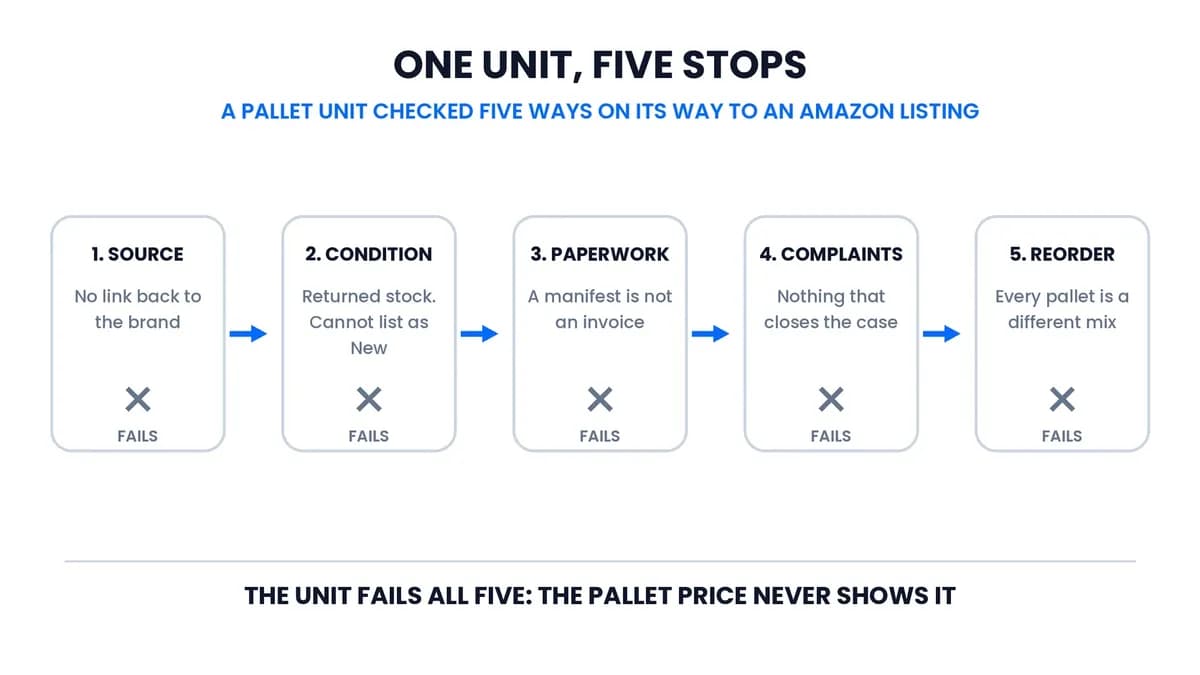
Say your pallet holds a cordless drill kit in a box that looks unopened. The same kit sells well on Amazon. Here is what happens when you try to sell it there.
1. Where Did the Unit Come From?
Liquidation stock is stock a retailer or seller chose not to put back on the shelf. That means customer returns, extra stock and items taken off display. Amazon runs its own version of this for sellers who use FBA. An Amazon staff post on FBA Liquidations explains that contracted liquidators buy returned and extra inventory in bulk. They typically pay 5 to 10 percent of the product's original value.
That low price shows how little the stock is worth to the people selling it. It also hints at how far the unit has traveled from the brand. The drill kit may have gone from a distributor to a seller, then to a shopper, back to a warehouse, to a liquidator, and finally to you. The only invoice that links it to the brand belongs to the business that first bought it, and you will never see that invoice.
2. Can You List It as New?
Amazon's condition guidelines say a New item should look like it came off a store shelf in its factory packaging. The guide also says New condition is a requirement for becoming the Featured Offer, which is the main buy button on a listing.
A returned unit has already been in someone's home. Amazon doesn't send FBA returns back out as New either. Through FBA Grade and Resell, Amazon checks eligible returns and relists them as Used, graded from Like New down to Acceptable. If Amazon grades a returned box as Used, listing a similar box as New is a risk to your account.
An unopened box doesn't prove much either. The National Retail Federation's 2025 returns report found that 9 percent of all returns are fraudulent. Among the problems it lists are people sending back different items or empty boxes. If a box like that reaches your buyer, the complaint comes to you.
3. What Paperwork Do You Have?
A pallet usually comes with two papers. One is the manifest, which lists what the liquidator says is on the pallet. The other is the bill for the pallet. Neither one works as a supplier invoice on Amazon.
Amazon staff guidance on invoices asks for a completed order, the supplier's contact details, product codes and quantities that match your sales. Now check a pallet against that list. The supplier on the bill is the liquidator. The manifest may not show a UPC or model number for every item. You also get only one or two of each item, which can't support months of sales.
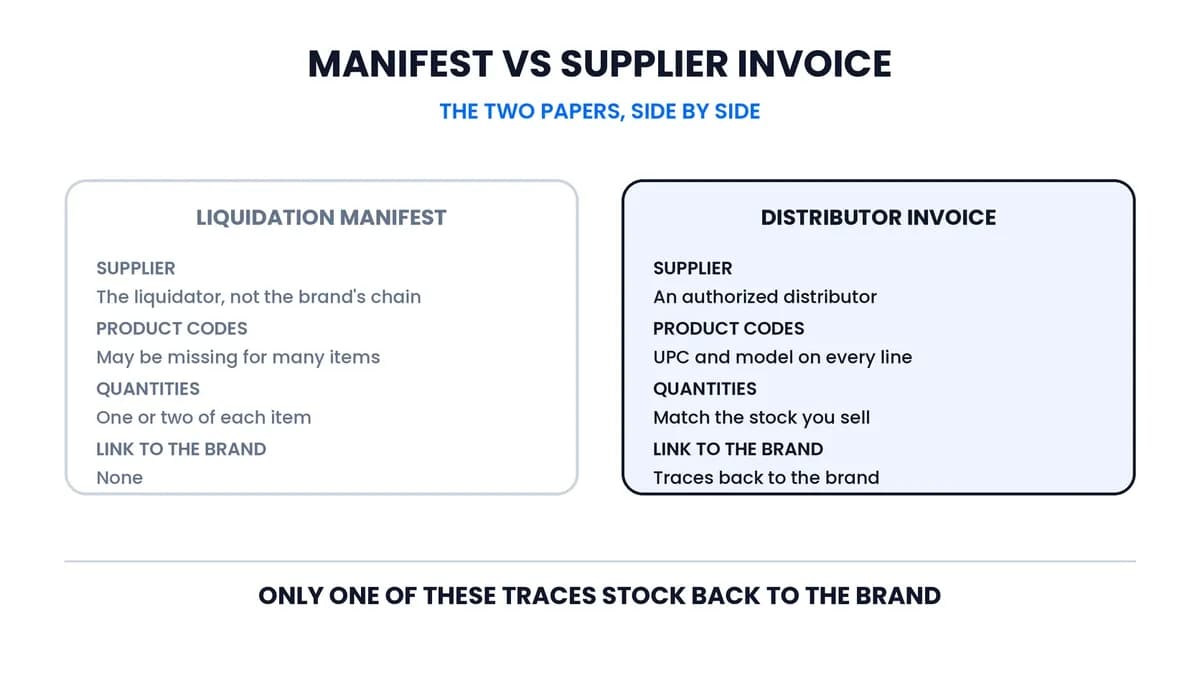
Brand and category approvals ask for even more. Reviewers look for an invoice that links your stock to the brand's authorized supply chain. A liquidator's bill can't do that, even when everything on it is true. Our guides on what a valid wholesale invoice looks like and Amazon ungating invoice requirements show what does pass. The pallet gave you a product to sell, but not the paperwork that proves where it came from.
4. What Happens If a Buyer Complains?
Say the kit sells and the buyer reports it as fake. Or the brand files a complaint about the listing. Amazon will ask where you bought it. What closes the case is a supplier invoice that traces the stock back to the brand. A liquidator's manifest can't do that. Our guide to Section 3 inauthentic complaints explains how that request works.
You won't see this cost when you price the pallet. The complaint sits on the same account that holds every approval you earned with real wholesale invoices.
5. Can You Buy It Again?
Now say nothing goes wrong and the kit sells fast. You want twenty more, but the pallet can't give you any. Each pallet is a one-time mix, and the next one will hold different products.
Wholesale is built for this. When a product sells, you reorder it at the same price level, in New condition, with a fresh invoice each time. That repeat order is what keeps an Amazon business running, and a pallet can't offer it.
Wholesale vs Liquidation Profit: Where Cheap Units Get Expensive
A pallet price looks great because you divide it by every item on the manifest. The number that matters is the cost of each unit you actually sell:
Real cost per unit = everything you spent ÷ units you actually sell
Everything you spent includes the pallet, the freight, the hours you spend testing and grading, and the cost of getting rid of what won't sell. Units you actually sell leaves out anything broken, missing parts or in the wrong condition for your channel. After the pallet arrives, the first number goes up and the second goes down. On Amazon, the units you do sell go up as Used, and Used offers usually sell for less than New.
Wholesale flips this. You know the cost per unit before you buy, and the stock is new. You can also work out your profit after marketplace fees before you order. The catch is real. Wholesale asks for approval, minimum orders and more cash up front, and each unit costs more. Our Amazon wholesale roadmap for beginners walks through those steps. What you get in return is a number you can plan around.
Where Liquidation Still Fits
None of this makes liquidation a bad business. Pallets suit channels made for used and open-box goods. eBay, for example, lets sellers list items as Open box, Used, or For parts or not working. A checked and graded pallet unit fits there, and many resellers run that model well. The problems start when pallet stock goes into an Amazon account that sells New. In the end, the choice between liquidation and wholesale reselling comes down to where you plan to sell.
Use the Pallet as Research, Then Buy Wholesale
If you already buy pallets for eBay or a local store, they can still help your Amazon business. They show you which products sell. When an item from your last pallet sells fast, treat it as a lead and look for it through wholesale.
- Write down what identifies it: the UPC, model number and brand on the box or label.
- Check whether the brand or category needs approval on your Amazon account.
- Search the product free to see real cost and stock from verified distributors in our network that carry it new. You'll also see what you'd make after selling fees.
- If the search finds nothing, Request a Supplier. Our team looks for an authorized wholesale distributor who carries the product, verifies them and brings them onto the platform. It's free on every plan, and you get an answer within 30 days either way.
- Apply to the distributor whose numbers work. You still have to wait for approval, but you'll know the cost and stock before you apply.
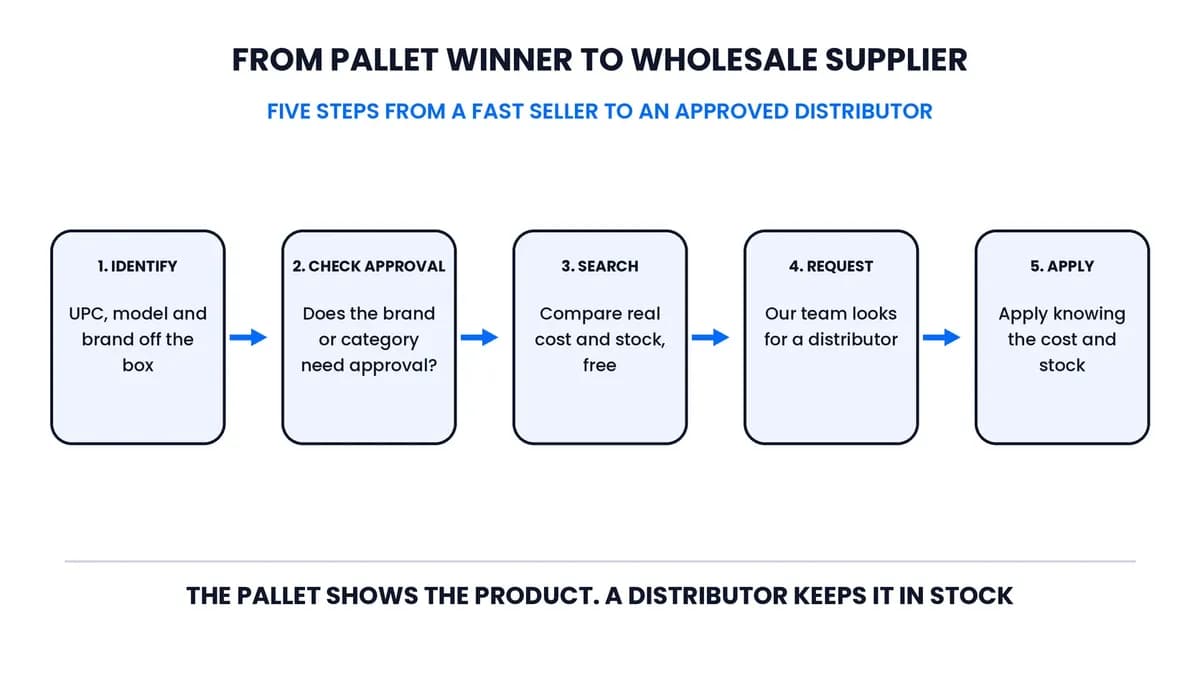
This method is called reverse sourcing. You start with a product you know sells and work back to a supplier who can keep it in stock. The pallet showed you the product, and a distributor can supply it new with an invoice every time it sells. Before you apply to anyone, compare the cost and stock side by side.
5 Checks Before You Buy Your Next Pallet
- Decide where you'll sell before you bid. If it's Amazon in New condition, a pallet is the wrong source.
- Ask what paperwork comes with the load: a manifest, a bill of sale, or nothing.
- List returned units in the Used grade they really are, even if the box is sealed.
- Work out the cost per unit you can sell, not per item on the manifest.
- When a pallet item sells well, find it through a distributor and buy it new.
The Choice Is Made Before Price Comes Up
For an Amazon seller, the liquidation pallets vs wholesale choice is decided before price even comes up. A pallet unit can't be listed as New and can't be traced to the brand. You also can't buy it again. That makes it a one-time sale that puts your account at risk. Wholesale costs more per unit and needs approval first. In return, every unit arrives new, with an invoice that holds up if Amazon asks.
If a pallet has already shown you a product that sells, take it to the wholesale side. Create a free account on B2B Supplier Hub, no card required, and search it before you apply to anyone.
Frequently asked questions
01Is buying Amazon liquidation pallets worth it?
02Are Amazon return pallets real or fake?
03Can you sell liquidation items on Amazon?
04Will Amazon accept a liquidation pallet invoice for ungating?
The B2B SupplierHub Team
Wholesale & sourcing
Stop hunting suppliers by hand. Type a UPC instead.
B2B Supplier Hub shows the suppliers in our network carrying a product on one page: wholesale cost, stock, and retail price side by side. Free to search, no card required.