
Sourcing
Prep Center vs Doing It Yourself: The Real Cost
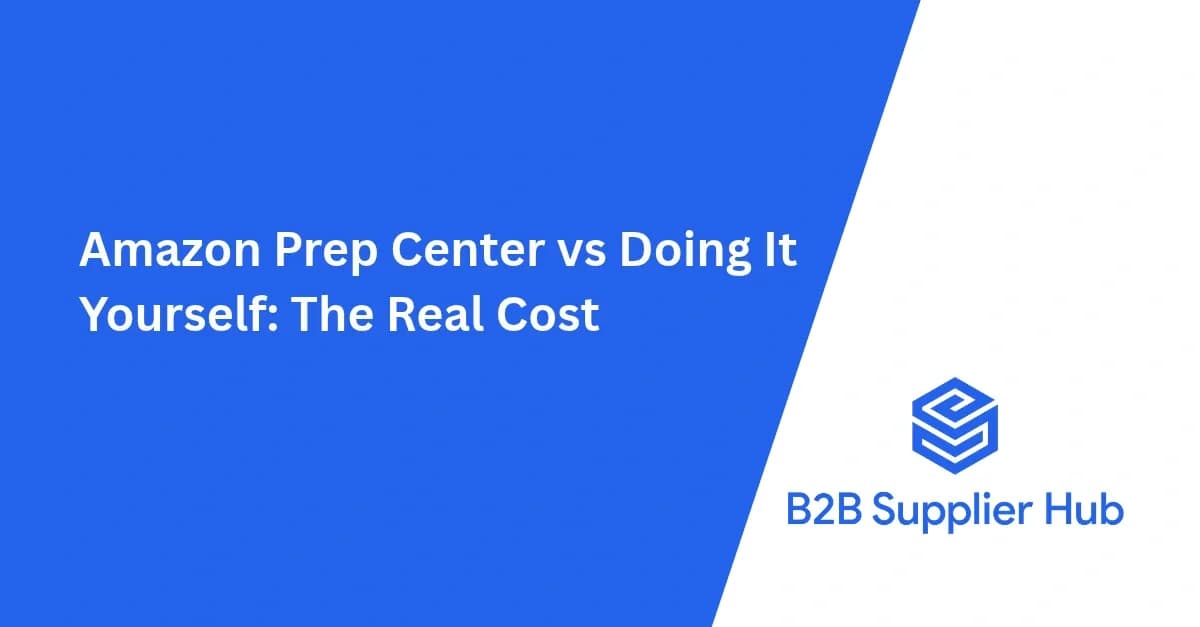
For a wholesale reseller, the Amazon prep center vs doing it yourself choice depends on one number. The prep center price pages we checked charge about $0.40 to $1.50 a unit all-in. Smaller sellers pay the top of that range. Doing it yourself costs less in cash, but your time has a price too. Put a number on your hour, and you can see which one is cheaper at your volume.
The choice got more urgent this year. Amazon stopped prepping and labeling for US sellers on January 1, 2026. And since March 31, wholesale resellers have had to put an Amazon barcode on nearly every unit. So the work now falls on you or on someone you pay.
What Changed in 2026: Amazon No Longer Preps for You
Until this year you could pay Amazon to bag and label your units when they arrived. That option is gone in the US. Amazon's developer notice on the change says it covers "all inventory that is sent to the US FBA service."
An Amazon staff reply on the seller forums says what that means for you: "all products must be prepped and labeled before sending them to our facilities." If a shipment arrives without the right prep and labels, units that are damaged or can't be traced won't be reimbursed. A seller asked if that meant hiring a prep center. An Amazon staff member answered: "That's one option." The other option is doing it yourself.
The second change matters even more for resellers. Amazon announced on its forums that commingling would end for inventory shipped on or after March 31, 2026. Resellers who aren't the brand's representative in Brand Registry "will now be required to use Amazon barcode stickers for products even if they have a manufacturer barcode." So a UPC on the box isn't enough anymore. Each unit you send needs its own Amazon label, and that adds a lot of prep work.
What a Prep Center Costs Per Unit
We read the public price pages of four US prep centers in November 2026. We're not naming them, because this isn't a recommendation. The table shows what they charge, line by line.
Service | What the pages charge |
|---|---|
All-in prep (receive, label, bag, create shipment) | About $0.40 to $1.50 a unit |
Under 1,000 units a month | Roughly $1.00 to $1.50 a unit |
Over 3,000 units a month | Roughly $0.60 to $0.95 a unit |
FNSKU label only | $0.25 to $1.00 a unit |
Poly bag | $0.35 to $0.50 a unit, often included |
Bubble wrap | $0.60 a unit on the one page that priced it |
Bundling or multipacks | $0.25 a unit on one page, quoted on the rest |
Receiving | Included on all four. Container unloads $300 to $500 |
Storage | $30 to $50 a pallet a month, or per unit after a free period |
Minimums | None, 300 orders a month, or 1,000 units a month |
The headline rate doesn't show everything. At least one page billed supplies like boxes and pallets on top. One center wanted a monthly software plan before it would prep for you. And the per-unit price drops as your volume grows. The rate you get as a new seller isn't the rate you'll pay at scale.
Compare the all-in rates. That's what you'd pay for a carton to arrive from your distributor and leave as a labeled, bagged Amazon shipment.
Prep is one line in your landed cost, next to the product, freight and Amazon's fees. So check the product is worth buying before you price the prep. You can search a product free and see real cost and real stock from every verified distributor in our network that carries it.
What Self Prep Actually Costs
Self prep feels free because nobody sends you an invoice. But it has three costs.
Supplies. Label sheets, a thermal or laser printer, poly bags, bubble wrap, tape and boxes. Amazon's prep and labeling guide sets the specs. Labels are "1 to 2 inches tall, 2 to 3 inches wide." They're printed in "black ink on non-reflective paper." Any bag with an opening larger than 5 inches needs a suffocation warning. And labels have to be readable on the outside of the bag.
Space. Cartons come in, units get labeled, cartons go out. A small order fits on a table. A pallet needs a garage and a truck that can drop it off. Our post on LTL freight for wholesale orders covers what receiving a pallet involves.
Time. This is the biggest cost and the easiest to overlook. You open cases, check counts, label each unit and bag the ones that need it. Then you build the shipment in Seller Central, pack boxes and print box labels. Now that nearly every wholesale unit needs an Amazon barcode, you touch every unit at least once.
Prep Center vs Self Prep: The Break-Even Math
You need three numbers to compare the two, and only you know them.
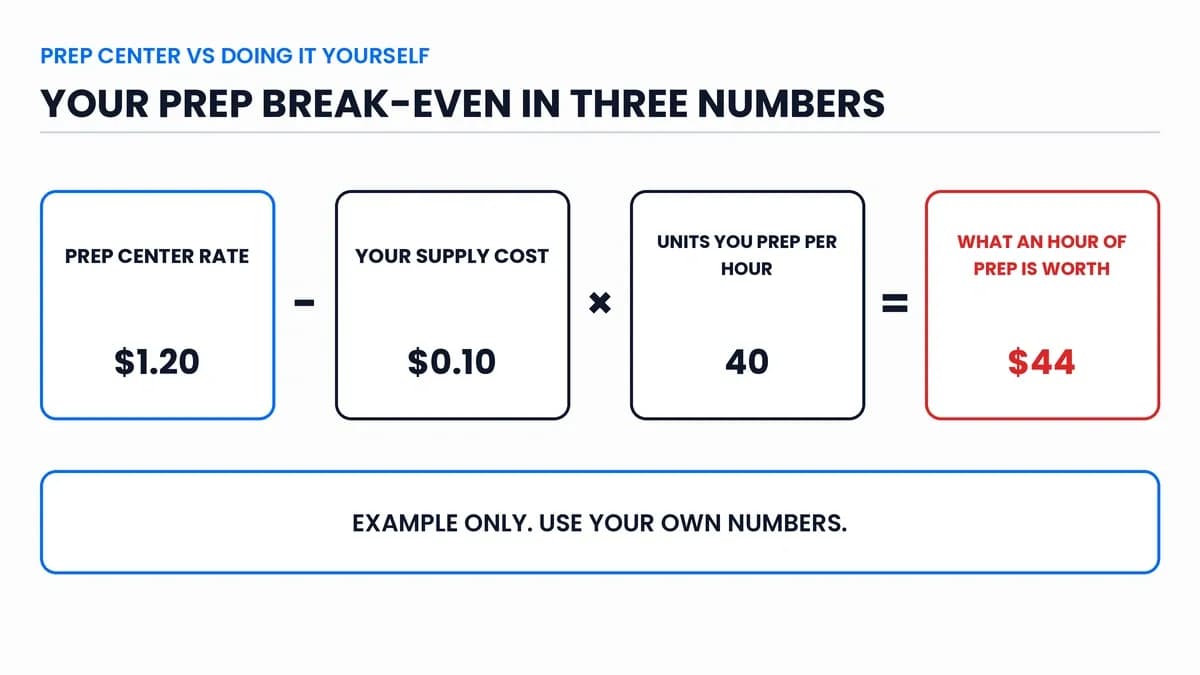
- The prep center's all-in rate for your volume. From the table above, say $1.20 a unit.
- Your supply cost per unit. Labels and bags. Work it out from what you actually pay. For this example, say $0.10.
- How many units you prep in an hour, start to finish, boring parts included. Time yourself on a real order. For this example, say 40.
The prep center saves you $1.10 a unit. That's $1.20 minus the $0.10 you'd spend on supplies anyway. At 40 units an hour, the center saves you $44 for every hour of prep. So ask yourself one thing. Is an hour of your time worth more or less than $44?
If you'd spend that hour finding products or talking to distributors, it's probably worth more. Then the prep center is cheaper. If you have spare evenings and a small order, self prep wins. These numbers are only an example. Plug in your own, and the answer may flip. Volume changes the answer in two ways. As you grow, the prep center's rate drops. Your own speed has a limit, and so do your hours. At very low volume, minimums can rule a center out. The pages we read set minimums like 300 orders or 1,000 units a month. So a sensible path is to prep yourself at first, then move to a center when you can't keep up.
Three Cases Where a Prep Center Is the Realistic Option
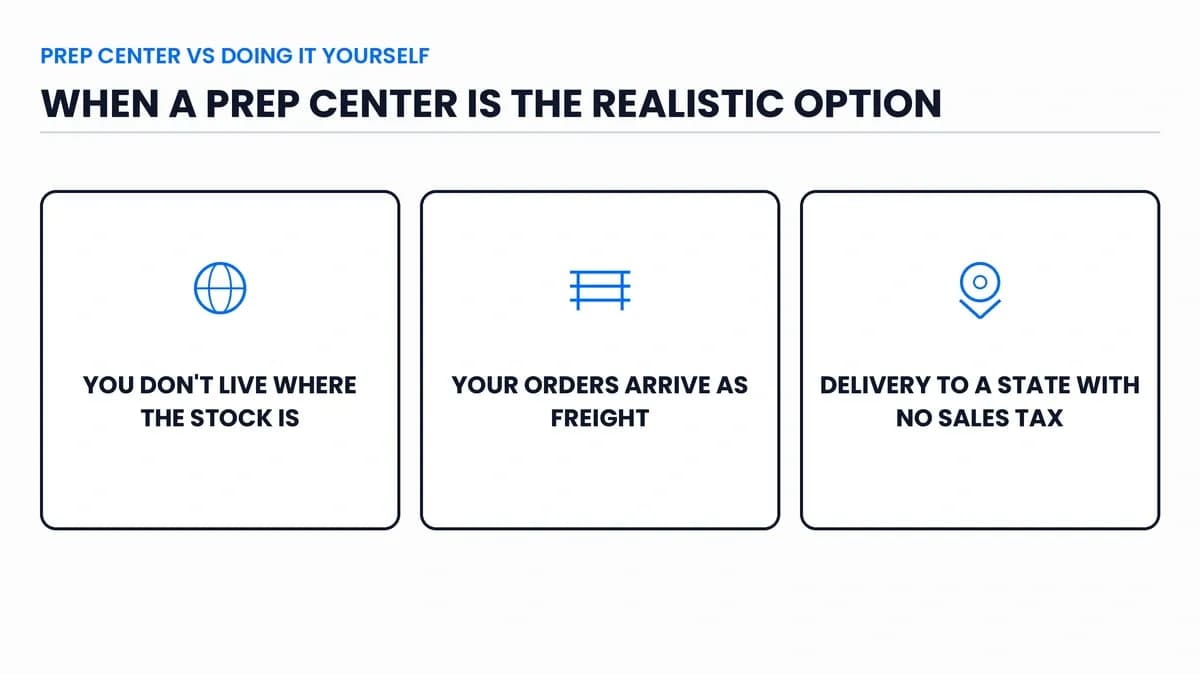
Sometimes the calculation doesn't matter, because doing it yourself isn't practical.
You don't live where the stock is. Maybe you sell on Amazon.com but live outside the US, or you travel a lot. Someone still has to receive and label the cartons. A prep center can do that for you.
Your orders arrive as freight. A pallet from a distributor needs a dock, a forklift or a liftgate delivery. A prep center has the dock. If you don't, every pallet needs a liftgate delivery, so ask your carrier what that adds to each order.
You want stock delivered to a state with no sales tax. The Tax Foundation lists five states with no statewide sales tax: "Alaska, Delaware, Montana, New Hampshire, and Oregon." When a distributor ships to one of them, there's no state sales tax to charge on that delivery. A prep center in one of those states can help while your resale certificates are still being accepted elsewhere. But it doesn't replace a resale certificate where you need one. It doesn't settle your own tax registration questions either. Our post on the multistate resale certificate covers how certificates work across states. This is general information, not tax advice.
What to Ask a Prep Center Before You Send Stock
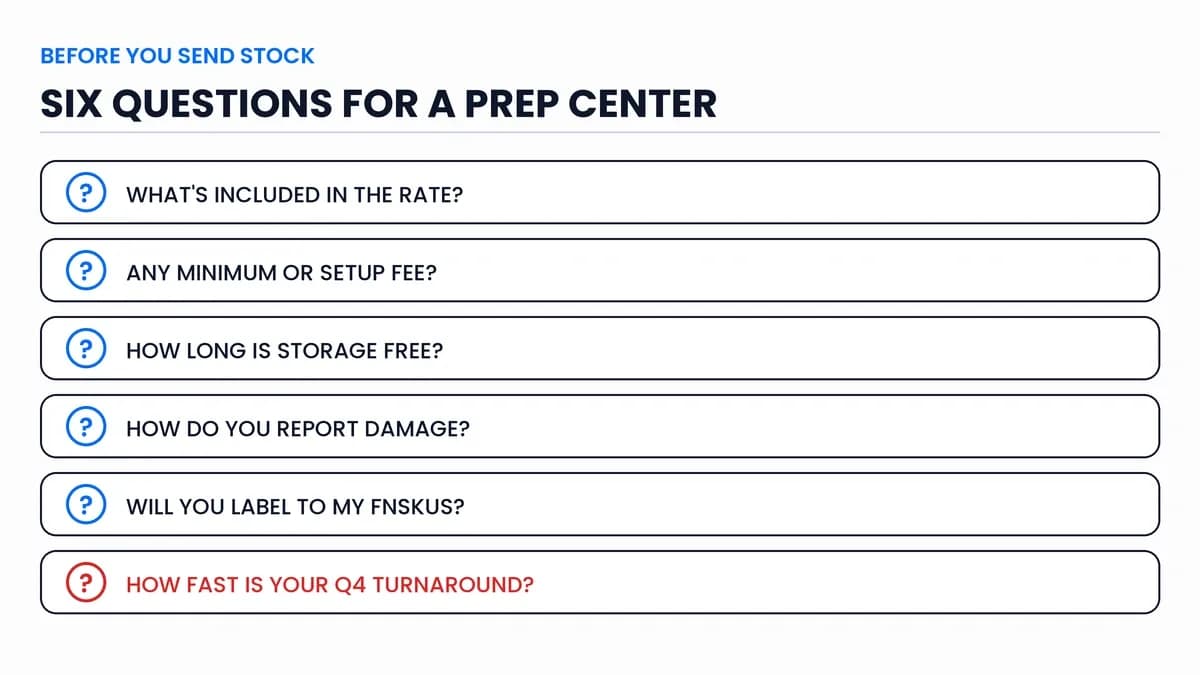
If you decide to use one, ask these questions first. They save you surprises on the first invoice.
- What's included in the per-unit rate, and what's billed separately? Ask about supplies, box labels and shipment creation.
- Is there a monthly minimum, a setup fee or a software plan?
- How long is storage free, and what does it cost after that?
- How do you report counts and damage when a shipment arrives?
- Will you label to my FNSKUs and send to the inbound locations I choose?
- How fast is your turnaround, especially in Q4?
The Q4 question matters most. Our Q4 sourcing timeline suggests keeping some stock at your prep center or warehouse in early November. If the center is slow, then you lose sales. Once the units are labeled, How to Send a Wholesale Order to Amazon FBA covers the shipment itself.
Amazon Prep Center vs Doing It Yourself: The Takeaways
- Amazon ended US prep and labeling services on January 1, 2026. Now it's you or a third party.
- Since March 31, 2026, resellers need an Amazon barcode on nearly every unit. That adds prep work.
- The prep center pages we read charge about $0.40 to $1.50 a unit all-in. The rate drops as volume rises.
- Self prep costs supplies, space and your time. Time is the easiest cost to forget.
- To compare, take the center's rate minus your supply cost, times your units per hour. Weigh that against what your hour is worth.
- A prep center is the realistic choice if you live away from the stock, receive freight, or want a no-sales-tax state.
Count Your Hour Before You Count the Savings
Self prep is only cheaper if your time is cheap. With small orders and spare evenings, it may well be. Maybe your hours go into finding products and opening distributor accounts. Then a prep center can be the better use of money, even at $1 a unit.
If a product you want has no distributor in our network yet, you can Request a Supplier and our team will go looking for one.
Once you have the product, time yourself on one real order. With that number, you can make the Amazon prep center vs doing it yourself call for your own business. Then add the real prep cost to every deal you look at. Our Amazon wholesale for beginners roadmap covers the steps before and after prep, from first order to first shipment.
Frequently asked questions
01How much does a prep center cost per unit?
02Is a prep center worth it?
03Do I need a prep center for wholesale?
04Can I do FBA prep at home?
The B2B SupplierHub Team
Wholesale & sourcing
Stop hunting suppliers by hand. Type a UPC instead.
B2B Supplier Hub shows the suppliers in our network carrying a product on one page: wholesale cost, stock, and retail price side by side. Free to search, no card required.