
Sourcing
Wholesale Sourcing Methods: Shows, Lists, Scanning, Reverse
Nobody goes looking for a new supplier for fun. You go because something broke. A distributor raised cost on a product that has sold well for two years, or a supplier ran out and could not say when more was coming. Either way you are left with a product that still sells and nowhere good to buy it.
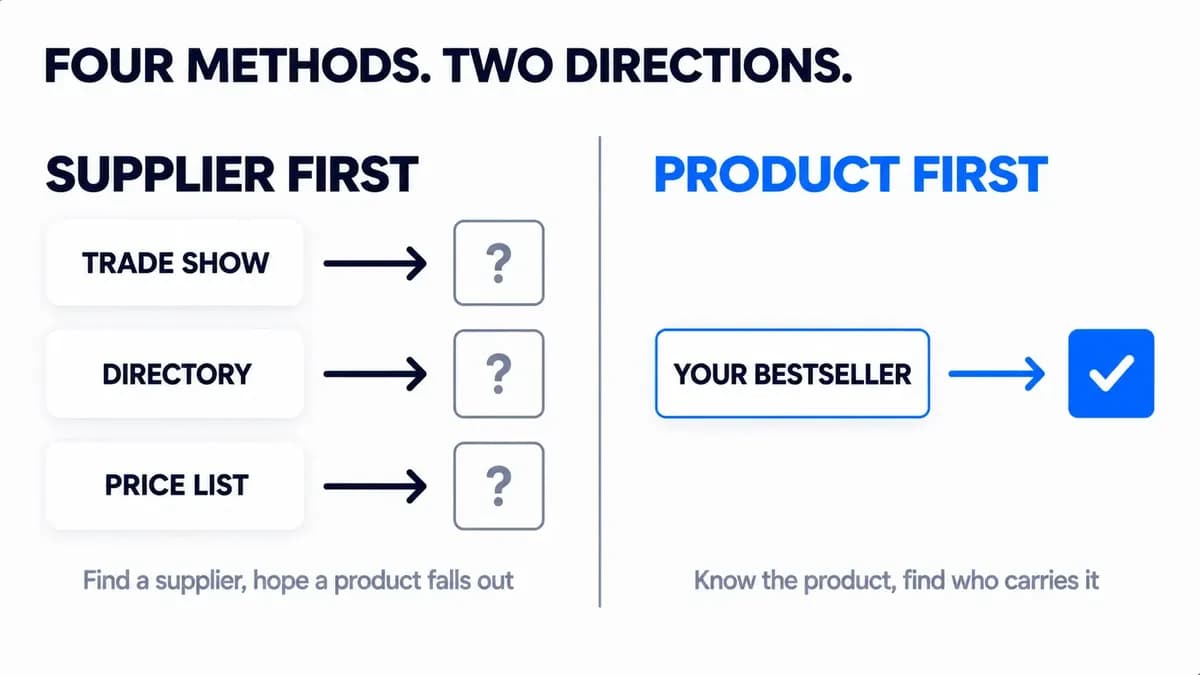
From there you have four options. You can go to a trade show. You can pay a directory for a list of names. You can get a distributor's price list and run it through scanning software. Or you can start with the product and search for who already carries it.
All four work. The difference is what each one costs you, and how each one fails.
Wholesale Sourcing Methods Compared at a Glance
Here is the short version, measured five ways.
- How long until you see a real cost. With a show it is weeks, because pricing only comes once the account is approved. A directory gets you there in days, if the calls and emails get answered, and many do not. Scanning is instant, but only after the distributor has sent you the sheet. With reverse sourcing the cost is the first thing on the screen.
- What you spend before you see a number. A show costs logistical expenses. A directory costs the subscription. Scanning costs the software, plus whatever it took to get the account in the first place. Reverse sourcing costs nothing until you decide to unlock a supplier.
- How often it actually works. Shows are good for relationships and bad for finding one specific product. Directories are full of stale names and middlemen, so a lot of the list goes nowhere. Scanning throws up thousands of lines, most of which never clear your profit target, and the few that do are already crowded. Reverse sourcing works when the network carries your product and comes back empty when it does not.
- Whether the invoice will pass. A show or a price list puts an actual distributor on the other end of the deal, so the paperwork is usually fine. Reverse sourcing into verified distributors gives you the same. Directories are the weak spot, because that is where middleman invoices come from.
- Who else is looking? At a show, everyone on the floor sees the same booths. With a directory, every subscriber gets the same list. With scanning, every approved account gets the same sheet. With reverse sourcing, you picked the product, so fewer people are standing where you are.
Three of these start with the supplier and hope a good product turns up. Only one starts with the product. That difference explains most of what comes next.
Trade Show Sourcing: The Relationship Method
Trade shows are the oldest way to do this, and they have not stopped working. A distributor at a show is there to find new accounts. Walk up, introduce your business, and you become a person to them rather than an application in a queue. That pays off later, when you need a favor on a backorder or a better tier on a reorder.
What you walk away with is a catalog, a rep's name, and an honest answer about what it takes to open an account. Pricing on the spot is rare. The numbers come after the show, once the application clears. So the money goes out early, in flights and hotel nights, and the time goes into the weeks of follow-up once you are home.
The shows themselves are smaller than many resellers remember. The CEIR Index for 2025 came in at 93.6, still 6.4% below 2019, even though attendance grew 4.7% over the year before, and real revenue for the exhibition industry is still more than 10% below where it was before the pandemic. Shows are coming back. Just not to the floor you walked in 2018.
The weakness is that you cannot walk a show floor looking for one specific product. You take what is exhibited. If the brand you need is not there, the trip did not solve your problem. A show helps you meet suppliers. It rarely helps you find one. Which shows and regional events are worth your time is covered in how to find local wholesale distributors.
Supplier Directories: Paying for Names
A directory sells you a list. Supplier names, websites, phone numbers, and a short description the supplier wrote about itself. If you are starting from zero and have no idea who sells in a category, that is a useful place to begin.
But the list leaves out everything that decides whether a supplier is worth your time. There is no per-product cost, no stock number, and no proof the listing is current. On many directories the "verified" badge is a listing tier the supplier paid for, not a check anyone did on the business.
Directories still have a place. If you sell in a category marketplaces do not dominate, or you are chasing an international brand with no obvious US presence, a directory can turn up names you would never find by searching.
The danger is the middlemen. Directories are easy to list on, and a reseller who buys from a middleman gets a perfectly real invoice from a company that is not a distributor. That invoice fails the moment a brand or marketplace asks for proof of supply. By then the money is spent.
Reverse Sourcing vs Price List Scanning
These two are what most serious resellers run week in, week out, so they deserve a direct comparison.
Price List Scanning: Fast, but Only Inside an Account You Already Have
This is the method most resellers already use, and it is quick once the distributor sends you the sheet. You upload the price list, the software matches each line to a marketplace listing, pulls fees and sale price, and shows you which lines clear your profit target. Thousands of lines in minutes. We walked through how it works in our guide on how price list analyzers work.
The catch is the sequence. You need the account before you have the sheet, which means scanning does not help you find a supplier. It helps you find products inside a supplier you already have. And a distributor sends the same sheet to every approved account, because that is the only sensible way to serve hundreds of them. So you are scanning the same lines as every other reseller they approved, and when a line looks good, you are rarely the only one who noticed.
Reverse Sourcing: Start From the Product, See the Cost First
This one does not need a price list at all. You take a product that already sells for you, search it by UPC or name, and see which distributors in the network carry it, what each one charges, and how many they have on hand. Then you compare them before you apply to any of them. The full method is in reverse sourcing for Amazon sellers, and the free way to trace a product to its distributor is in how to find who distributes a product.
Because you chose the product and not the list, fewer people are looking at the same thing. And seeing the numbers costs nothing.
Reverse sourcing has limits too. You only see what is in the network you are searching, so if no distributor there carries your product, the search comes back empty. The distributor still decides whether to approve your account. And on B2B Supplier Hub, the live categories today are electronics, sports and outdoors, and tools and home improvement. What reverse sourcing removes is the wait to see the numbers. The approval is still the distributor's call.
Even so, the numbers are the expensive part of this whole process. On B2B Supplier Hub, you can search a product free and see real cost and real stock from every verified distributor in our network that carries it. The only thing you pay for is the supplier's name, and only when the numbers already work for you.
Invoice Quality: Which Methods Produce Real Proof of Supply
Most resellers do not think about the invoice until a marketplace asks for it. By then it is too late to change where the stock came from.
The rule is the same almost everywhere now. Amazon's guide for category and brand approval says the invoice has to come from a manufacturer or authorized distributor, be dated within the last 180 days, and show your name and address exactly as they appear on your seller account. eBay's counterfeit policy asks for the same thing, an invoice from the brand or an authorized distributor. So the question is never whether the invoice looks real. It is who wrote it.
That makes the comparison easy. If you met the distributor at a show, they are a distributor, and the invoice will say so. If you are scanning their price list, they approved your account, so the same is true. Reverse sourcing into verified distributors gets you there as well. Directories are the one method where this goes wrong, because that is where middlemen live. The invoice looks fine, the listing goes up, and the reseller finds out it was never going to pass when the listing comes down.
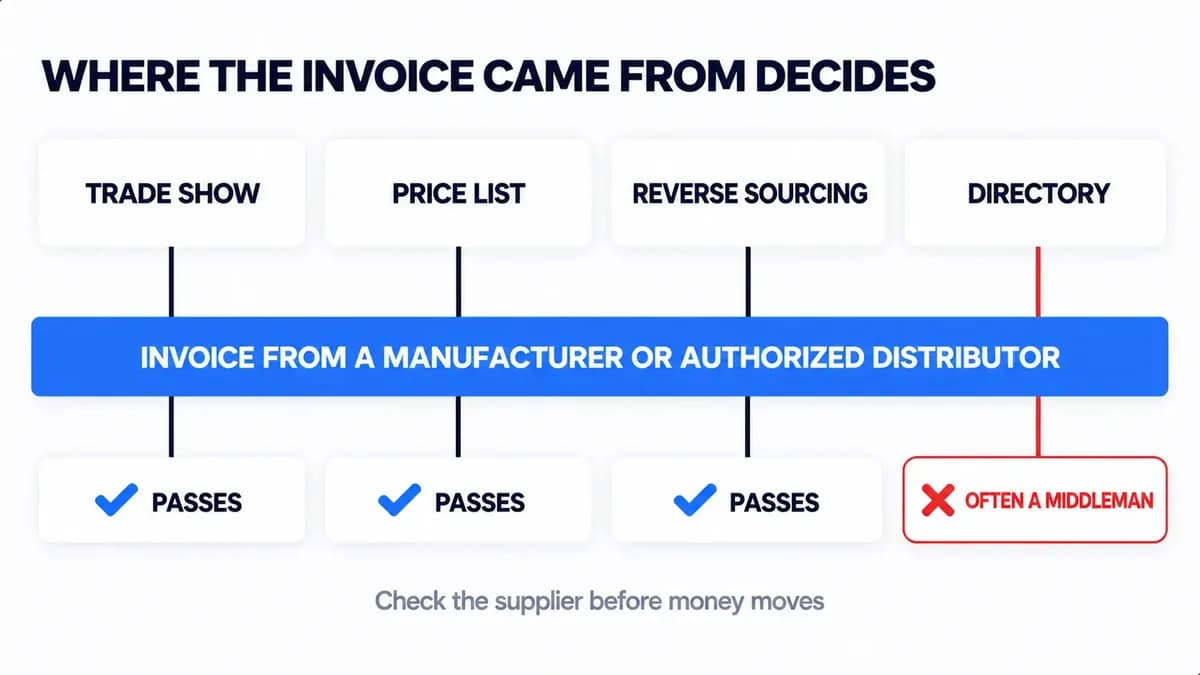
Whatever method you use, check the supplier before money moves. The checks are in how to verify a wholesale supplier before wiring money.
How to Source Wholesale Products: Which Method, When
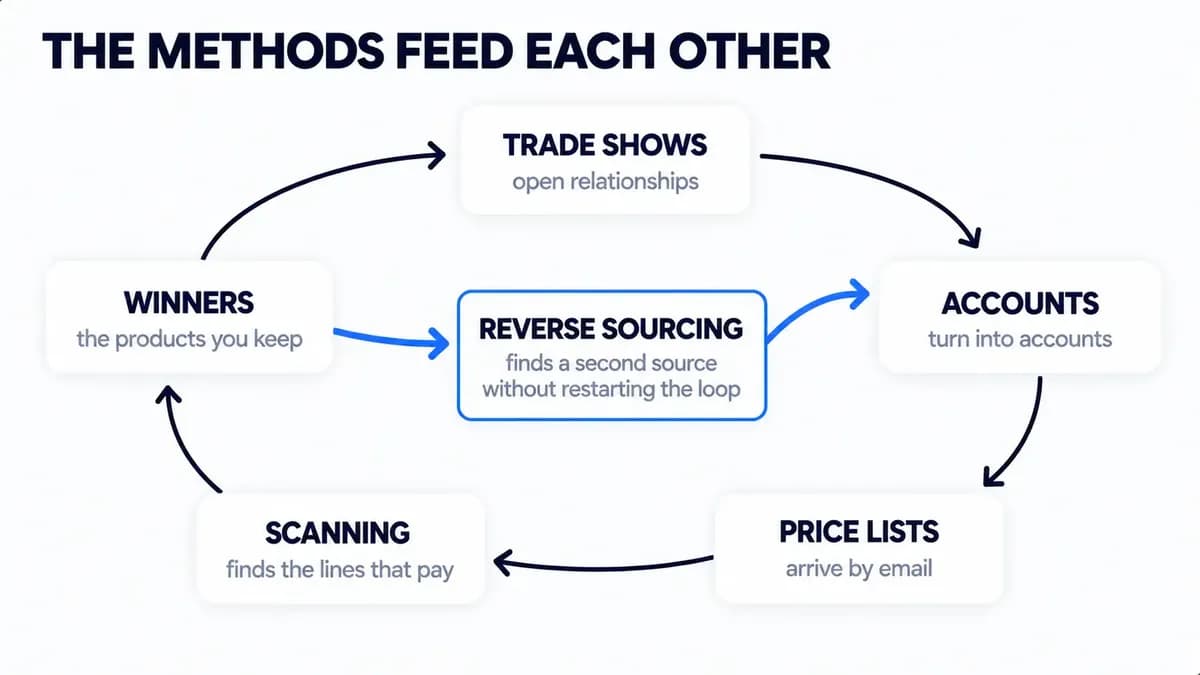
The mistake is treating these four as competitors. In a working business, they feed each other.
Shows open relationships, and relationships turn into accounts. Accounts send you price lists, and scanning finds the winners inside them. Then, when a winner needs a second source, or a supplier stops performing halfway through the year, reverse sourcing finds the replacement without sending you back to the start.
If you have a VA, scanning and reverse sourcing are the weekly jobs you can hand over. Shows and account applications stay with the owner. They are about the relationship, and the relationship is with you.
The Product Is The Shortcut
Every method here gets cheaper when you know the product first. You stop paying for names you cannot use, the lists everyone else is scanning stop eating your week, and a show stops being a bet on whether the right brand turned up.
So start with the product you trust most. Type it into the search and see who carries it and what they charge. If nothing comes back, that does not mean no distributor has it. It means no distributor in our network has it yet. Tell us the product through Request a Supplier and our team will find an authorized distributor who carries it, verify them, and bring them onto the platform. It is free on every plan, and you get an answer within 30 days, either way.
Frequently asked questions
01What is the best way to source wholesale products?
02Is reverse sourcing better than price list scanning?
03Are trade shows still worth it for wholesale resellers?
The B2B SupplierHub Team
Wholesale & sourcing
Stop hunting suppliers by hand. Type a UPC instead.
B2B Supplier Hub shows the suppliers in our network carrying a product on one page: wholesale cost, stock, and retail price side by side. Free to search, no card required.