
Sourcing
What Is a B2B Wholesale Marketplace, and How Is It Different From a Directory?
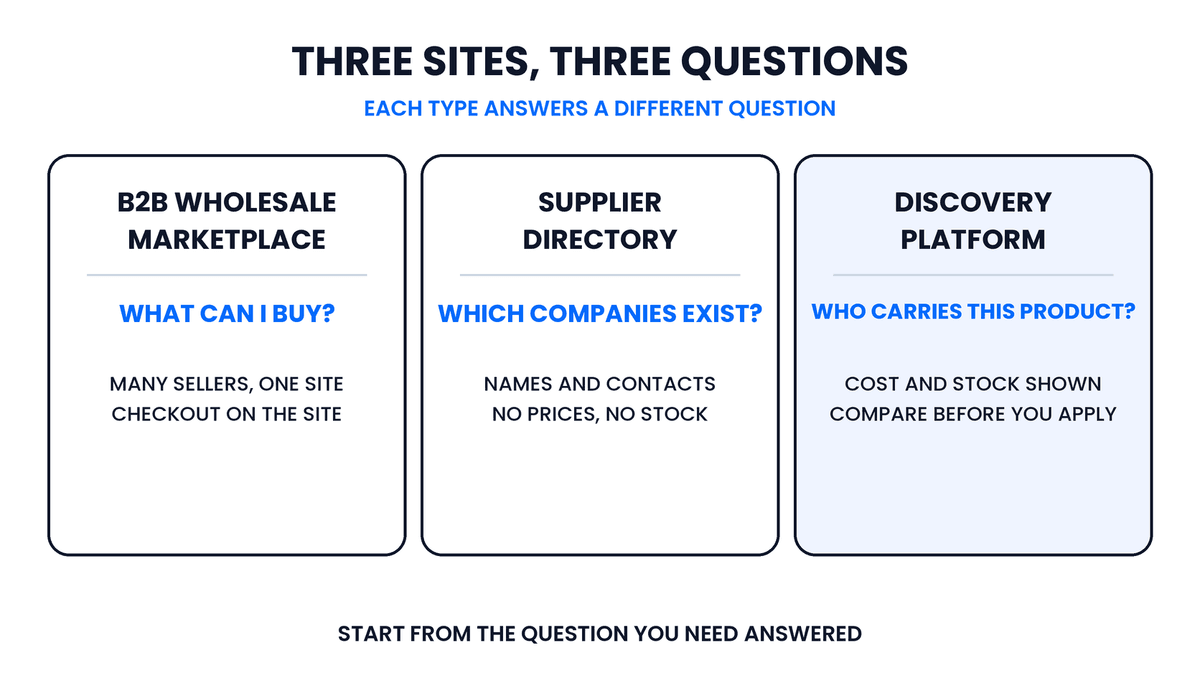
Search for wholesale suppliers and three kinds of sites come up in front of you: marketplaces, directories, and discovery platforms. A B2B wholesale marketplace is a website where many sellers list wholesale products and businesses buy from them through the site. They look alike at first, but the wrong one can cost you: you pay for names you can't use, or buy from a seller whose invoice won't hold up.
A supplier directory sells you a list of company names and contact details. A discovery platform lets you search for a product and see which distributors carry it, with their cost and stock. We build the third kind, so we will be clear about where each one falls short, ours included.
B2B wholesale marketplace | Supplier directory | Discovery platform | |
|---|---|---|---|
Who lists | Many sellers list their own products: brands, wholesalers and other resellers | The directory owner lists company names and contacts | The platform adds distributors and their catalogs |
Verification | Each marketplace sets its own checks, so it varies | Varies, and listings can go out of date | The platform checks each distributor before adding them |
Pricing shown | Yes, often after you sign up as a business | Rarely | Cost and stock for each distributor, before you contact anyone |
How you buy | You check out on the site | You contact each supplier, apply, then buy from them | You choose a distributor, apply if needed, then buy from them |
Best for | Small orders, new brands, buying from factories | A starting list of companies to call | Finding a supplier for a product you already know |
What Is a B2B Wholesale Marketplace?
If you have ever wondered what a B2B marketplace is, think of the online stores you already shop on. The difference is that the buyers are businesses. Lots of sellers list products in one place, and the site handles search, checkout and payment. That means you can buy from a seller without opening an account with them first. Many sites will still ask you to prove you are a business before they show wholesale prices.
Common B2B marketplace examples fall into a few groups. Some are large global sites where overseas factories list products, often with high minimum orders and long shipping times. Others focus on smaller brands selling to independent shops in small amounts. There are also business stores run by big retailers, such as Amazon Business and Walmart Business.
For a shop owner restocking shelves, a marketplace is often all they need. They see a price, order a case and pay by card.
For a wholesale reseller, the bigger question is who is behind each listing. The seller might be the brand, a distributor, or another reseller who bought the same goods one step earlier, and the listing often doesn't make this clear. It matters because the invoice you get will carry that seller's name. If you resell on a marketplace yourself, you may one day need that invoice to show where your stock came from.
Before you buy from a marketplace seller, look at the business name and address on their profile. Ask how they get the brand's products, and ask what the invoice will show. If a seller won't say where the goods come from, buy somewhere else. If the difference between a brand, a distributor and a reseller is new to you, our guide to how B2B wholesale distribution works explains it step by step.
Supplier Directory vs Marketplace: What Happens Next
A supplier directory sells access to a list. You usually pay a membership fee, search by category and get company names, websites and contact details. You can't buy anything on the site itself, and it rarely shows prices or stock.
The real difference shows up in your next step. On a marketplace, you can place an order. On a directory, the work is only starting. You email each supplier, ask for a price list, fill in an account form and wait. Then you do it all again with the next name.
If you are thinking about paying for one, ask a few questions first. When was each listing last checked? Does it show which brands each supplier carries? Can you get your money back if the contacts are out of date? If the answers are vague, expect to check every name yourself. We go deeper on this in how a supplier directory compares with a sourcing request.
A directory can still help when you are new to a category and want a list of companies to look into. Just don't treat a name on the list as proof. It won't tell you whether that company carries the product you want, whether its stock is real, or whether it buys from the brand at all.
The Third Type: A Discovery Platform
A discovery platform turns the search around. You start with the product, using its UPC, name or model number. The platform then shows which distributors in its network carry it, with each one's cost and stock, so you can compare them before you contact anyone.
This is what B2B Supplier Hub does. It is a B2B wholesale platform where you compare US wholesale suppliers by real cost and stock before you apply to any of them. Our team checks each distributor before bringing them onto the platform. Searching is free. When you find the distributor you want, you spend a credit to unlock their name and contact details, then deal with them directly. We take no commission on what you buy.
It has limits, and you should know them before you rely on it. It only shows distributors in our network. Right now that covers electronics, sports and outdoors, and tools and home improvement, with more categories on the way. Seeing a distributor's numbers also doesn't mean they will approve you. You still apply to them, the same way you would if you had found them anywhere else.
One Product, Three Places to Look: A Worked Example
Say you sell a replacement battery for a cordless drill, and it sells well. You want a second supplier before the busy season. Here is roughly how the search goes on each kind of site.
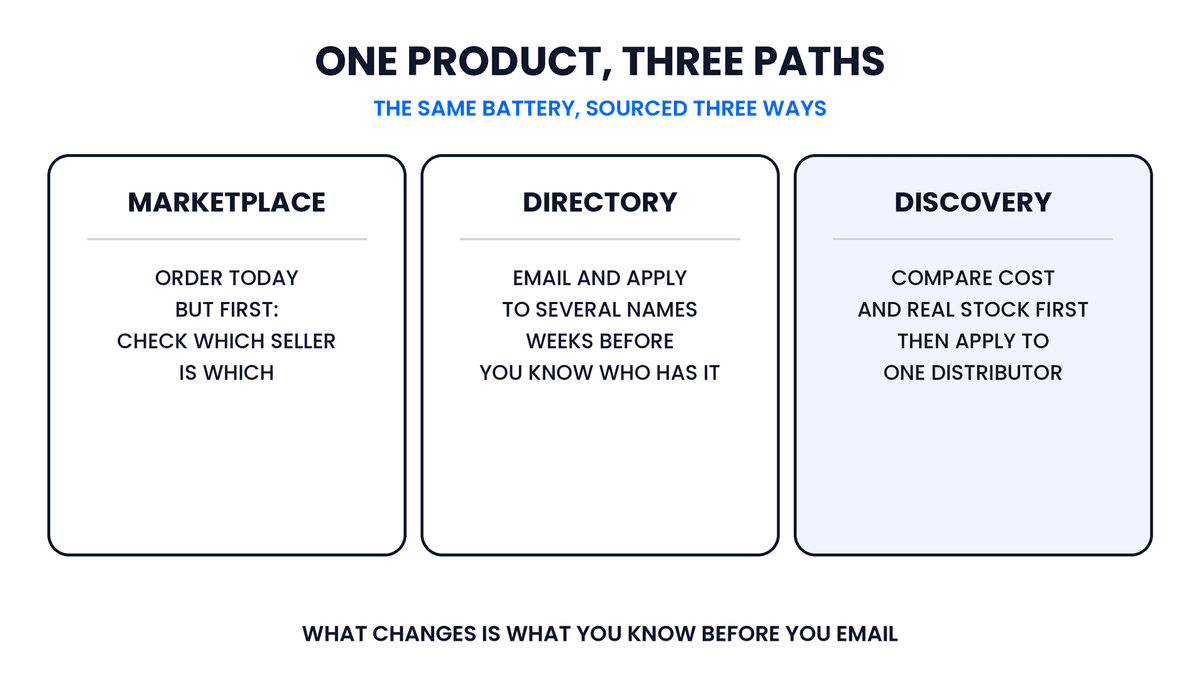
On a marketplace, you search the product name and find several listings. One seller looks like the brand, and two look like other resellers. Prices show once you sign up, and you could order today. First, though, you need to work out who each seller is and whether their invoice will show a source you can stand behind.
On a supplier directory, you search the tools category and get a list of companies that sell tools. None of the entries say whether they carry this battery or what it costs. You pick the five most likely names, send five emails and fill in whatever forms come back. Weeks later, you might know which of them has it.
On a discovery platform, you search the product free by its UPC. The distributors in the network that carry it show up side by side, each with cost and stock. You pick the one whose numbers work, unlock it, and apply to that one distributor. If none of them carry it, you can ask our team to find an authorized wholesale distributor for it instead.
Every route takes some work, and none of them gets you approved by a distributor. What changes is how much you know before you start sending emails.
How Each Type Makes Money, and Why It Matters to You
It helps to know how each kind of site gets paid, because that shapes what it shows you. Marketplaces usually take a fee on each order. So their search is built around what you can buy today, from whoever has listed it.
Directories usually charge a membership fee. The list itself is what they sell, and a long list can look like good value even when some of the names are out of date.
We charge for subscriptions and unlock credits, and we take no commission on your orders. Prices and stock are free for anyone to see. What you pay for is the name of a distributor you have already chosen, so you see the deal before you pay for the name.
Which One Should a Wholesale Reseller Use?
There isn't one best site for every job. Many lists of the best B2B wholesale marketplaces mix all three types together, which makes them hard to compare. It is easier to start from what you need right now.
What you need | Where to start |
|---|---|
Try a new product in small amounts | A marketplace |
Buy from a new brand that sells direct | A marketplace |
Buy from an overseas factory | A factory marketplace |
A rough list of companies in a new category | A directory, then check each name |
A second supplier for a product that already sells | A discovery platform |
A better price on a product you reorder | A discovery platform |
A new supplier after one stopped selling to you | A discovery platform |
Many resellers ask whether there is a single B2B marketplace for resellers that covers all of this. There isn't, and most established resellers end up using more than one type.
There is one more thing to weigh. On a marketplace, you skip opening an account with each seller, and that saves time. A direct account with a distributor takes longer to set up, but it grows into a working relationship. Over time it can bring payment terms, a contact who tells you when stock arrives, and invoices in the distributor's own name. For a product you plan to sell for years, that is usually worth the extra paperwork. Our guide to wholesale sourcing methods, from trade shows to reverse sourcing shows which method suits which job.
The Seller Test: 5 Questions Before You Buy on Any Wholesale Site
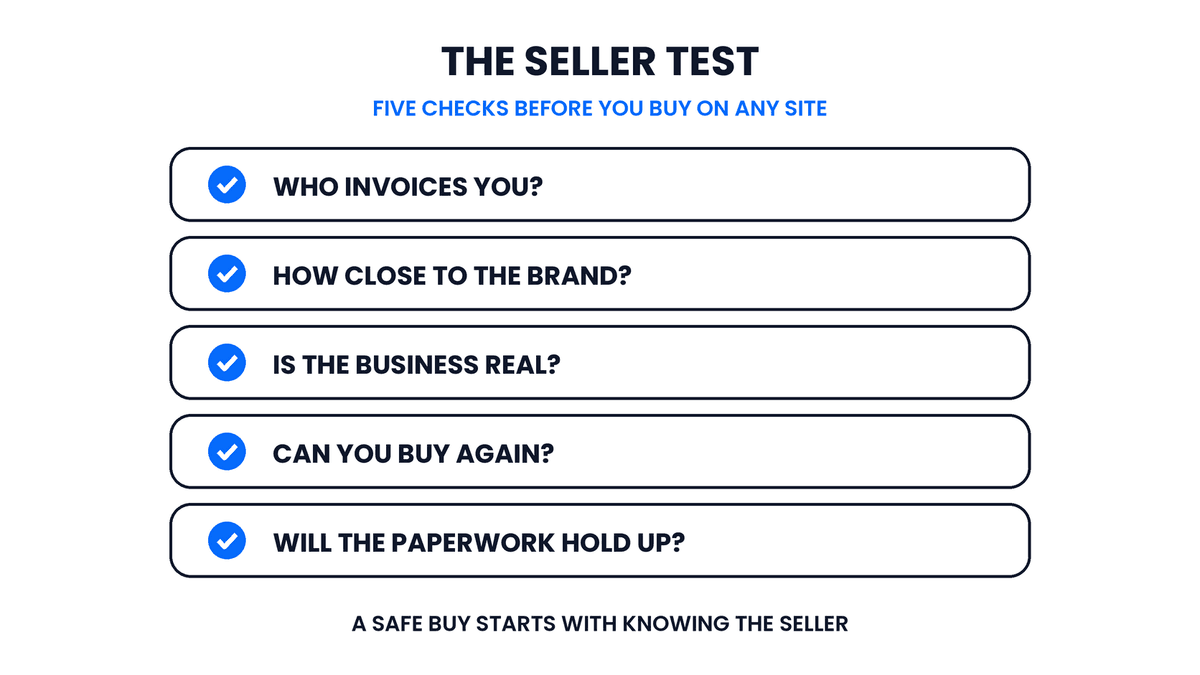
Whatever site you use, a safe purchase comes down to knowing who the seller is and where they got the goods. Ask these before your first order, even when the price looks good:
- Who invoices you? On a marketplace, it may be a seller you have never heard of. With a directory or a discovery platform, it is the company you contacted.
- How close are they to the brand? A brand, an authorized distributor and a middleman can all sell the same item. Our guide to authorized distributors, middlemen and gray market sellers explains the difference.
- Is the business real? Look for a physical address and a phone number that someone answers. A real distributor will also ask for your business details before selling to you. Our guide on how to verify a wholesale supplier lists the warning signs.
- Can you buy again? A one-off order is easy anywhere. For a product that sells steadily, ask whether the same source will have it next month at a similar cost, and whether they will open an account for you.
- Will the paperwork hold up? If you sell on Amazon, your invoice may be checked when you apply to sell in a category or when a complaint comes in. Read what counts as a valid wholesale invoice before you buy.
Start From the Product You Already Sell
A B2B wholesale marketplace is useful for buying what is already listed, and a directory can give you a first list of names. When you already know the product and need a supplier for it, start your search with the product itself. Compare what each distributor charges, then check the seller before you place the first order.
Frequently asked questions
01Is B2B a legit company?
02Is Amazon a B2B marketplace?
03Is Walmart a B2B company?
04What is the difference between a supplier directory and a marketplace?
The B2B SupplierHub Team
Wholesale & sourcing
Stop hunting suppliers by hand. Type a UPC instead.
B2B Supplier Hub shows the suppliers in our network carrying a product on one page: wholesale cost, stock, and retail price side by side. Free to search, no card required.